


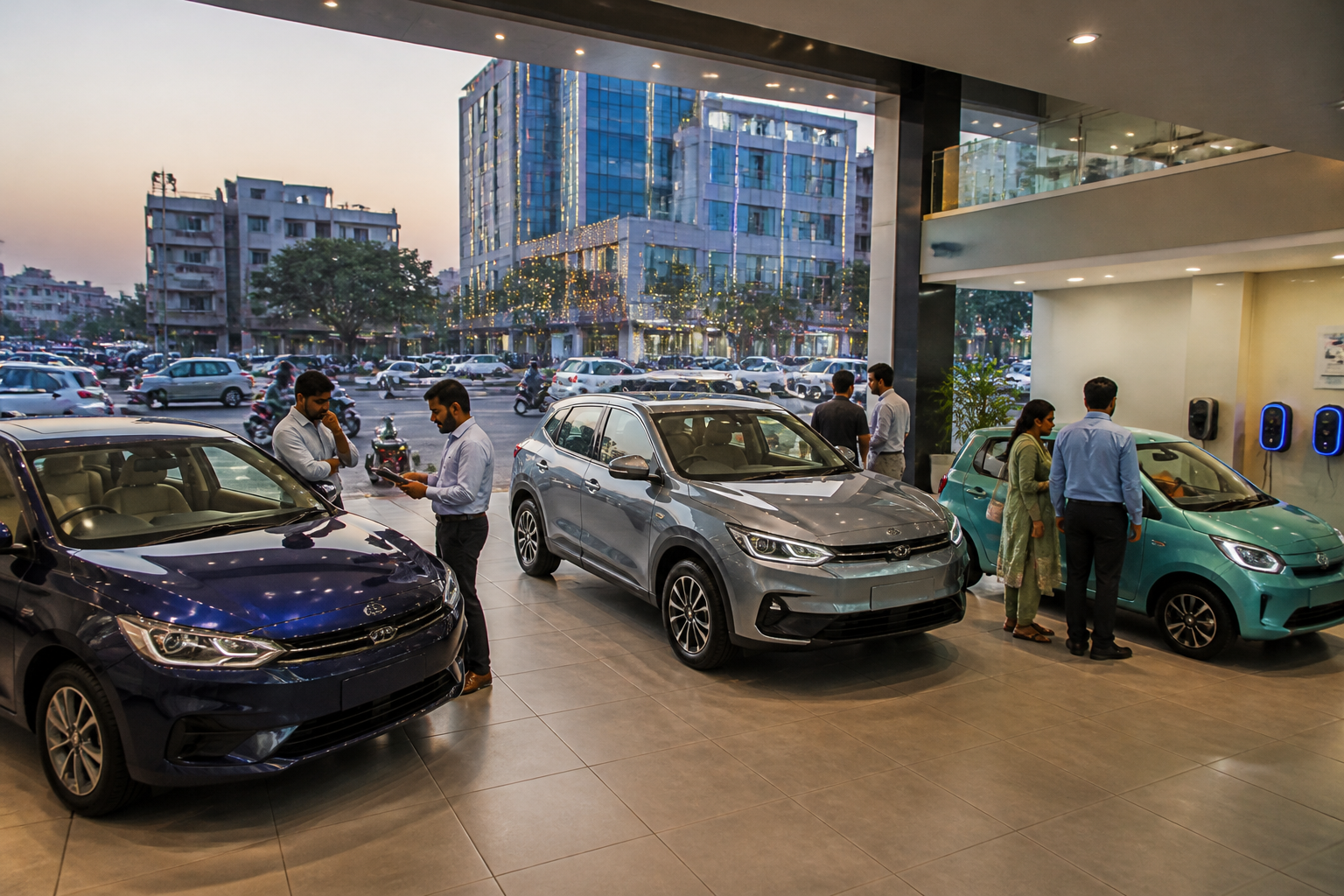
Gujarat’s passenger-vehicle market is growing, but the more significant shift is happening beneath the headline number. Registrations rose 19.6% year on year to 37,340 in September from 31,217 a year earlier, according to data from the Federation of Automobile Dealers Associations (FADA) Gujarat. At the same time, the state’s buyers showed a more diverse preference for petrol, diesel, hybrid, electric and CNG vehicles.
The data presents a market that is expanding without moving in a single direction. CNG remained the largest powertrain category, accounting for 35% of passenger-vehicle registrations in September. However, its share fell from 41.6% in September 2025. Hybrids increased their share from 4.6% to 7.1%, while electric vehicles rose from 4% to 6.9%.
Together, hybrids and EVs accounted for about 14% of registrations in September. That is still a minority share, but the increase is important because it occurred alongside continued growth in petrol and diesel registrations. Petrol and ethanol-powered cars rose to 29% of the market from 27.9% a year earlier, while diesel increased to 23.1% from 20.9%.
The pattern suggests that Gujarat’s vehicle market is not undergoing a simple replacement of internal-combustion vehicles with electric cars. Instead, consumers are adding new powertrain options to an existing market in which operating costs, vehicle availability, purchase price, driving requirements and refuelling or charging access can all influence the decision.
That distinction matters for urban mobility. A rise in EV and hybrid registrations does not, by itself, indicate that a city’s transport system has become cleaner or less dependent on conventional fuels. It shows that newer technologies are gaining acceptance among buyers. The wider consequences will depend on how quickly those vehicles enter the active fleet, how they are used, and whether supporting infrastructure keeps pace with demand. The supplied data does not establish those broader outcomes.
FADA Gujarat state chairperson Hitendra Nanavati attributed the growth to resilient consumer demand and increasing confidence in the passenger-vehicle market. He also said buyers were actively considering newer powertrain options. His assessment captures the market’s central tension: the overall number of cars is rising while the composition of those cars is becoming more varied.
The decline in CNG’s share is particularly notable in a state where it remained the leading category. A lower percentage does not mean that CNG registrations declined in absolute terms; the available report provides market shares but does not give the number of CNG vehicles registered. The change instead shows that other categories grew faster or captured a larger portion of the expanding market.
Hybrids and EVs also represent different forms of transition. Hybrid vehicles retain an internal-combustion engine while adding electric assistance, whereas battery-electric vehicles depend entirely on electricity for propulsion. Their combined rise therefore signals growing interest in alternative powertrains, but it should not be read as a uniform shift towards full electrification.
The September numbers also show why headline growth needs to be separated from technology adoption. Passenger-vehicle registrations grew by 6,123 units over the year, while the market shares of several powertrains changed at the same time. Since the report does not provide registrations by powertrain, it is not possible to calculate the exact unit increase for hybrids, EVs, CNG, petrol or diesel from the supplied material alone.
This limitation is important for policymakers and industry. Market share can change because a category grows, because another category loses ground, or because both occur simultaneously. A stronger understanding of Gujarat’s mobility transition would require monthly powertrain-wise registration counts, the geographic distribution of registrations, vehicle usage patterns and information on charging and fuelling access. Those details are not included in the FADA figures cited in the report.
The market is also being shaped by supply conditions. Jigar Vyas, the chief executive of an Ahmedabad car dealership, said availability issues were high and waiting periods had reached 60 days for some models. He added that bookings would begin during Navratri and that festive offers and consumer sentiment could support sales in the coming weeks.
Waiting periods complicate the interpretation of demand. A registration reflects vehicles entering the registered market, but a buyer’s choice can be affected by whether a particular model is available, how long delivery will take and what offers dealerships provide. If preferred models are unavailable, registrations during a given month may not fully represent the first choice of consumers. The report does not identify the affected models or specify whether the waiting periods were concentrated in any particular powertrain category.
The approaching Navratri-Diwali period is therefore both a commercial milestone and a test of the market’s momentum. FADA Gujarat expects demand to strengthen during the festive season, while the dealership executive cited higher enquiries, purchase decisions and promotional offers as factors that could support sales. These are expectations from industry representatives, not confirmed outcomes.
Gujarat’s two-wheeler market reinforces the same mixed pattern. Registrations rose 13.6% to 1.32 lakh units from 1.16 lakh a year earlier. Petrol and ethanol-powered two-wheelers continued to dominate with a 92.7% share, although electric vehicles increased their share to 7.2% from 5.3%.
The contrast between passenger vehicles and two-wheelers is significant for urban transport. Cars and two-wheelers occupy different roles in household mobility, have different purchase economics and respond differently to charging, running-cost and availability considerations. The data shows EV share rising in both segments, but it does not establish that the transition is progressing at the same speed or for the same reasons.
For cities, the immediate issue is not only how many electric or hybrid vehicles are sold. It is how vehicle growth interacts with road space, parking, energy demand and the daily movement of residents. The supplied report does not provide evidence on congestion, emissions, parking pressure or electricity consumption, so those effects cannot be quantified here. What the registrations do show is that vehicle ownership demand remains strong even as the powertrain mix begins to change.
That combination creates a more complex planning environment. A market that is still adding cars and two-wheelers can increase pressure on urban roads even when a larger share of new vehicles uses electric or hybrid technology. At the same time, the gradual acceptance of these options could alter the requirements for charging facilities, dealership services and maintenance networks. The report provides no city-level infrastructure assessment, but its registration trends indicate why such questions are becoming more relevant.
The institutional picture is also divided. FADA Gujarat supplies the market data cited in the report, dealerships influence availability and sales conditions, manufacturers determine model supply, and consumers make choices within those constraints. The data therefore describes an outcome produced by several actors rather than a single policy intervention. No specific government scheme, subsidy, municipal programme or regulatory change is identified in the supplied material as the cause of the September shift.
The strongest conclusion is that Gujarat’s vehicle market is broadening rather than decisively turning away from conventional fuels. CNG remains the largest passenger-vehicle category, petrol and diesel shares have increased, and hybrids and EVs have gained ground. The transition is visible, but it is taking place inside a growing market rather than replacing the existing market altogether.
The next useful indicators will be the vehicle registrations recorded during the Navratri-Diwali period, the availability of high-demand models and whether the increased shares of hybrids and EVs continue beyond a single month. Those figures will show whether September marked a sustained change in buyer preferences or another stage in a market still balancing conventional fuels with newer powertrain choices.

