


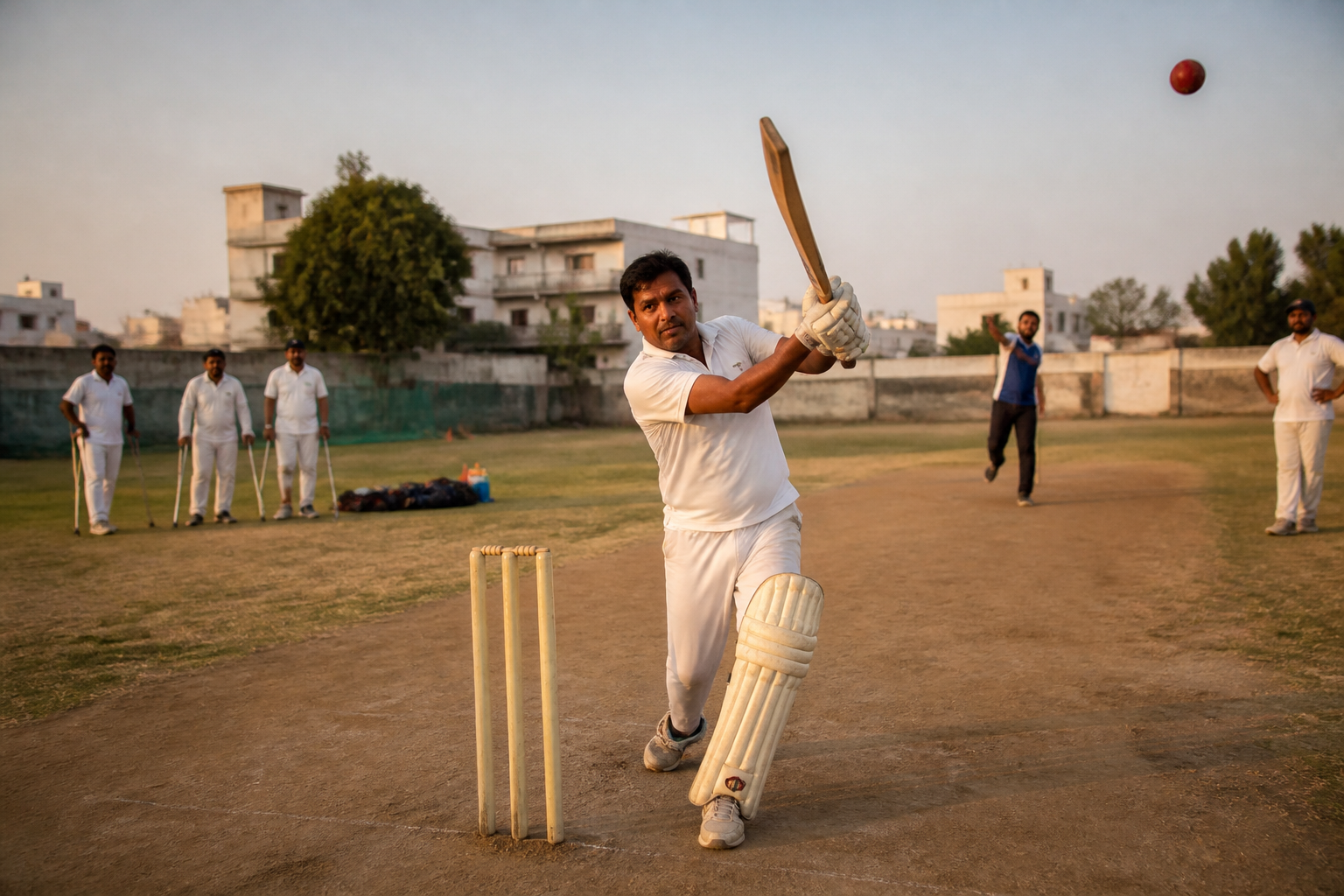
Gujarat’s disabled cricketers are reaching the international stage without the financial and institutional support normally associated with representing a country. A report by Divya Bhaskar – Ahmedabad documents how players who have played for India against Afghanistan, England and Sri Lanka are still working as carpenters, printing-press employees and showroom staff to support their families, while paying for travel, equipment and medical treatment themselves.
The cases point to a structural gap in disability sport: sporting recognition has developed faster than the systems needed to make participation financially sustainable. International selection can provide visibility, but it does not necessarily provide match fees, prize money, annual contracts, injury cover or job protection. For the players featured in the report, representing India has been an achievement without becoming a dependable livelihood.
This distinction matters because elite sport requires time, mobility and repeated expenditure. A player may have to travel for camps, domestic tournaments and international series, take leave from employment, purchase equipment and manage injuries. When the sporting system does not compensate those costs, the burden moves from the institution to the individual player and their family.
The report’s account of Gujarat’s disabled cricket structure identifies the administrative problem directly. Dipen Gandhi, secretary of the Gujarat Cricket Association for disabled persons, said the Board of Control for Cricket in India created a separate committee for disabled cricket in December 2021. According to Gandhi, several state associations, including those in Punjab, Hyderabad, Puducherry, West Bengal, Uttar Pradesh, Delhi and Tripura, subsequently created committees for disabled cricket. Gujarat, he said, has not yet formed such a committee.
A state-level committee is not simply an additional organisational layer. It is the mechanism through which decisions about facilities, player coordination, tournaments, funding and institutional support can be made. Without a recognised body within the state cricket structure, players may have limited access to a consistent channel for raising concerns or seeking assistance. The report does not establish that a committee alone would solve every financial problem, but it records the argument that such a body could help provide facilities and organise support.
The individual cases show how the gap operates in practice. Gujarat team captain Ashit Jaiswar played in a five-match T20 and three-match one-day series against Afghanistan in 2018 and was included in a 16-member team for a World Series in England in 2019. The report says he received no match fee or prize money for several international tournaments. He received assistance of Rs 3,500 for the 2018 Afghanistan series and now works as a carpenter with his father in Sanand.
Rajiv Mishra, a former player who has spent 12 years in cricket and represented India in several international matches, has also played in more than five national tournaments. According to the report, the only financial assistance he received during his cricket career was Rs 3,500 for the 2018 Afghanistan series. He now works two shifts at a polyester printing and packaging company to support his family.
Rohan Vaghela’s experience shows the employment cost of participation. The 26-year-old all-rounder played against Afghanistan in 2018 and England in 2024. The report says he received neither match fees nor prize money for those series. After asking for a month’s leave to play, he returned to find that his job had been given to someone else. He now works at a car showroom on a monthly salary of Rs 12,000. The report also says that despite taking 20 wickets in a national tournament, he received no award.
For Keval Patel, the cost appeared as debt rather than lost employment. The 28-year-old from Bharuch played against Afghanistan in 2018. After suffering an injury during a national tournament, he incurred treatment expenses of Rs 45,000 and had to borrow money to pay for the care, according to the report.
The youngest case in the report is that of Nansola Adil, a 19-year-old from Palanpur who was selected for a three-match T20 series against Sri Lanka in 2025 because of his chinaman leg-spin bowling. He was 18 at the time and was described as the youngest player in the team. His selection demonstrates that the pathway to international sport exists. The other cases show that the pathway after selection remains uncertain.
Together, these accounts reveal three different types of vulnerability. The first is income insecurity: players may represent the country without receiving regular compensation. The second is employment insecurity: participation can require extended leave, with no guarantee that a job will remain available. The third is cost exposure: equipment, travel and medical treatment can become personal expenses even when the player is competing at national or international level.
These are not separate problems. They reinforce one another. A player who must work two shifts may have less time for training. A player who cannot afford equipment or travel may find it harder to remain available for selection. An injury can create debt, while the absence of prize money or contracts removes the possibility of recovering that cost. The sporting achievement remains visible; the financial consequences remain largely private.
The report also contrasts disabled cricket with the broader cricket system governed by the BCCI, describing the latter as having a more complete professional and financial structure. It says disabled cricket lacks regular match fees, annual contracts and fixed prize money comparable to that structure. The comparison is important not because all sporting systems must be identical, but because it clarifies what professionalisation means in practical terms: predictable payments, institutional responsibility and protection against the costs of participation.
A committee within a state association could provide an administrative starting point, but the evidence in the report indicates that the larger question is financial design. A functioning support system would have to address how players are paid, how tournament expenses are covered, how equipment is supplied and how injuries are treated. It would also need to consider what happens when players take leave from employment for official competitions.
The governance issue is therefore not limited to whether Gujarat has formed a committee. It concerns where responsibility sits. If players are selected through a sporting system but must negotiate travel, equipment, employment and medical costs individually, the system is transferring operational risk to people with the least financial security. The absence of a clear state-level institution can make that transfer harder to challenge or correct.
The report does not provide a statewide budget, the total number of affected players, the number of tournaments held annually or a formal response from the Gujarat Cricket Association or the BCCI on the specific allegations. Those gaps limit the scale of what can be established from the available material. However, the cases provide consistent evidence of a support problem: multiple players with international or national experience are relying on other employment, and the amounts mentioned are either absent, irregular or insufficient to support a sporting career.
The larger urban question is how cities and institutions recognise talent without building the conditions required for people to sustain it. The players profiled come from Sanand, Bharuch, Palanpur and other parts of Gujarat, but their difficulties are connected to systems of work, mobility, healthcare, sport administration and family income. Disability access is not only about whether a player can enter a ground. It also concerns whether the player can travel, train, compete, recover from injury and return to employment without being financially penalised.
For Gujarat’s disabled cricketers, international representation has confirmed sporting ability but has not guaranteed institutional security. The next measurable step is whether Gujarat forms the committee described by Gandhi and whether any such body is given the authority and resources to address match fees, prize money, equipment, travel, injury treatment and employment-related support. Until those mechanisms are established, selection for India will remain an achievement that may carry substantial personal cost.
