


Greater Noida Authority CEO Dr Balkar Singh has identified farmer grievances, infrastructure quality and resource conservation as immediate priorities after taking charge and holding his first meeting with officials.
Singh, a 2004-batch IAS officer who previously served as CEO of the Uttar Pradesh State Industrial Development Authority, directed officials to address farmers’ concerns on priority and consider their legitimate demands during land acquisition. He also called for acquisition to be expedited through mutual consent.
The approach places land acquisition and engagement with affected farmers at the centre of the authority’s early agenda. The report said Singh instructed officials to ensure that farmers and allottees visiting the authority office were treated respectfully and that their grievances were resolved within stipulated timelines.
Infrastructure delivery was another focus of the meeting. Singh directed officials to carry out regular quality checks on projects and seek independent assessments from reputed agencies. The report did not specify the projects covered, the agencies that could conduct the assessments or the standards against which construction quality would be evaluated.
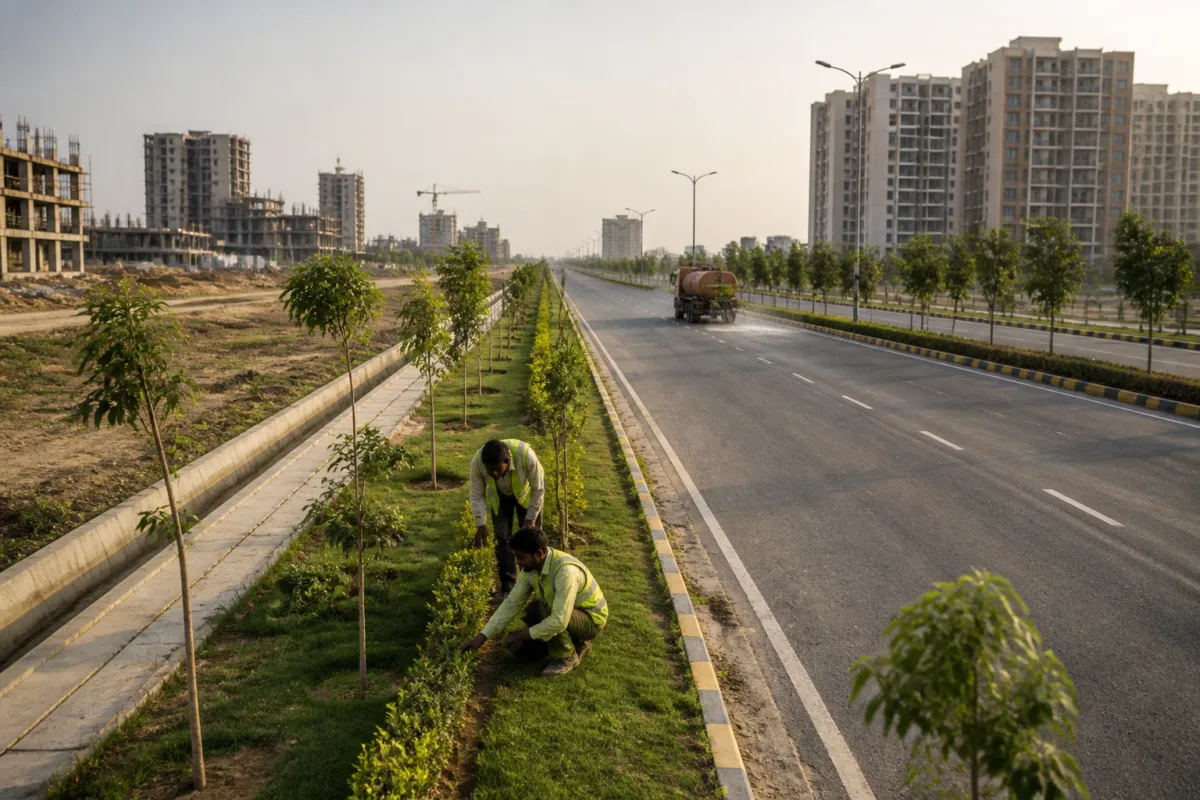
To address dust pollution, Singh asked officials to plant grass along roadsides and central verges. He also directed the authority to reuse treated sewage water for irrigation and construction, with the stated aim of conserving groundwater.
The water-reuse direction links civic infrastructure with construction and urban environmental management. Its implementation would depend on the availability and quality of treated sewage, as well as systems for conveying and monitoring the reused water, none of which were detailed in the report.
Singh further called for a single-window clearance system to facilitate investors. He asked officials to identify vacant residential plots where construction had not begun, potentially giving the authority a clearer picture of stalled or inactive development parcels.
The priorities cover several functions of the Greater Noida Authority: land acquisition, grievance handling, project oversight, road-edge management, treated-water reuse, development approvals and residential land utilisation. However, the authority has not, according to the report, announced deadlines, project-wise targets or monitoring arrangements for these directions. Their public impact will therefore depend on how they are translated into procedures, assessments and time-bound action.

