


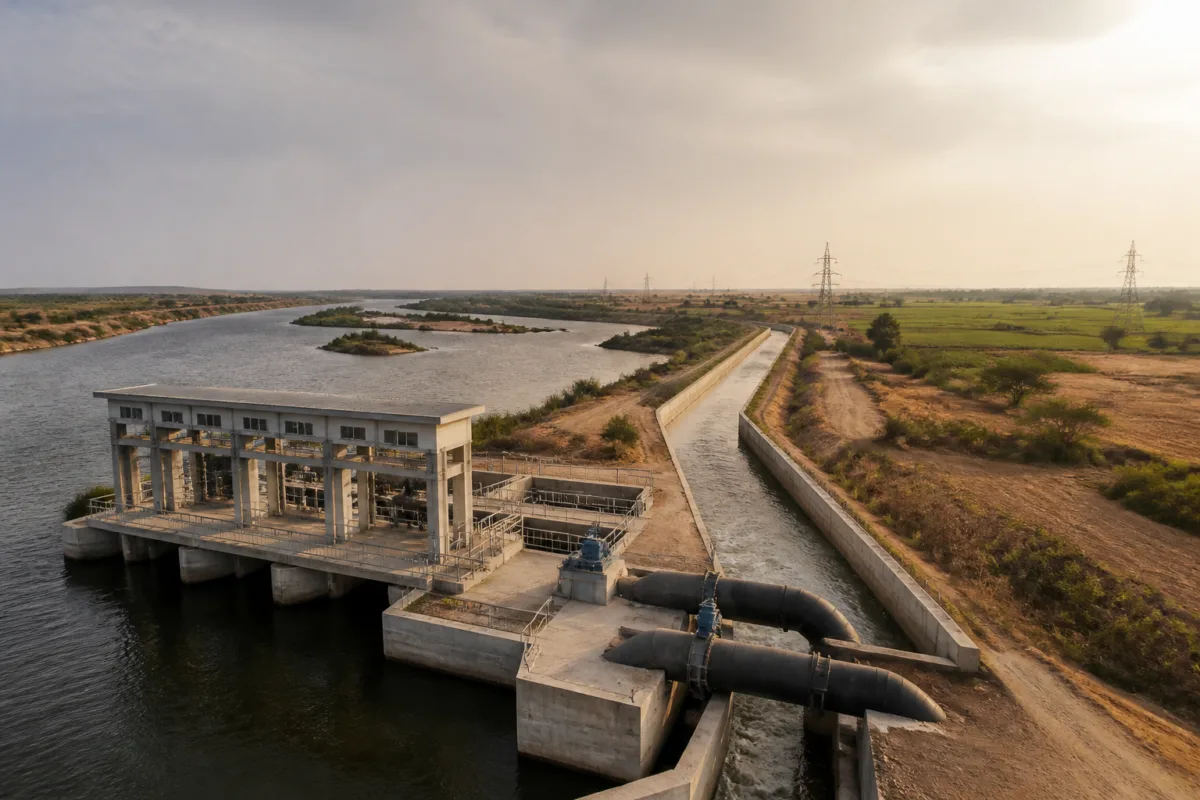
The Godavari-Cauvery link project has become the latest flashpoint in Telangana’s long-running struggle to secure water for irrigation, drinking supply and industry. Former minister T Harish Rao has alleged that a proposed shift in the project’s alignment from Ichampally-Sammakka Sagar to Polavaram could bypass Telangana and endanger the state’s claimed 43 tmcft share from the proposed diversion.
Rao, a leader of the Bharat Rashtra Samithi, made the allegations at a media conference at Telangana Bhavan, according to a report by The Times of India – Hyderabad. He said the National Water Development Agency has scheduled discussions on the project at its November 3 meeting in New Delhi. He also called for the Centre to withdraw the proposed changes and ensure that any river-linking plan does not compromise Telangana’s water interests.
The immediate dispute is over alignment. Rao said Andhra Pradesh Chief Minister N Chandrababu Naidu wrote to the Centre on October 7 seeking to route the project through Polavaram instead of the earlier Ichampally-Sammakka Sagar route. According to Rao, the proposed Polavaram-Bollapalli route would bypass Telangana, while the earlier route through Ichampally and Nagarjuna Sagar was expected to support irrigation in areas covering more than 2.3 lakh acres in the erstwhile Warangal, Nalgonda and Ranga Reddy districts.
These competing routes are not merely engineering alternatives. They represent different distributions of water infrastructure, beneficiaries and administrative responsibility. A route through Telangana would place the state within the project’s physical and operational chain. A route that bypasses the state could alter which regions receive direct irrigation or water-supply benefits, even if the larger project continues to draw on the same river system.
That is why the 43 tmcft figure is central to the dispute. Rao claimed that the Godavari-Cauvery link project proposes to divert 148 tmcft of water, of which Telangana’s allocated share is 43 tmcft. If that claim is accepted in the project’s planning framework, the alignment question is also a question about how that entitlement would be delivered, measured and protected. The report does not include the text of the project proposal, the NWDA’s technical assessment or a formal statement from the Centre confirming the allocation.
The distinction between an allocation and access to water infrastructure is important in any inter-state project. A state may claim a share on paper, but the practical value of that share depends on the location of intake points, reservoirs, canals, pumping systems and delivery networks. It also depends on operating rules and on which authority controls the infrastructure. The available report does not establish how the proposed alignment would legally or operationally affect Telangana’s entitlement. It records Rao’s allegation that the change would compromise it.
The dispute also exposes the institutional complexity of river-linking projects. The NWDA is the agency identified in the report as convening the next discussion. The Centre would therefore be involved in considering the proposed changes, while the governments of Telangana and Andhra Pradesh are advancing competing positions. The final implications for water distribution cannot be understood from political statements alone; they would require examination of the project’s detailed alignment, diversion calculations, command areas, cost structure and operating arrangements.
Rao’s account places the disagreement within a wider sequence of proposals. He alleged that the Polavaram-Banakacherla idea had earlier been presented as a plan to take 200 tmcft, was later referred to as Nallamalasagar, and is now being advanced under the Godavari-Cauvery link project. These assertions are political claims in the supplied report and are not independently established there. Their significance lies in showing how project names and alignments have become part of the contest over control of Godavari water.
The political dispute is also linked to Telangana’s existing irrigation infrastructure. Rao urged an all-party delegation to inspect major pump houses and review the functioning of lift-irrigation projects across the state. He specifically named the Devadula, Kalwakurthy and Kannepally schemes, alleging that they were not being operated to their full capacity. He described the state’s present water scarcity as a “man-made drought” caused by inadequate planning and operation.
Those allegations shift the debate from future river-linking to the performance of assets that already exist. A new inter-state project may promise additional water or wider distribution, but the immediate experience of farmers and households can also depend on whether pumping systems are functional, whether water reaches designed command areas and whether schemes are operated at their intended capacity. The supplied material does not provide operating data for the three lift-irrigation schemes, so the extent of the alleged under-utilisation remains unverified.
This is the central urban and regional-governance question raised by the controversy: who is responsible for converting a water entitlement into reliable supply? The answer may involve the Union government, the NWDA, state water-resource departments and the agencies operating lift-irrigation infrastructure. It also involves the geography of delivery. Water allocated to a state does not automatically translate into drinking water for towns, irrigation for farms or dependable supply for industry unless the physical and administrative systems are aligned.
For Telangana, the stated concern extends beyond agriculture. Rao argued that the proposed alignment could affect irrigation, drinking water and industrial water supply. That breadth matters because water systems serve multiple urban and rural demands simultaneously. Decisions about diversion and routing can therefore affect not only command areas but also the future planning assumptions of towns, industrial users and public agencies responsible for water supply.
The numbers cited in the dispute show the scale of the stakes, even though they require confirmation from primary project documents. The proposed diversion is described as 148 tmcft, Telangana’s claimed share as 43 tmcft, and the irrigation potential associated with the earlier alignment as more than 2.3 lakh acres. These figures should be tested against the NWDA’s project records and any formal inter-state agreement before they are treated as settled facts.
The next institutional milestone identified in the report is the NWDA discussion scheduled for November 3 in New Delhi. That meeting could clarify whether the alignment change is formally under consideration, what technical basis has been offered for routing the project through Polavaram, and how the proposed route would address the interests claimed by Telangana. The supplied report does not state the meeting’s agenda, decision-making status or whether representatives of Telangana have been invited.
The controversy also highlights a recurring weakness in public water debates: political claims often arrive before the underlying project documents are accessible to citizens. In this case, the public-interest questions are specific. What is the approved or proposed alignment? What diversion volume is being considered? How is Telangana’s 43 tmcft share defined? Which districts and urban systems would receive water under each route? Who would operate the infrastructure, and what safeguards would apply if the route changed?
Until those questions are answered through official project records, the immediate conclusion is limited but important. The Godavari-Cauvery link project is not simply a dispute over a line drawn on a map. The proposed route could determine which state is physically connected to the scheme, which regions are listed as beneficiaries and how a claimed water entitlement is converted into infrastructure and supply. The November 3 discussion, along with formal responses from the Centre, Telangana and Andhra Pradesh, will be critical to establishing whether the proposed alignment represents a technical modification or a substantive redistribution of expected benefits.

