


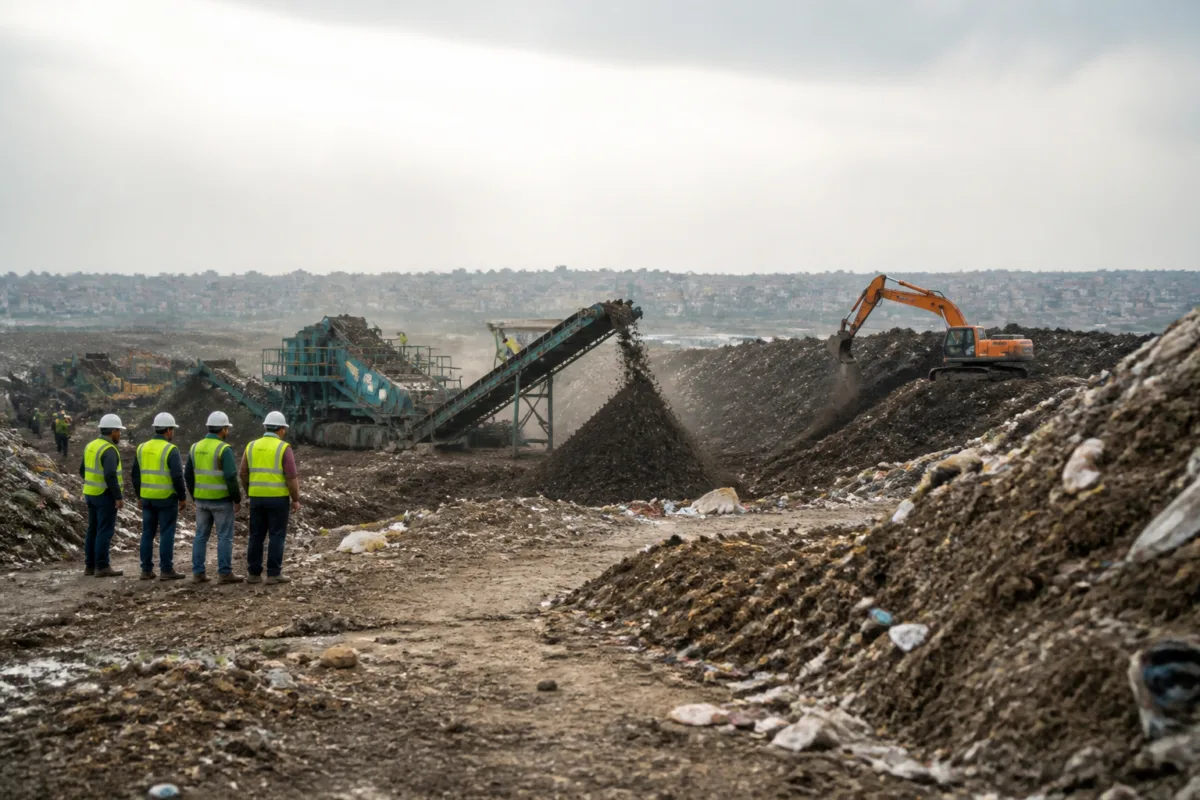
Delhi’s landfill biomining programme has achieved measurable progress, but the 12-day halt at Bhalswa and Okhla shows why clearing legacy waste is not simply a question of assigning tonnage targets. The interruption has come during a transition between contractors, with the outgoing concessionaire having stopped work and the new agency yet to install the machinery needed to begin. The immediate consequence is a delay to a programme whose latest deadline for flattening the two dumpsites is January 31, 2027.
The episode brings together three different problems that are often treated separately: the difficulty of transferring a large, equipment-intensive municipal contract; the persistence of old waste at Delhi’s major dumpsites; and the continuing arrival of fresh waste while legacy waste is being processed. Together, they show that landfill remediation is not a one-time clean-up project. It is an operating system that must keep moving while the city continues to generate and deposit waste.
According to officials quoted by The Times of India, the Municipal Corporation of Delhi has completed the process of appointing a new concessionaire for Phase III of biomining at Bhalswa and Okhla. The new agency agreed to work at rates lower than those being paid to the existing concessionaire under Phase II. Officials said the civic body could not continue paying the higher rates when a lower offer was available under the applicable norms.
The previous concessionaire had verbally agreed to continue biomining until Phase III became operational, but that arrangement did not continue. The old agency has now removed its operations, while the new concessionaire is still preparing to start. The transition requires the installation of machinery for biomining and related processing work. This gap between the end of one contract and the operational start of the next has stopped work for at least 12 days and is expected to extend for at least another week.
That interruption matters because the earlier arrangement had already processed substantial quantities of legacy waste. The concessionaire was initially assigned to biomine 20 lakh metric tonnes at Okhla and 30 lakh metric tonnes at Bhalswa over 18 months. After completing those targets within the stipulated period, it received additional work for another 10 lakh metric tonnes at Okhla and 15 lakh metric tonnes at Bhalswa. Officials said those additional quantities were also completed.
The figures indicate that the programme has not been inactive. By the middle of September, a total of 220.06 lakh metric tonnes had been biomined across Delhi’s three major dumpsites: 71.64 lakh metric tonnes at Okhla, 103.27 lakh metric tonnes at Bhalswa and 45.15 lakh metric tonnes at Ghazipur. Around 100 acres had been reclaimed through legacy-waste remediation, including 45 acres at Bhalswa, 35 acres at Okhla and 20 acres at Ghazipur.
Yet the same figures show the scale of the remaining task. MCD estimates that 102.2 lakh metric tonnes of legacy waste remain across the three sites. The remaining quantities are reported at 15.7 lakh metric tonnes at Okhla, 19.5 lakh metric tonnes at Bhalswa and 66.9 lakh metric tonnes at Ghazipur. Ghazipur therefore accounts for the largest reported share of the remaining waste, even though the current stoppage is at the other two sites.
This uneven distribution is important for understanding the programme’s next phase. Progress cannot be judged only by the total tonnage processed or the acreage reclaimed. It also depends on where the remaining waste is concentrated, whether equipment is available at the right site, and whether each contractor transition preserves continuity. A city may report large cumulative quantities while still facing long delays at an individual landfill or a difficult final stretch at another.
The deadlines add another layer of pressure. The latest target for flattening Bhalswa and Okhla is January 31, 2027, while Ghazipur’s target is December 2027. The report notes that MCD has already missed the flattening deadline for Bhalswa and Okhla at least five times. The current pause therefore does not represent the beginning of the delay problem; it is another interruption in a programme that has repeatedly struggled to meet its stated timetable.
The contractor change also highlights an institutional tension in public procurement. MCD officials have cited the lower rates offered by the new concessionaire as the reason the old agency could not simply be retained at a higher price. That position reflects a basic procurement principle: a civic body cannot routinely continue a more expensive arrangement when a lower eligible offer is available. But the operational result is a gap between contractual decision-making and physical work on the ground.
For a conventional service, a short mobilisation gap may be manageable. At a landfill, the transition involves machinery, processing systems, site logistics and the handling of large volumes of material. The time needed to install equipment becomes part of the project’s practical timeline, even when the contract has already been awarded. The supplied information does not establish whether the transition terms included a fully operational handover mechanism, but the stoppage demonstrates the importance of that question for future phases.
The challenge is intensified by the fact that Delhi’s dumpsites continue to receive fresh waste. Okhla, Bhalswa and Ghazipur together receive between 3,000 and 4,000 metric tonnes of fresh waste every day, according to the report. This means that remediation is taking place while the underlying flow of waste continues. Every day of processing capacity lost to a contractor transition occurs alongside another day of new material reaching the landfill system.
This is the central structural issue behind the latest halt. Biomining can reduce the accumulated stock of legacy waste, but it cannot by itself prevent the dumpsites from being replenished. The programme therefore has two linked requirements: accelerate the removal and processing of old waste, and ensure that new waste is diverted into adequate processing systems instead of continuing to add pressure to the dumpsites.
MCD has awarded separate tenders for waste-processing plants at five locations, with a combined capacity of 5,900 metric tonnes per day. These plants are expected to become operational by the end of November. If delivered on schedule, the capacity would be larger than the reported daily inflow of fresh waste to the three dumpsites. But the supplied report does not establish how much of that capacity will be operational at the start, how it will be distributed among the sites, or whether it will process all categories of incoming waste. Those implementation details will determine whether the plants reduce the flow reaching the landfills in practice.
The reported numbers also reveal why flattening deadlines are difficult to sustain. The three sites have already processed 220.06 lakh metric tonnes and reclaimed about 100 acres, yet more than 102 lakh metric tonnes remain. At the same time, fresh waste continues to arrive daily. The programme is therefore managing a moving target: the legacy stock must be removed faster than new waste accumulates, while equipment and contracts remain functional.
The immediate next step is the installation of machinery by the new concessionaire and the resumption of biomining at Bhalswa and Okhla. The wider test will be whether the November commissioning target for the five processing plants is met and whether the January 2027 flattening deadline survives the latest stoppage. Ghazipur, with the largest reported quantity of remaining legacy waste, will require separate attention under its December 2027 target.
The evidence confirms progress, but it also confirms that cumulative achievement has not eliminated execution risk. Delhi’s landfill problem is now defined as much by continuity, procurement transitions and daily waste inflows as by the amount of old waste already processed. The next milestones will show whether the city can convert contract awards and reported capacity into uninterrupted, site-level operations.

