


Emkay Global’s initiation of coverage on GMR Airports, with a Buy rating and a Rs 120 target price, is framed as an equity-market call. But the brokerage’s thesis also reveals a wider change in the way large airports are being planned and operated in India. The airport is no longer being treated only as a transport facility that earns from passenger movement, landing and parking fees. It is increasingly being developed as a commercial platform combining aviation, retail, cargo, advertising, parking and real estate.
That shift matters because the core aviation revenues of an airport operator are regulated and subject to revenue-sharing obligations. According to the Economic Times report, Emkay expects GMR Airports’ higher-margin non-aeronautical and adjacent businesses to become the main drivers of incremental profitability. The brokerage’s projections are therefore not simply about passenger growth. They are about whether GMR can capture more value from the land, commercial assets and services surrounding its airports.
GMR Airports is described as India’s largest private airport operator by passenger traffic, with a 27.3% market share in FY26. Its portfolio comprises nine airport assets, including six in India. The scale of that network gives the company a base across which it can consolidate operations and develop businesses that would otherwise remain fragmented at individual airports.
The distinction between aeronautical and non-aeronautical revenue is central to the company’s strategy. Aeronautical revenue includes passenger charges, landing fees and parking fees, but these streams are regulated. They are also linked to revenue-sharing arrangements, limiting the operator’s ability to independently expand margins. Businesses such as duty-free retail, food and beverages, cargo, advertising and commercial property offer greater scope for direct control over pricing, operations and asset development, although the supplied report does not establish how each individual business is regulated or how profitable it is.
The report says these non-aeronautical and adjacent businesses accounted for 67% of GMR Airports’ revenue in FY26. It also says the company is moving from a landlord and concession-based model towards directly owning and operating more of these activities. Duty-free operations at Delhi and Hyderabad airports and cargo operations at Delhi have been consolidated under the standalone airport platform. This indicates an organisational effort to bring more airport-linked businesses within the operator’s direct control rather than relying primarily on third-party concessions.
The change is visible in the reported performance of the adjacency segment. GMR’s adjacency revenue increased 127% in FY26 and contributed about 25% of total revenue, according to the report. Emkay expects the segment to grow at a 14% compound annual rate between FY26 and FY29 as the company expands operations across its airport portfolio. These figures are brokerage estimates and should be read as a forecast of business performance, not as an independently established outcome.
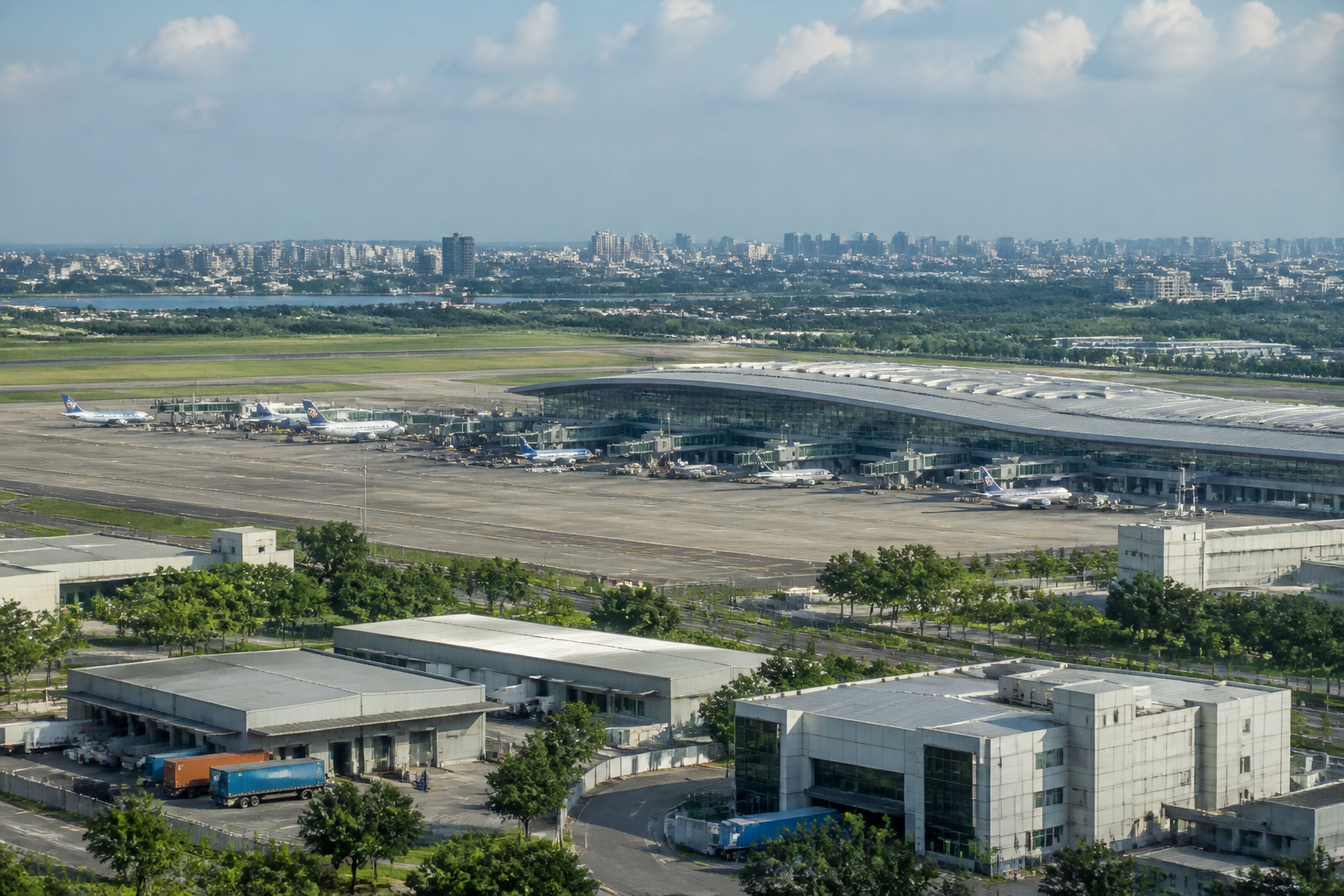
The broader urban implication is that airport expansion increasingly involves more than runways, terminals and aircraft movements. Airports are large urban interfaces where passengers transfer between transport systems, goods enter supply chains, and commercial districts develop around major infrastructure. When an operator moves into cargo, retail and commercial properties, the airport becomes part of a larger economic geography. Its performance then depends not only on aviation demand but also on how effectively it connects transport infrastructure with consumption, logistics and surrounding land.
GMR’s land portfolio illustrates this relationship. The company has received development rights over about 3,003 acres across its Indian airports. Of this area, 552 acres have been monetised, leaving approximately 2,451 acres available for future development. The monetised land generated lease income of around Rs 980 crore in FY26, largely from Delhi Airport. The report says GMR is now moving beyond land leasing towards self-developing commercial properties.
That transition changes the role of airport land within the business model. Leasing land can generate recurring income while leaving development to other parties. Self-development gives the operator a more direct role in deciding what is built, how assets are operated and how income is captured. The supplied material does not specify the types, locations or timelines of the proposed commercial properties, so the precise urban form of this development remains unclear. It does, however, establish that a substantial land bank is being treated as a future source of recurring income and asset value.
For cities, this raises questions about the relationship between airport-led development and the surrounding urban system. Commercial construction around airports can strengthen employment, logistics and service activity, but it also creates demand for roads, public transport, utilities and land. The report does not provide details on local planning approvals, infrastructure capacity or the public agencies responsible for coordinating development around GMR’s airports. Those issues will be important in assessing how the company’s commercial strategy translates into physical change on the ground.
Emkay’s financial projections show the scale of the expected shift. The brokerage expects GMR Airports’ consolidated revenue to grow at a 13.7% compound annual rate to nearly Rs 21,800 crore by FY29. EBITDA is projected to rise at a 16.5% compound annual rate to about Rs 9,100 crore, while operating cash flow is expected to increase at a 17.9% compound annual rate to about Rs 8,000 crore. The projected EBITDA margin is expected to improve from 38.9% in FY26 to 41.8% by FY29.
The forecasts also connect commercial expansion with the company’s balance sheet. Emkay expects stronger earnings and operating cash flows to reduce GMR’s net debt-to-EBITDA ratio from 6.7 times in FY26 to 4.9 times by FY29. Absolute debt is still expected to remain elevated. This means the strategy is being assessed not only on its ability to produce revenue, but also on whether that revenue can support deleveraging. The report does not establish whether the forecast will be achieved or identify the principal risks to the projections.
The company’s latest reported quarter provides the immediate operating context. GMR Airports recorded a 23% year-on-year increase in consolidated total income to Rs 4,085 crore in the June quarter of FY27, compared with Rs 3,321 crore a year earlier. EBITDA rose 22% to Rs 1,568 crore, while profit after tax stood at Rs 148 crore. The quarter marked the company’s fourth consecutive quarter of profitability, according to the report.
These results support the narrative of improving operating performance, but they do not by themselves establish that the longer-term commercial-development strategy will deliver the brokerage’s forecasts. The reported quarter covers a specific period, while the FY29 projections depend on the scaling of businesses across multiple airport assets, the development of available land and the continued growth of passenger and non-passenger activity.
The strategy also reflects the institutional structure of Indian airports. Operators work within regulated aviation frameworks while seeking additional income from activities that sit alongside the core transport function. The result is a hybrid model: the airport remains critical infrastructure, but its financial sustainability is increasingly tied to commercial operations. This places importance on how concessions, development rights, revenue-sharing arrangements and direct operating responsibilities are structured.
GMR’s stated movement towards direct ownership and operation makes that institutional question more significant. Consolidating duty-free and cargo operations may allow the company to coordinate these activities more closely with its airport platforms. It may also increase the operator’s exposure to the execution demands of running businesses beyond aviation. The supplied report provides no detailed assessment of operating costs, regulatory approvals or implementation risks, so those aspects remain unresolved.
The available numbers show a company attempting to build a broader airport ecosystem. Adjacency revenue has become a major component of the business; airport land has already generated lease income; and the company is considering a larger role in commercial property development. At the same time, the operator remains dependent on a capital-intensive infrastructure network and carries elevated debt, making the pace and quality of execution important to the financial case presented by Emkay.
The central urban question is therefore not simply whether GMR Airports can increase its earnings. It is how airport assets are being transformed into mixed transport, logistics and commercial districts, and whether the institutions governing those districts can keep pace with that transformation. The supplied evidence confirms the direction of the company’s strategy and the scale of the land and revenue opportunity identified by the brokerage. It does not yet establish the final form of the developments, their infrastructure requirements or their effects on surrounding communities. Those are the developments that will require closer monitoring as GMR moves from leasing airport land to building and operating more of the commercial assets itself.
