


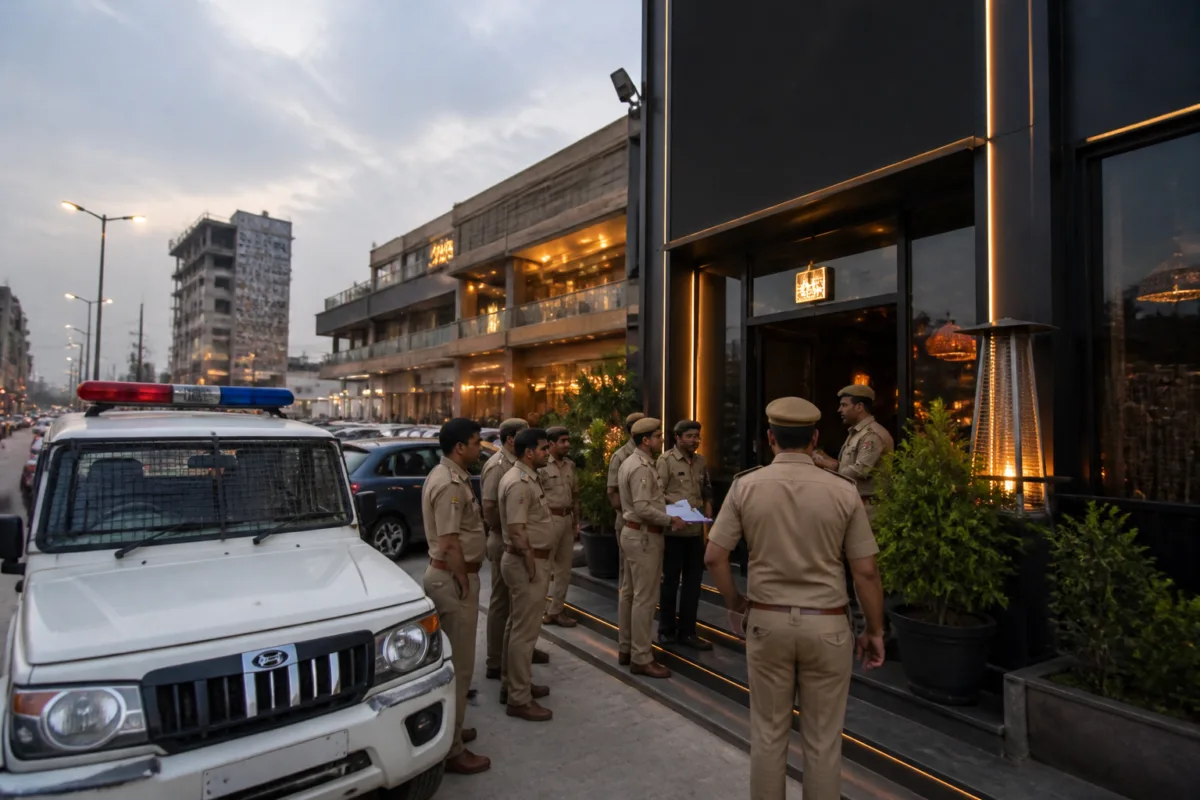
Ghaziabad’s latest action against three venues serving tobacco hookahs is more than a raid story. It exposes how regulation of commercial spaces depends on three linked systems working together: police enforcement, district-level licensing and internal accountability. The reported sequence in Trans Hindon shows what happens when an activity described by the police as unauthorised is found inside restaurants, a bar and a club, and when enforcement also turns inward towards the officials responsible for local supervision.
The police have written to the district magistrate seeking cancellation of the licences of The Public House at Angel Mega Mall in Kaushambi, Yarana Bar and Restaurant in Sahibabad, and God Father Club near Wave Cinema. The venues were identified after police operations on 17 and 19 October. The report also says that four police personnel, including two outpost in-charges and two head constables, were suspended after the raids.
The central administrative question is not simply whether a venue was found serving hookah. It is whether a city’s licensing and inspection framework can identify violations before they become visible through surprise action. The available report does not establish how long the three venues had been operating in this manner, whether they had faced earlier notices, or which specific licensing authorities had inspected them before the police intervention. Those gaps matter because licence cancellation is a formal regulatory step, while a raid is an enforcement event.
According to the report, Deputy Commissioner of Police Trans Hindon Rijul personally carried out raids at two locations. At The Public House and Yarana Bar and Restaurant, police found a large number of young people smoking hookahs and seized tobacco and hookahs. A further case involving illegal hookah service was reported at God Father Club on 19 October. The sequence indicates that the police treated the issue as a repeated or geographically connected enforcement concern rather than as an isolated incident at one premises.
The police position, as reported, is that licences are not issued for serving tobacco hookahs. On that basis, the deputy commissioner of police wrote to the district magistrate seeking cancellation of the licences of the three restaurants, club and cafe identified in the operations. The wording is significant: the police have sought cancellation, but the supplied report does not say that the licences have already been cancelled. The final decision therefore remains with the district administration or the competent licensing authority.
That distinction is important in understanding how urban commercial regulation works. Police can detect an alleged violation, conduct a search or seizure and submit a request for administrative action. Licence cancellation, however, is a separate process. The report does not provide details of notices issued to the venues, hearings, findings by the licensing authority or the legal provisions under which cancellation would be considered. Until those steps are documented, the action remains a police recommendation rather than a completed licensing outcome.
The venues themselves are part of the city’s formal commercial landscape. The Public House operates in a mall in Kaushambi, Yarana Bar and Restaurant is in the Sahibabad area, and God Father Club is near a cinema complex. Their locations place the issue within mixed-use urban environments where restaurants, entertainment venues, shopping spaces and high-footfall public destinations operate close to one another. The report does not establish whether the three venues share ownership, management or any common operating arrangement. It does show that enforcement was spread across different kinds of commercial premises in the Trans Hindon area.
The reported presence of young people at two of the venues adds a public-facing dimension, but the supplied material does not identify their ages, whether any health or safety complaints were made, or whether cases were registered against customers. The confirmed details are narrower: police found people smoking hookahs, seized tobacco and hookahs, and moved to pursue action against the establishments. A responsible reading of the report should not extend those facts into broader claims about the scale of hookah use in Ghaziabad or the health profile of the customers involved.
The internal disciplinary action is the strongest governance signal in the episode. Two outpost in-charges and two head constables were suspended after the police operations. The report does not specify the formal charges, whether the suspensions relate to alleged negligence, failure of supervision or another departmental finding, and whether a further inquiry has been ordered. Even so, the action indicates that the police administration viewed responsibility as extending beyond the venues themselves. Enforcement was directed at the commercial operators, while supervision within the police structure was also questioned.
This creates a two-level accountability chain. The first level concerns whether commercial establishments comply with the conditions attached to their licences and whether they provide services that the police say are not authorised. The second concerns whether local police units detect and act on violations within their areas. If the police seek cancellation of licences while suspending local personnel, the institutional response is addressing both the alleged activity and the conditions that allowed it to continue or remain undetected.
The report does not provide enough evidence to determine whether the suspensions will improve regular inspection or whether cancellation requests will be accepted. It also does not say whether the district magistrate has acted on the police letter. These are the next factual checkpoints. A letter seeking cancellation is not equivalent to an order, and a suspension is not equivalent to a final departmental finding.
The episode also illustrates the difference between event-based enforcement and routine regulation. Surprise raids can produce immediate visibility: police identify a venue, seize material and announce action. But routine regulation depends on records, inspections, licence conditions and communication between departments. None of those underlying mechanisms are described in the supplied report. As a result, the story confirms that enforcement occurred but does not establish whether the broader licensing system is consistently monitoring similar venues across the district.
That limitation should shape the questions that follow. Has the district administration received and processed the cancellation request? Were the three establishments given an opportunity to respond? Were their operating licences issued by the same authority or under different regulatory frameworks? Did earlier inspections record compliance? The source material does not answer these questions, and they should not be treated as settled facts. They are the administrative steps that would determine whether the police action results in a durable regulatory outcome.
For residents, the immediate implication is that three named venues face possible licence consequences after police action, while the internal police response has already included four suspensions. For the city, the wider significance lies in how enforcement responsibility is distributed. The police can identify and seize; the district administration can consider licensing action; local police units are expected to supervise their areas. The effectiveness of the response will depend on whether those actions remain connected after the initial raid.
The Ghaziabad case therefore remains an unfolding governance story rather than a completed crackdown. What is established is the police action, the seizure of hookahs and tobacco at identified locations, the suspension of four police personnel and the request to cancel three venue licences. What remains unresolved is whether the district magistrate will approve cancellation, what findings will emerge from any departmental process, and whether further inspections will identify similar violations elsewhere. Those decisions will show whether the episode produces a lasting change in commercial venue oversight or remains a limited enforcement intervention.

