


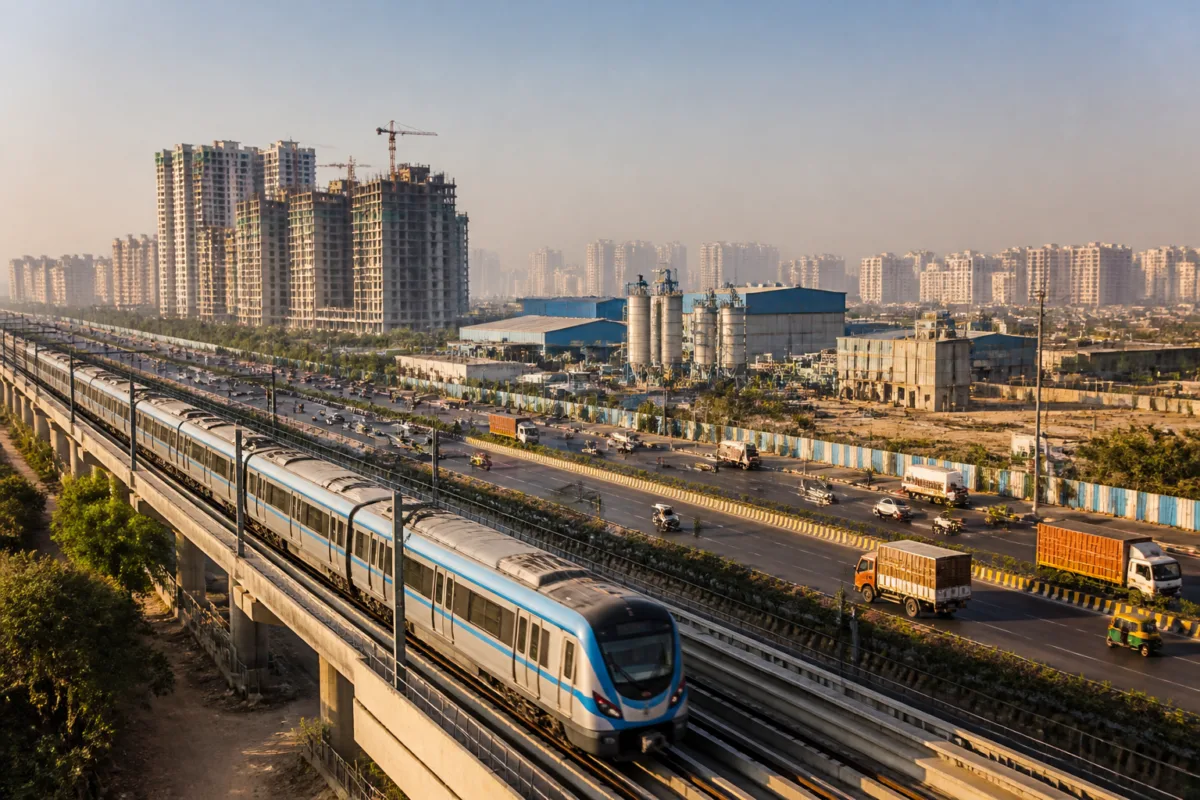
Ghaziabad’s emergence as a stronger economic gateway between Delhi and western Uttar Pradesh is being driven by a combination of regional rail, expressway and metro connectivity, industrial investment and urban expansion. But the district’s transformation also exposes a harder urban question: whether transport infrastructure can be matched by coordinated planning, civic services and development around the nodes it is creating.
For much of its modern history, Ghaziabad was understood mainly as an industrial suburb of Delhi. Its location immediately east of the national capital gave it access to markets, suppliers, jobs and institutions, but its identity remained closely tied to Delhi’s economic gravity. The shift described in the latest assessment is different. Ghaziabad is increasingly being positioned as an economic and transport node in its own right, connecting Delhi with Meerut, Hapur, western Uttar Pradesh and the wider northern Indian market.
That change is not the result of a single project. It reflects the gradual construction of a larger metropolitan system in which administrative boundaries matter less to daily movement, industrial location and access to employment. The Delhi-Ghaziabad-Meerut corridor, the Delhi-Meerut Expressway and the expansion of the Delhi Metro network have together altered the practical relationship between the district and the National Capital Region.
The significance of this shift lies in the type of connectivity being created. Conventional urban transport primarily serves movement within a city. The Namo Bharat rapid rail service is designed to connect multiple economic centres across a region. For Ghaziabad, that creates the possibility of functioning not only as a residential extension of Delhi, but also as an intermediate centre linking different labour markets, industrial areas and service economies.
The supplied report presents this regional rail connection as a change in economic geography. Faster movement between Delhi, Ghaziabad and Meerut can allow workers, students, entrepreneurs and consumers to move across a wider corridor. It can also make locations outside Delhi more accessible to companies seeking proximity to the capital without locating inside it. The available material does not establish how many people are using the corridor, or how much travel time has changed in practice, but it identifies the institutional logic behind the investment: transport is being treated as a foundation for investment, employment and urban growth rather than only as a mobility intervention.
The Delhi-Meerut Expressway adds a road-based layer to that regional integration. Alongside the rapid rail corridor, it strengthens the connection between the national capital and western Uttar Pradesh. The Delhi Metro’s role is somewhat different. Its network has expanded access from Ghaziabad residents to employment, education, healthcare and commercial opportunities across Delhi-NCR. For businesses, that access can enlarge the effective labour market by allowing workers to travel across municipal and state boundaries.
This distinction between regional and urban transport is important. A metropolitan economy does not function through one mode alone. Rail, expressways, metro lines, local roads, feeder services and pedestrian connections must work as a network. The report points to this network effect, but it also identifies a major risk: connectivity can increase development pressure faster than civic infrastructure can absorb it.
Ghaziabad’s economic base provides a foundation for that expansion. The district has long been associated with engineering, manufacturing, electrical goods, machinery, steel-related industries and other small and medium enterprises. Its proximity to Delhi has given these businesses access to a large consumer market, suppliers and services. The current transition, as described in the report, is therefore not a straightforward replacement of industry with real estate or services. It is an attempt to build a more diversified economy on top of an existing industrial base.
Better roads and regional rail can improve the movement of raw materials and finished goods. At the same time, the district is seeing growth in logistics, warehousing, retail, healthcare, education, professional services and real estate. This mix is consistent with the way large metropolitan regions distribute economic functions. Manufacturing, logistics, housing and services do not need to be located within one city when transport links allow them to operate across a wider geography.
However, the source material does not provide specific investment totals, employment figures, industrial land data or evidence of how much economic activity has shifted into Ghaziabad. That limitation matters. A stronger transport connection creates an opportunity for economic diversification, but it does not by itself guarantee industrial modernisation, formal employment or balanced urban growth. Those outcomes depend on land availability, infrastructure quality, administrative coordination, business conditions and the capacity of local institutions.
The policy context is similarly broad. The report links Ghaziabad’s prospects to Uttar Pradesh’s wider emphasis on improving the investment environment, developing industrial infrastructure and simplifying business processes. Districts near the NCR receive a particular locational advantage because they can offer businesses access to the national capital as well as to the state’s expanding markets.
This places Ghaziabad between two administrative and economic systems. It must function as part of the NCR while also serving as an urban and industrial centre within Uttar Pradesh. That dual role can create opportunities, but it also requires coordination across agencies responsible for transport, land use, housing, roads, drainage, water, sewerage and industrial development. A regional rail corridor can cross jurisdictions in minutes; planning and budgeting systems often do not.
The most important planning issue is therefore what happens around transport infrastructure. The report identifies transit-oriented growth around major stations, stronger last-mile connectivity and coordinated development between residential, commercial and industrial areas as necessary components of Ghaziabad’s next phase. These are not secondary urban design concerns. They determine whether new infrastructure produces accessible economic opportunity or simply encourages scattered construction and longer local journeys.
The pressure is already visible in the city’s infrastructure requirements. Population growth, expanding residential areas and rising traffic increase demand for road capacity, junction improvements, drainage, water supply, sewage systems, public transport and urban renewal. The report treats these interventions as part of a single urban system rather than as isolated civic works. That framing is significant because transport-led growth can expose weaknesses in basic services even when the headline projects themselves are completed.
For residents, the changing geography of work is one of the clearest consequences. Improved connections can widen access to jobs across Delhi-NCR, reducing the extent to which employment opportunities are restricted to Ghaziabad itself. At the same time, the expansion of manufacturing, logistics, retail, healthcare, education and other services could create more jobs within the district. The result is a two-way labour market: residents can travel outward, while economic activity can also move inward.
Yet the available report does not establish whether this access is affordable, reliable or equally distributed. It does not provide data on fares, station accessibility, last-mile travel, travel times for different neighbourhoods or the experience of lower-income households. Those questions will determine whether regional integration remains primarily an investment narrative or becomes a broad-based improvement in urban opportunity.
Ghaziabad’s strategic importance also extends beyond its municipal boundaries. It sits within a network connecting Delhi with Meerut, Hapur, Bulandshahr and other districts of western Uttar Pradesh. As infrastructure improves across this network, the district can serve as an interface between the national capital’s mature markets and the state’s industrial and consumption centres.
The larger urban question is whether Ghaziabad can use its location without becoming dependent on Delhi for its identity and economic direction. Its industrial experience, established markets, skilled manpower and improving connectivity provide the basis for a stronger regional role. But a gateway is effective only when movement through it is supported by functioning local systems. Roads, drainage, water, sewerage, housing and public transport will shape the everyday value of the larger corridor as much as its expressways and rapid rail services.
The evidence supplied confirms a clear change in ambition: Ghaziabad is being developed as more than an eastern extension of Delhi. It is being integrated into a Delhi-Ghaziabad-Meerut economic and transport geography while retaining an industrial role within Uttar Pradesh. What remains unclear is the scale of the resulting economic gains, their distribution across communities and the ability of civic institutions to keep pace. Those are the measures that will determine whether connectivity becomes sustained urban transformation or simply a new layer of infrastructure over an overstretched city.

