


A study by Nomura Research Institute Consulting & Solutions India has put a large price on one of infrastructure’s least visible risks: corrosion. It estimates that corrosion costs India’s infrastructure sector about ₹1.42 lakh crore every year, equivalent to 2.9 per cent of the sector’s GDP, and says wider use of galvanised steel could save up to ₹49,580 crore annually.
The finding arrives as India’s infrastructure network expands rapidly. Between 2015 and 2025, the national highway network grew to around 1.46 lakh kilometres, the number of airports rose from 74 to 157, port capacity doubled from about 800 million tonnes per annum to 1,600 MTPA, and around 25,871 kilometres of new railway tracks were added, according to the study. The central issue raised by the report is not simply which material should be selected for a project. It is whether the way infrastructure is procured and maintained adequately accounts for the cost of keeping that asset functional over several decades.
The distinction matters because corrosion is a lifecycle problem. A structure may meet its initial construction target and appear economically efficient when judged only by its tender price. But if exposed steel requires repeated treatment, repainting, replacement or extended repairs, the cost of the asset continues long after construction has ended. NRI’s argument is that material selection, inspection and maintenance should be assessed together, especially when public infrastructure is expected to serve for decades.
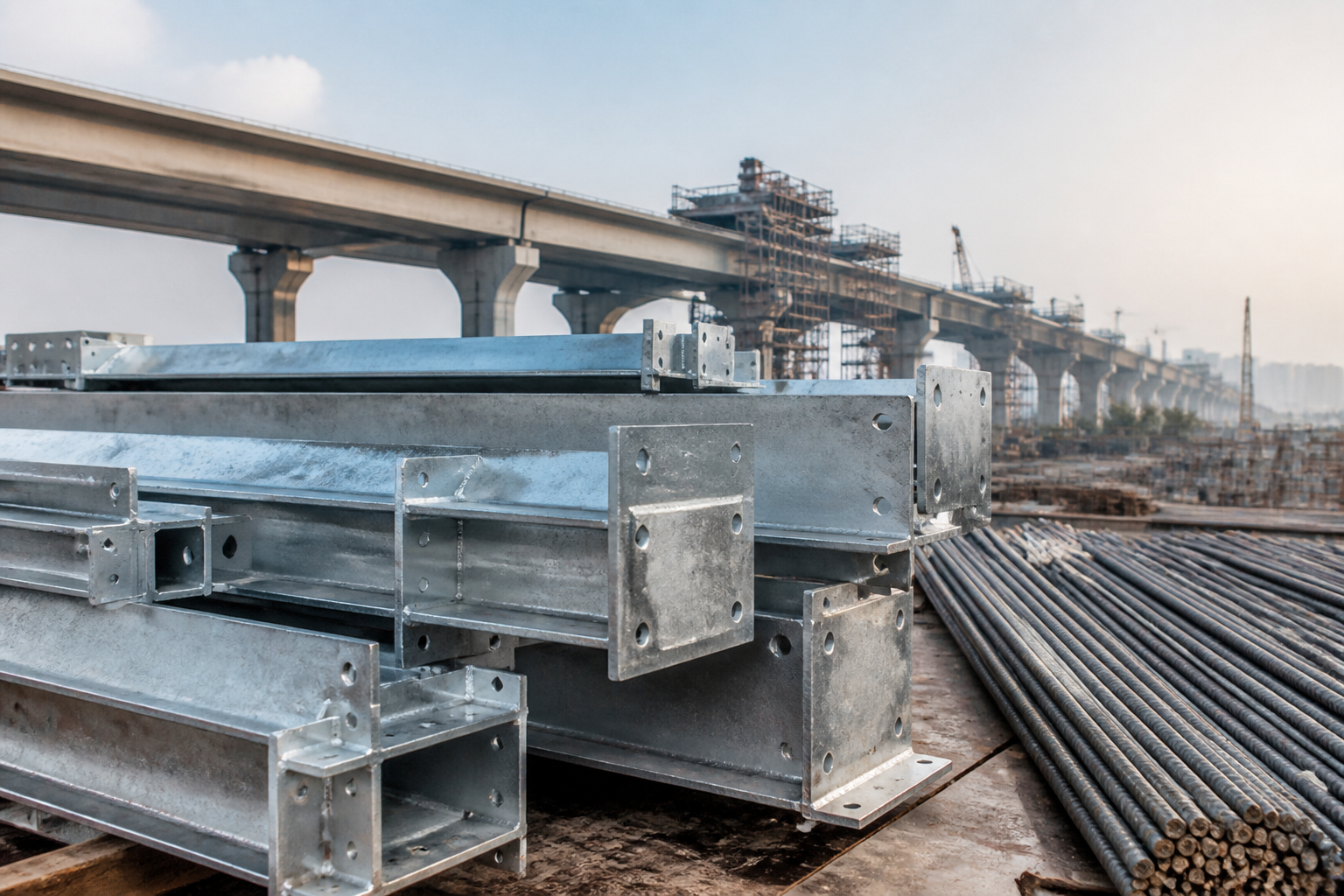
Galvanising protects steel by applying a zinc coating. The report identifies structural steel, reinforcement and other exposed steel components as areas where the coating can offer longer service life and lower lifecycle costs compared with some alternatives. It also makes a distinction between the upfront price of a material and its annualised cost over the useful life of an asset. Galvanised steel can cost more at the beginning, but the study says the higher initial expenditure may be offset by longer durability and reduced recurring maintenance.
That trade-off is particularly important in locations where moisture and chlorides accelerate deterioration. NRI has called for stronger corrosion-protection requirements in coastal and high-humidity regions. The study points to the United States and Japan, where protection requirements are more closely linked to exposure conditions. In that approach, the environment in which a structure will operate becomes a central part of the technical specification, rather than a secondary consideration after the design and material have already been determined.
The report’s comparison of reinforcement illustrates the argument. Conventional TMT reinforcement typically offers durability of around 40 to 50 years, depending on environmental conditions, according to the supplied material. Galvanised TMT, by contrast, is estimated by NRI to provide a service life exceeding 100 years, including in high-chloride marine environments. The study says this longer service period can produce a lower annualised lifecycle cost despite the higher upfront price.
The comparison is similar for structural steel. Multi-coat paint systems may have a coating life of 10 to 25 years and can require repainting during an asset’s life. Hot-dip galvanising, the report says, can provide durability beyond 100 years in suitable conditions and offer better lifecycle economics in high-moisture environments. These estimates are presented by NRI and are not an independent assessment contained in the supplied material. Their significance lies in the procurement question they raise: whether public agencies should compare protection systems over the full operating life of an asset instead of treating construction cost as the principal measure of value.
India’s infrastructure expansion makes that question more consequential. A larger network means a larger stock of bridges, stations, terminals, roads, port facilities, railway structures and other assets that must be inspected and maintained. The figures cited by NRI describe the scale of expansion but do not establish how much of the existing network is exposed to corrosion, how maintenance budgets are distributed, or how much of the estimated annual loss is attributable to specific asset classes. They do, however, show why a material decision made at the design stage can have implications far beyond an individual project.
The study also identifies inadequate material selection and poor adherence to inspection and maintenance schedules as factors that can weaken structural integrity and shorten the useful life of infrastructure. This places corrosion within a broader governance framework. Durable construction is not achieved by material choice alone. It depends on specifications, quality control, application standards, site supervision, inspection records and timely maintenance. A protection system that is not properly specified, installed or monitored may not deliver the performance expected from it.
The same challenge extends to urban assets that are not part of large national networks. NRI cites the fact that more than 2,000 buildings in Mumbai were under redevelopment in 2025. The study uses this as an indication of the wider challenge of maintaining ageing urban assets. Redevelopment decisions can involve structural condition, repair costs, land economics and the capacity of existing buildings to continue serving residents. The supplied material does not establish that corrosion was the cause of those redevelopment cases. It does show, however, that the management of ageing assets is a city-level issue as well as an infrastructure-sector concern.
This is where lifecycle costing connects with urban planning. Roads, railways, ports and airports are visible investments, but their performance depends on less visible systems of inspection and renewal. In buildings, the same principle applies to reinforcement and exposed structural elements. If maintenance is deferred, a relatively manageable deterioration problem can become a structural or redevelopment challenge. If agencies select materials solely on the basis of initial expenditure, they may transfer costs to future budgets, operators, residents or taxpayers.
Rahul Sharma, Director–India at the International Zinc Association, said that in corrosion-prone environments, galvanisation can help reduce recurring maintenance requirements and extend asset life. He said lifecycle performance should increasingly be considered alongside upfront cost for long-life infrastructure. His comments represent an industry-linked view and are consistent with the report’s central argument, but they do not by themselves establish that galvanisation is suitable for every project or environment.
That qualification is important. The evidence supplied does not provide a project-by-project comparison of galvanised steel with other corrosion-protection systems. It does not specify the assumed prices, discount rates, maintenance intervals or environmental conditions behind the ₹49,580-crore savings estimate. Nor does it identify the infrastructure projects where the proposed savings could be achieved first. The report therefore functions as a case for changing the basis of evaluation, rather than as proof that one material should replace all others.
A shift towards lifecycle procurement would also require clearer institutional responsibilities. Project authorities would need to define exposure conditions, set corrosion-protection requirements, assess durability over the intended service life and verify compliance during construction. Operators and maintenance agencies would need reliable inspection schedules and records. Procurement documents would need to make room for whole-life cost comparisons, while oversight systems would need to check whether the promised durability has been achieved in practice.
The study’s reference to the United States and Japan suggests one possible direction: linking protection requirements more explicitly to the environment in which infrastructure operates. Coastal and high-humidity regions may require different specifications from inland locations, but the supplied material does not provide the detailed standards used in either country. It does establish the principle that exposure conditions should influence technical requirements.
The numbers in the report frame the scale of the policy choice. Corrosion is estimated to cost ₹1.42 lakh crore annually, while wider use of galvanised steel is estimated to generate savings of up to ₹49,580 crore a year. The infrastructure base has expanded across highways, aviation, ports and railways, increasing the number of assets whose long-term condition will affect public service delivery. At the same time, the contrast between a 10-to-25-year coating life for some paint systems and a claimed service life exceeding 100 years for galvanised applications highlights why initial price cannot be the only metric for long-life assets.
What the evidence confirms is the scale of the maintenance question and the potential value of designing for durability. What it does not yet confirm is how the estimated savings would translate across India’s varied construction practices, climates, asset types and procurement systems. The next stage would require agencies to test the assumptions through project-level cost comparisons, exposure-specific specifications and transparent monitoring of performance over time.
As India continues to add infrastructure while managing an ageing urban asset base, the decision about materials is also a decision about future maintenance obligations. NRI’s study brings that obligation into sharper focus: infrastructure spending cannot be assessed only by what it costs to build. It must also account for how long an asset remains safe, serviceable and affordable to maintain.
