


India’s Gaganyaan programme is creating a research challenge that extends well beyond rockets, spacecraft and crew training: how to keep astronauts metabolically stable and physically healthy when ordinary Earth conditions no longer apply. A new collaboration involving the Postgraduate Institute of Medical Education and Research in Chandigarh, the Indian Space Research Organisation, the Central Food Technological Research Institute in Mysore and IIT Ropar is examining that question through the connected fields of nutrition, gut microbiota, metabolism and bone health.
The project is significant because it treats food not merely as a supply item for a space mission, but as a potential health intervention. According to the Times of India report, the ISRO-funded research will use ground-based simulation facilities to study how space-like conditions affect physiological functioning. Researchers will initially examine specific foods and dietary interventions in animal studies before using the findings to develop food and nutrition strategies for astronauts.
The research is being undertaken in the context of Gaganyaan, India’s first human spaceflight programme. The report states that the maiden crewed flight is expected in 2027. That timeline gives the project a practical purpose: findings must eventually be translated into food, dietary and health protocols that can be used during human missions. The immediate work, however, is still at the laboratory and simulation stage, and the research team has not presented the final astronaut diet as an established outcome.
The collaboration also shows how human spaceflight depends on institutions that are not traditionally associated with launch systems. ISRO supplies the mission context and funding, but the research described in the report draws on PGI’s clinical and biomedical expertise, CFTRI’s food-technology capabilities and IIT Ropar’s research role. The arrangement reflects the multidisciplinary nature of astronaut health, where medical science, food development, microbiology and engineering have to operate together.
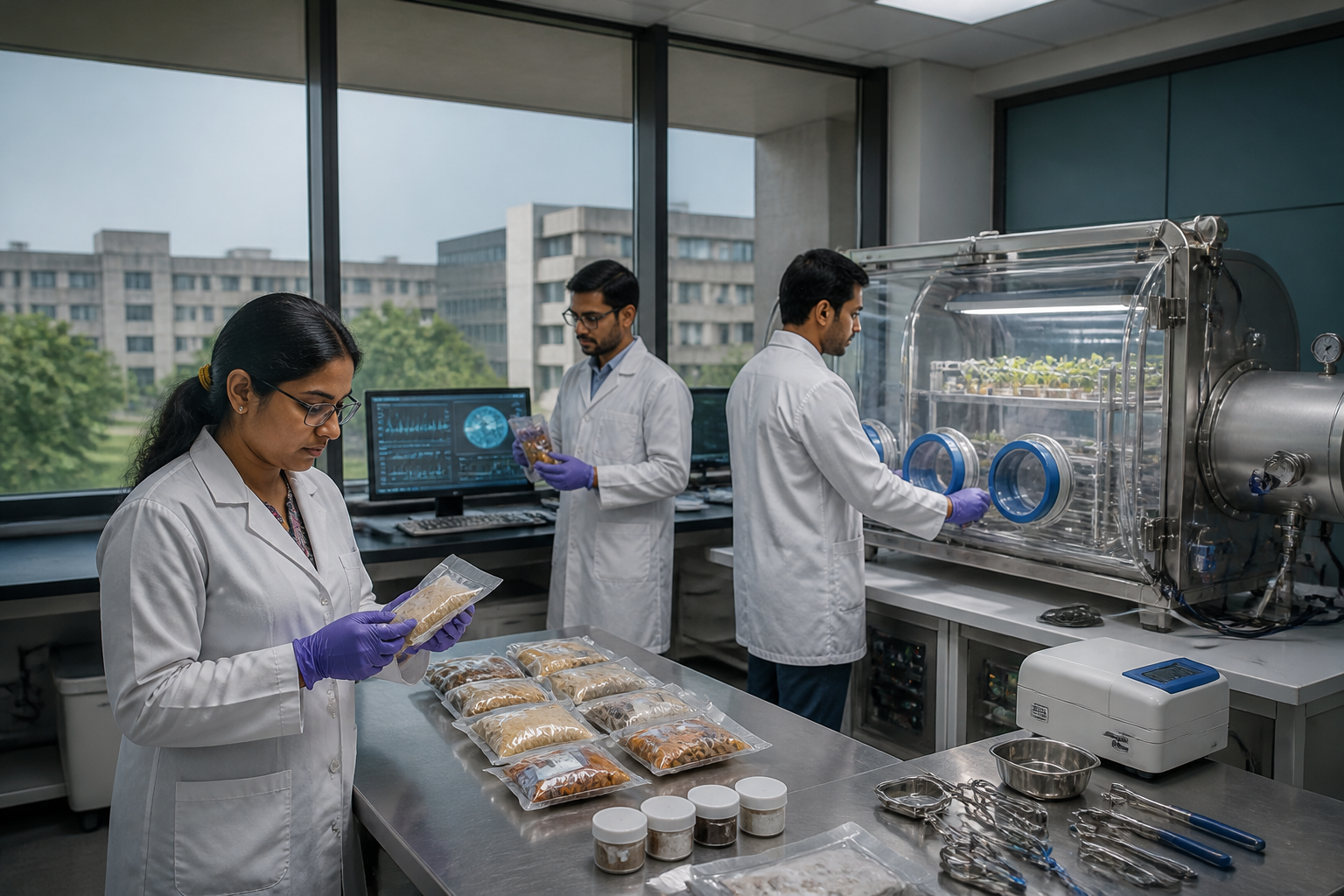
At PGI, the proposed simulation laboratory will be central to that work. Rahul Saini, a project scientist, said the project began in April and that the laboratory would soon be established at the institute. The facility is intended to mimic relevant space conditions and allow researchers to observe metabolic and microbial changes without sending experiments into orbit. The use of ground-based simulation is important because it provides a controlled setting for testing hypotheses before any intervention is considered for astronauts.
One of the study’s principal areas is acid-base homeostasis, the balance required for normal physiological functioning. The report identifies this as a specific focus of the ISRO-funded research. Space conditions can alter how the body responds to its environment, and the project will examine those changes alongside nutrition and gut health. The stated aim is not simply to catalogue biological effects, but to identify dietary replacements or interventions that could help manage them.
Gut microbiota is another major focus. These microorganisms, which live in the digestive tract, influence digestion, metabolism and immune function. Prof S K Bhadada, a co-principal investigator from PGI, said the study would examine how specific foods alter gut microbiota and how microbial shifts under simulated space conditions could be linked to metabolic and endocrine disorders such as obesity, diabetes and osteoporosis. His work in the collaboration will focus on bone health, while Dr Poonam Khanna from PGI’s department of community medicine will work on nutrition.
This connection between gut microbiota and bone health gives the project a wider biomedical scope. Astronaut nutrition is often understood in terms of calories, shelf life, packaging and ease of consumption. The PGI-led approach adds another layer: whether food can help protect bodily systems that may be vulnerable during a space mission. The research described in the report is therefore concerned with the relationship between diet and the body’s broader physiological response, rather than with food preparation alone.
The project’s proposed sequence is also revealing. Researchers will first study food-related changes in animals under simulated space conditions. They then hope to use the results to develop appropriate food and nutrition strategies for human spaceflight. This staged method separates early biological investigation from later application. It also makes clear that the eventual use of any dietary intervention will depend on evidence generated through the research process.
For Gaganyaan, the institutional challenge is to convert specialised laboratory findings into reliable operational systems. Astronaut food must support health during a demanding mission, but it must also be developed, tested and supplied within the safety requirements of human spaceflight. The material supplied for the project does not specify the final menu, the duration of the trials, the planned crew diet or the operational conditions under which the food will be used. Those details remain to be established as the research progresses.
The collaboration is also designed to involve people beyond the astronaut corps. Organisers are planning an interactive webinar on October 12 featuring ISRO astronaut Group Captain Angad Pratap. They have stated that participants do not need to be space travellers, arguing that research involving the broader population can help validate findings and support national-level research as results emerge. This suggests that the project is being positioned not only as a mission-specific exercise but also as a platform for wider scientific engagement.
That wider role matters because the biological questions being examined are not exclusive to space. The project’s investigators have linked gut microbiota and metabolic changes to conditions including obesity, diabetes and osteoporosis. However, the source does not claim that the space research will directly produce treatments for those conditions. Its stated objective is to understand how food and dietary interventions may influence health under simulated space conditions, with possible applications emerging as the evidence develops.
The project therefore sits at the intersection of national mission planning and public research capacity. Gaganyaan creates a demanding application for Indian science, but the work is being distributed across a medical institute, a space agency, a food research organisation and an engineering institute. That structure is important because astronaut health cannot be addressed by one discipline or one department. It requires an institutional chain linking simulation, biological research, food technology and mission requirements.
The research also highlights a less visible part of space infrastructure. Launch vehicles and crew modules are the most visible assets of a human spaceflight programme, but the ability to sustain a crew depends on supporting systems that operate before, during and after launch. Nutrition, microbiology and bone health belong to that less visible layer. Building domestic expertise in these areas may be as important to mission readiness as the more visible hardware, although the project’s eventual contribution will depend on its findings and their validation.
What is established so far is that the collaboration has been launched, the project began in April, a simulation laboratory is being established at PGI and initial studies will examine food, gut microbiota and physiological changes under simulated space conditions. What remains open is how quickly the laboratory will become operational, which interventions will show measurable benefits, and how research findings will be assessed before they are used in a crewed mission. Those are the milestones that will determine whether the initiative becomes a functioning astronaut-health system rather than only a promising research programme.
