


India’s food inflation is no longer confined to a single crop or market. Rising prices for onions, ginger, cooking oil, dairy, chicken and sugar are showing how weather stress, global conflict, energy policy and festive demand can move through the food system and reach urban households, restaurants and street businesses.
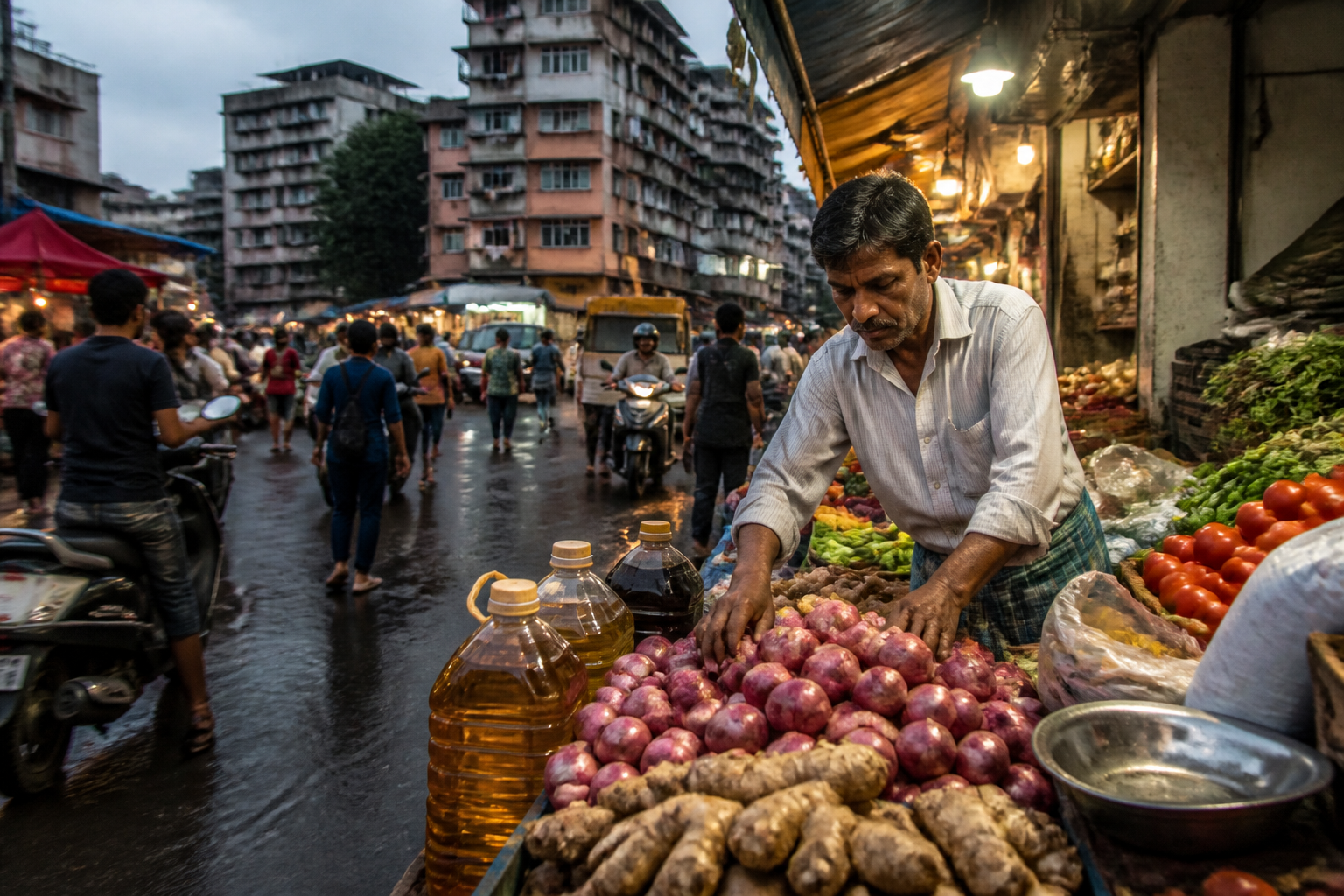
The traditional thali offers a useful measure of that pressure because it brings several supply chains together on one plate. Onions, a basic ingredient in many Indian dishes, were almost 50% more expensive in August than a year earlier, while ginger prices had risen by more than 70%, according to the latest consumer price index data cited in the report. Vegetable oil, milk and paneer have also become more expensive.
Food accounts for nearly 40% of monthly spending in cities and almost half of monthly spending for some rural families. That difference matters for urban economies because food inflation does not stop at the household kitchen. It affects the prices charged by restaurants and food carts, the margins of small traders, the cost of prepared meals and the volume of demand available to businesses operating on thin margins.
The current pressure is being produced by several forces at once. Monsoon rainfall since June has been 15% below normal, and the weather office expects September rainfall to remain subpar. The report links the shortfall to El Niño, a weather phenomenon associated with drier conditions in India. A weaker monsoon can affect the harvest outlook for rice, soybeans, corn and sugar cane, while reducing the reliability of supplies that feed both households and businesses.
The planting data points to a narrowing window for recovery. Rice and corn plantings were running more than 3% behind the previous season, with little time remaining in the planting cycle. Domestic sugar prices rose sharply in August amid concerns about a shortfall, prompting the government to permit a tranche of duty-free sugar imports. India is the world’s second-largest sugar producer, making the decision an indication of the pressure being felt in a major agricultural market.
The relationship between rainfall and food prices is also significant. Yuvika Singhal, an economist at Quant Eco, said every percentage-point shortfall in rainfall compared with normal levels during deficient monsoon years corresponds to an approximately 25-basis-point increase in food inflation. The figure does not establish the outcome for the current season, but it shows why rainfall is closely watched by households, traders, policymakers and the Reserve Bank of India.
The monsoon is only one part of the supply story. Crop damage in Maharashtra caused by unseasonable rains in March reduced onion yields, according to Jaydatta Sitaram Holkar, a member of one of the state-run wholesale markets for farm commodities. Wholesale onion prices are expected to soften when the new crop arrives next month, but higher transport costs are keeping retail prices elevated. This gap between wholesale correction and retail relief illustrates how logistics can delay the effect of improved supply at the point of consumption.
Ginger is facing a different timing problem. Supplies have tightened before the next harvest, while fresh supplies are expected in December and January, according to V. Srinivasan of the ICAR-Indian Institute of Spices Research. For consumers and food businesses, that creates a period in which prices may remain exposed even if a future harvest eventually improves availability.
Policy is adding another layer to the competition for crops. India brought forward its 20% ethanol-blending target from 2030 to 2025, expanding demand for corn and rice as feedstocks alongside sugar cane. The policy is connected to energy security and has expanded across thousands of fuel stations, but it also creates additional demand for crops that have food and feed uses.
Madan Sabnavis, chief economist at Bank of Baroda, said farmers could sell to ethanol producers first if they receive a higher price. That does not mean biofuel demand is the sole cause of current food inflation. It does mean that food availability is increasingly shaped by more than household consumption and export demand. The same crop can be part of the food system, the animal-feed system or the energy system, with prices influencing where supplies go.
That competition is visible in the urban poultry market. Ajaz Azam Qureshi, a chicken and egg seller in Mumbai’s suburbs, said feed prices for the live birds he buys daily had doubled in the previous month. He raised chicken prices to 260 rupees per kilogram from 240 rupees, even as the month of Shravan reduced meat demand. With that period over in Maharashtra, he planned to raise prices to 300 rupees per kilogram.
Qureshi’s account captures a difficult urban pricing equation. A seller must protect margins when input costs rise, but higher prices can reduce consumption and weaken business. If feed costs do not fall, a later reduction in chicken prices becomes difficult. The result is pressure on both sides of the transaction: households pay more, while small sellers risk losing customers.
Small restaurants face a similar constraint, intensified by competition. Shivam Fauzdar, who runs a restaurant in Noida, said he had raised prices after an earlier surge in liquefied petroleum gas costs but was struggling to increase menu prices again as ingredient costs climbed. Nearby food carts sold flatbreads with vegetables or lentils at lower prices, limiting the room for another increase.
This is where food inflation becomes an urban governance and livelihood issue rather than only an agricultural one. Restaurants, food carts and small retailers operate within neighbourhood markets where customers can switch to cheaper alternatives quickly. Their costs include ingredients, cooking fuel, transport and labour, while their ability to pass on those costs depends on local competition and household purchasing power.
Cooking energy has also become part of the pressure. India faced shortages of liquefied petroleum gas earlier in the year because of conflict in the Middle East. When fuel and ingredients rise together, food businesses face a compounded increase in operating costs. The impact is not limited to the price of raw commodities; it affects the cost of preparing, transporting and selling meals in cities.
The wider inflation picture makes the timing more consequential. Food accounts for more than a third of the retail inflation basket and has accelerated each month this year, according to the report. Broader inflation rose in August to its highest level since December 2024 and exceeded the Reserve Bank of India’s 4% medium-term target for a third consecutive month.
That gives food prices significance beyond the monthly household budget. The central bank targets headline consumer price inflation, so persistent food pressure can influence the broader interest-rate environment even when other parts of the economy are moving differently. The report cites Sabnavis as saying that the rise in food inflation will have implications for interest rates.
The festive calendar adds a demand shock to an already vulnerable supply system. The period leading to Diwali in November typically brings higher consumption of sugar, cooking oil, traditional sweets and fried foods. Demand peaks do not automatically produce shortages, but they can make price movements more visible when supplies are already constrained by weather, damaged crops, transport costs or competing uses.
The structural issue is that India’s food system is highly connected but not equally resilient at every stage. A weak monsoon affects production. Crop damage changes wholesale availability. Transport costs influence retail prices. Biofuel demand competes for feedstocks. LPG disruptions raise preparation costs. Finally, urban consumers and small businesses absorb the combined effect through household purchases, menu prices and reduced consumption.
That chain also explains why a national food inflation number can conceal sharply different urban experiences. A household that cooks at home is exposed to staples, vegetables, oil and fuel. A restaurant customer encounters the same pressures through a prepared meal. A food-cart operator may face lower selling prices but similar ingredient costs. A poultry seller adds animal feed to the equation. These are different points in the same system.
The evidence supplied in the report confirms that the present episode has multiple drivers rather than a single trigger. It also shows that some relief is expected from incoming onion and ginger supplies, although the timing and extent of that relief remain dependent on harvests, transport costs and demand. The government’s duty-free sugar imports are an immediate policy response, while ethanol blending remains a longer-term energy policy with implications for crop allocation.
The developments that merit monitoring are therefore clear: September rainfall, the arrival of new onion and ginger crops, rice and corn planting outcomes, domestic sugar prices, transport costs, feed prices and food demand during the festive season. Together, they will determine whether the pressure visible in the everyday thali eases or continues to spread through India’s urban cost of living.
