


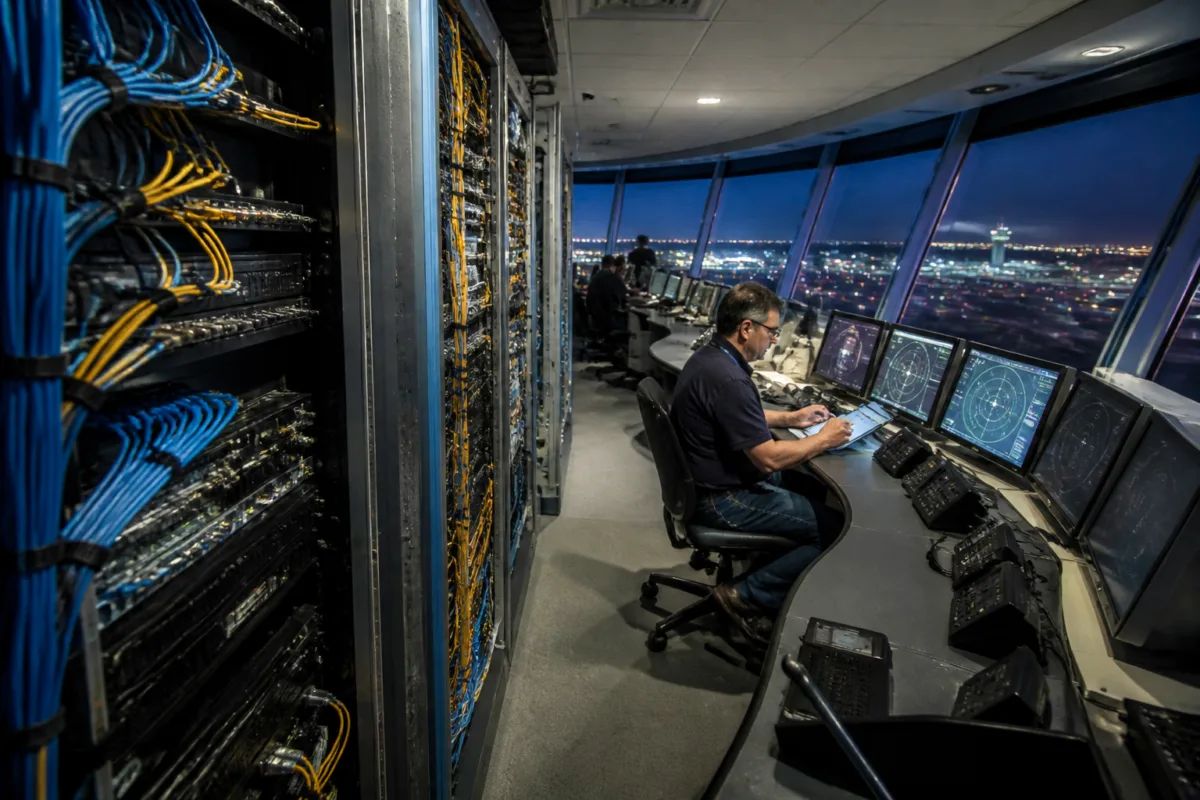
A nearly five-hour shutdown of the US aviation system that disrupted more than 20,000 flights has exposed a problem larger than a suspected faulty router: the country’s air traffic control network is being modernised while decades-old communications infrastructure remains responsible for keeping the system operational. The incident began during a routine migration from copper telecommunications lines to fibre and forced the Federal Aviation Administration (FAA) to issue a nationwide ground stop after communications data became unstable across much of the network.
US officials said a router installed by government contractor L3Harris may have caused the failure, although the root cause had not been established. Transportation Secretary Sean Duffy said officials were investigating whether the incident resulted from user error, an installation error or a faulty router. L3Harris said it was supporting the FAA’s investigation into the conditions that led to the ground stop on November 13.
The uncertainty over the precise trigger is important, but it does not erase the wider infrastructure issue. The router was part of a planned conversion from legacy copper lines to a fibre-optic system. L3Harris said it had completed more than 70% of the planned airspace communications conversion. At the same time, the FAA continues to operate equipment that officials describe as roughly 25 years old and that was supposed to have been replaced in 2006.
That combination creates a difficult transition problem. The new system has to be installed without interrupting a national network that depends on the old system. The old system must remain available while new equipment is connected, tested and brought into service. Each stage of the change therefore carries the possibility that a local error, component failure or configuration problem could spread through a system whose operational consequences extend far beyond the original installation site.
## How a local technical problem became a national disruption
The incident did not begin with the complete loss of communications at every FAA facility. The FAA said communications did not go down, but data became unstable. According to Duffy, new routers began flooding other routers with more than 1,000 connection attempts every four to five seconds. The resulting communications problems affected aircraft and radar data at FAA facilities.
The overload reached 17 of the FAA’s 22 en route centres. These centres handle aircraft moving between airports and across large sections of national airspace. When the FAA could not identify the root cause, it issued a nationwide ground stop. The decision meant that the agency prioritised preventing aircraft from entering an air traffic control environment whose data communications could not be reliably understood.
This is the defining feature of critical urban and national infrastructure: the visible disruption is often much larger than the initial technical fault. A router may be installed at one or more remote locations in Arkansas and Texas, but aviation depends on the continuous exchange of information across facilities, aircraft and radar systems. A local fault can therefore become a network-wide operational problem when the system lacks sufficient isolation or when the agency cannot quickly determine which component is responsible.
The disruption also arrived as weekend travel was beginning. That timing increased the number of passengers and flights affected, although the source report does not establish the full financial cost of the shutdown. The event demonstrates how infrastructure reliability depends not only on equipment capacity, but also on maintenance windows, system redundancy and the ability to contain failures before they spread.
## The technology problem is older than the outage
The FAA’s communications network has experienced several failures in recent years. The report refers to incidents involving errant fibre cuts, accidental deletion of files and a melted component that produced a strong chemical smell. In September, thousands of flights in the densely populated Northeast were delayed or cancelled after a circuit failed at a Philadelphia air traffic facility and a construction crew accidentally severed a fibre-optic cable in New Jersey.
In 2023, a nationwide ground stop lasting 90 minutes disrupted 11,000 flights after a government contractor unintentionally deleted files. That was the first nationwide ground stop since the hijacked aircraft attacks of September 11, 2001, according to the report.
These incidents had different immediate causes, but they point to a common operational reality: the FAA’s network has limited tolerance for failures in components, files, cables and maintenance procedures that would be manageable in a more modern and compartmentalised system. The recurring issue is not simply that individual workers or contractors can make mistakes. It is that the consequences of a mistake can expand across a network serving the entire country.
The FAA also continues to rely on other outdated technologies. The agency said only a week before the latest outage that it would replace floppy disks used for weather and other critical information at more than 400 air traffic control facilities by the end of 2028. The report also refers to decades-old Compaq computers, replacement parts bought on eBay and the continued use of paper flight strips at major airports.
The paper-strip transition, which began in 2022, is expected to take until at least 2028 across 49 major airports. Taken together, these details show that modernisation is not a single procurement project. It involves communications networks, computers, operational records, weather information and the working practices of controllers. Each layer has its own replacement timetable, dependencies and risks.
## Funding is available, but replacement remains difficult
Congress has provided the FAA with $12.5 billion to upgrade its ageing air traffic control and telecommunications systems. Duffy has also requested an additional $50 billion for air traffic control and airports. The agency spends $1 billion annually maintaining its old copper-wire system, according to the report.
Those figures reveal the cost of postponement. Maintaining a legacy system can appear less disruptive than replacing it, particularly when the existing network still performs essential functions. But maintenance spending does not necessarily remove the underlying risks associated with obsolete equipment, scarce replacement parts or systems that were designed for an earlier technological environment.
The transition from copper to fibre illustrates the administrative challenge. L3Harris said more than 70% of the planned conversion had been completed, but the outage occurred during work intended to move telecommunications lines from the old system to the new one. The replacement programme therefore has to manage two risks at once: the risk of continuing to operate obsolete infrastructure and the risk of introducing new equipment into a live national system.
That makes contractor oversight and system testing central to public safety. Officials are examining whether the fault involved L3Harris installation work, user action or a defective router. The supplied material does not establish responsibility. It does establish that the FAA’s modernisation programme relies on coordination between a federal agency and external contractors while critical aviation operations continue.
Duffy said the FAA would reevaluate when work is carried out at smaller facilities, after noting that the outage occurred during a period of heavy travel. The statement indicates that the timing and location of maintenance are being considered alongside the technical design of the replacement system. The next question is whether those operational changes can reduce disruption while the broader conversion continues.
## A national network with urban consequences
Air traffic control is national infrastructure, but its failures are experienced in cities. Airports are concentrated in metropolitan regions, and delays at one facility can affect connecting passengers, airport workers, cargo movements and ground transport systems far from the original technical fault. A nationwide ground stop can therefore become a city-level disruption through cancelled flights, crowded terminals and interrupted travel plans.
The latest shutdown also shows why infrastructure resilience cannot be measured only by whether a system is functioning under normal conditions. The FAA said the centres did not go dark. The problem was instability in the data needed to coordinate aircraft and radar information. A system may therefore remain physically powered and partially connected while still being operationally unsafe.
The evidence supplied in the report confirms that the FAA is in the middle of a long-running replacement effort, that substantial portions of its communications infrastructure remain old and that earlier failures have produced large-scale flight disruptions. It does not yet confirm whether the latest outage was caused by a faulty router, an installation error or user error. That distinction remains under investigation.
What deserves monitoring is the FAA’s response on three fronts: the findings of the investigation into the November 13 ground stop, the remaining progress of the copper-to-fibre conversion and the timetable for replacing other legacy systems. Until those programmes are completed, the reliability of US aviation will continue to depend on managing a complex overlap between old infrastructure and new technology.

