


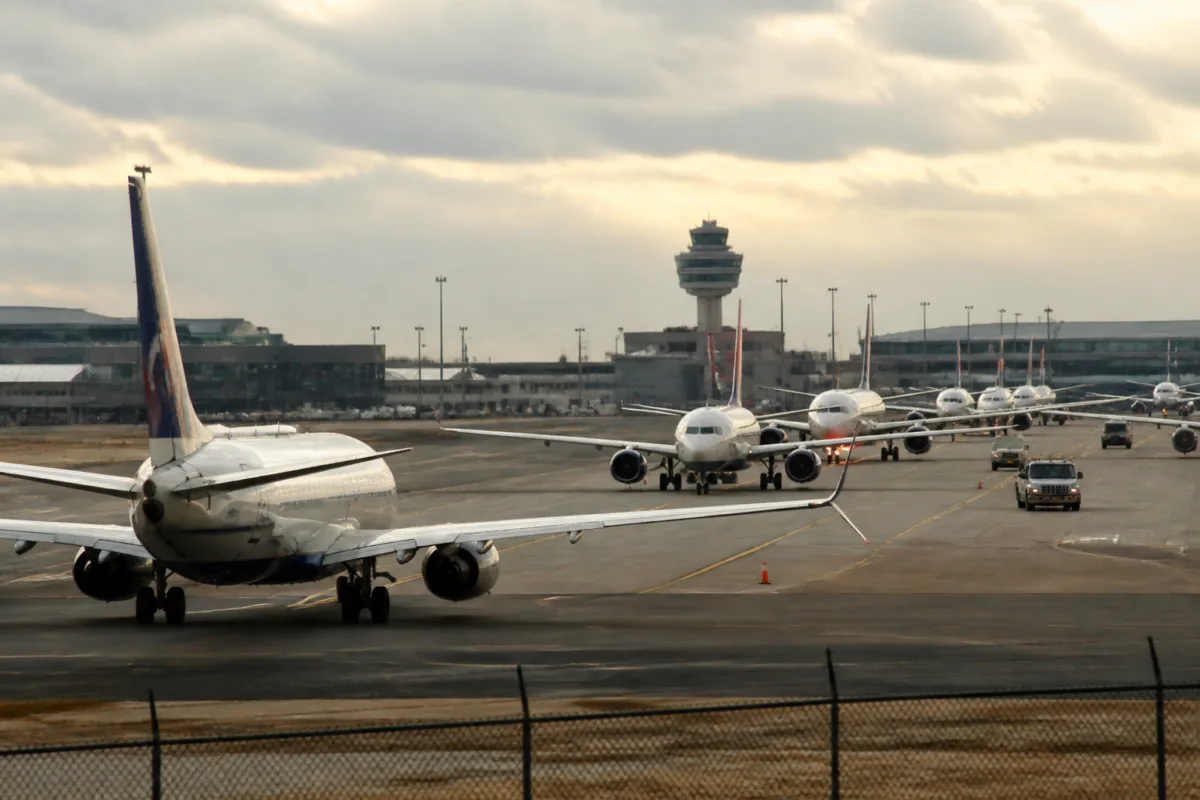
US air travel disruption caused by the longest nationwide ground stop in 25 years is expected to ease by the end of Sunday, Federal Aviation Administration Administrator Bryan Bedford said, although airlines continued to report cancellations and delays as they worked to restore normal schedules.
The ground stop lasted more than four hours on Friday after problems emerged during an upgrade to the US air traffic control system. Officials said new technology being added to the network overloaded antiquated equipment, creating intermittent communication and radar gaps. More than 3,000 aircraft that were already in the air landed safely when the grounding order was issued, according to Homeland Security Secretary Markwayne Mullin.
Airlines cancelled thousands of flights on Saturday as they attempted to reposition aircraft and rebook passengers affected by the disruption. Flight tracking company FlightAware reported more than 4,100 cancellations, while Cirium placed the number above 3,200. The disruption affected domestic services as well as flights operating to and from the United States, with delays and cancellations also recorded at London’s Heathrow Airport.
Transportation Secretary Sean Duffy said a contractor had been replacing part of the system’s old copper wiring with fibre-optic cable when the overload occurred. Officials were investigating whether contractor incompetence or a faulty wire caused the failure. Duffy said the incident was not connected to the FAA’s new artificial intelligence-powered system, which is being introduced to help identify problems in the airspace network.
The scale of the disruption was amplified by the way aircraft and crews are scheduled across the aviation system. Aviation consultant Andrew Charlton said the stoppage affected about a quarter of the 45,000 flights operating in the United States each day. Aircraft scheduled for one route are often required for several later services, meaning a delay at one airport can quickly affect domestic and international operations.
Passengers reported long waits at airports, aircraft held on the tarmac and difficulty finding replacement flights. Some travellers turned to buses, trains and hotel rooms after being unable to continue their journeys. Sports teams also changed match timings, arranged hotel accommodation, rescheduled flights and chartered buses. A college football game involving Mississippi and Oklahoma was delayed by a full day.
The FAA said airlines would continue to experience delays and cancellations while the backlog was cleared. Tim Johnson, consumer director at the UK Civil Aviation Authority, warned that follow-on disruption could continue as carriers rebook passengers and restore services. Officials said the ground stop was necessary because controllers could not reliably communicate with pilots, but stressed that no one was in danger during the incident.
The failure has renewed attention on the age of the US air traffic control system. The FAA began replacing thousands of copper wires with fibre-optic lines and upgrading hundreds of radio systems last year after Congress approved $12.5 billion for the overhaul. Duffy and the White House are seeking an additional $30 billion to complete the work. The FAA is expected to continue reviewing the outage and the contractor’s role as airlines work towards restoring their schedules by the end of Sunday.

