


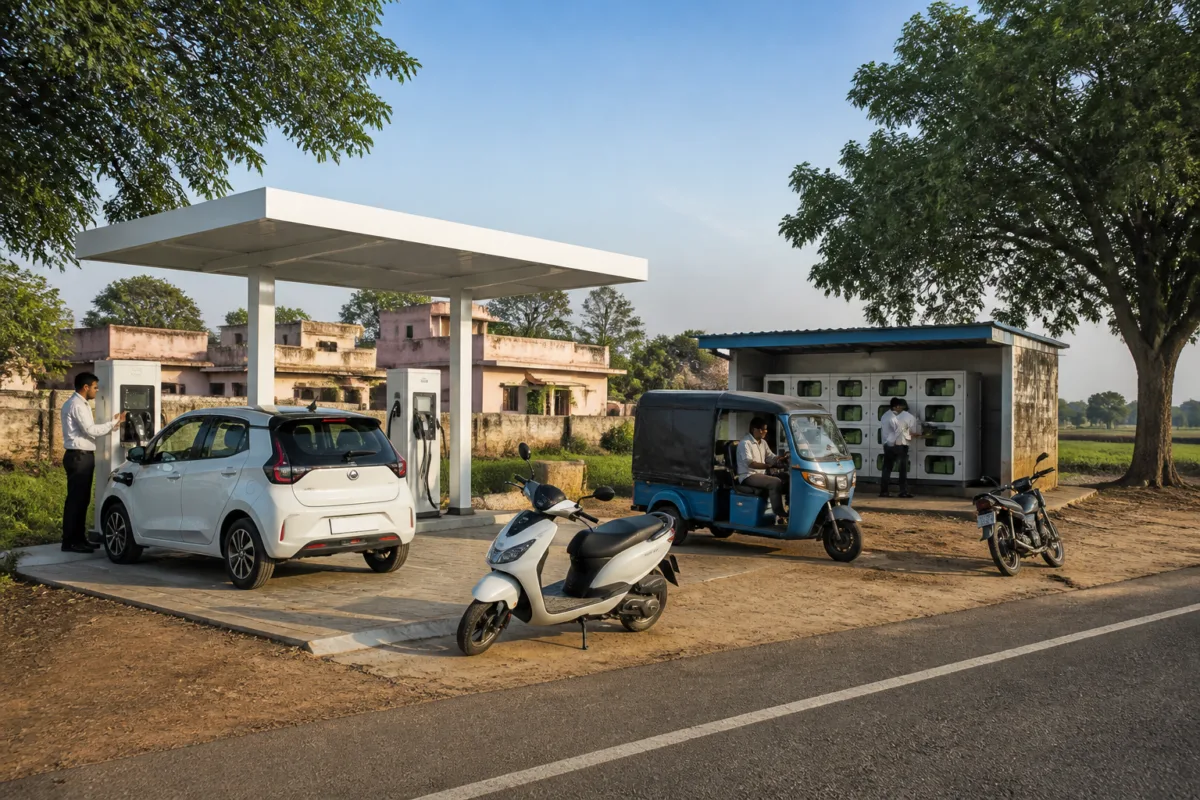
The Union ministry of Panchayati Raj and Convergence Energy Services Limited (CESL) have signed a memorandum of understanding to develop electric vehicle charging and battery-swapping facilities on gram panchayat-owned land across India, creating a potential new source of revenue for rural local bodies while expanding clean-mobility access beyond cities.
The collaboration covers gram panchayats, block-level bodies and district panchayats in states across the country. The MoU was exchanged recently in New Delhi, according to a report by The Times of India. It establishes a framework for the two organisations to explore the development of charging stations and battery-swapping facilities on land controlled by rural local governments.
CESL is a wholly owned subsidiary of Energy Efficiency Services Limited, which operates under the Union ministry of power. The Panchayati Raj ministry is responsible for the government side of the partnership. The arrangement brings together the institution overseeing rural local governance and a public-sector energy services company involved in energy-efficiency and clean-mobility initiatives.
Under the proposed model, underused public assets could be converted into facilities that serve electric two-wheelers, three-wheelers, four-wheelers and medium- and heavy-duty vehicles. The report does not identify the first locations, the number of stations planned, the investment required or a schedule for construction and commissioning. Those details are expected to depend on further exploration under the MoU framework.
For gram panchayats, the most significant feature is the possibility of generating Own Source Revenue, or OSR. Revenue from establishing and operating charging and battery-swapping facilities could provide rural local bodies with an additional income stream for local development activities and infrastructure. Unlike transfers and grants from higher levels of government, OSR is raised directly by local authorities, although the report does not specify the proposed ownership, operating or revenue-sharing arrangements for the facilities.
The initiative also places rural and semi-urban areas within the country’s expanding electric-mobility network. Charging access is particularly relevant for vehicles travelling between towns, villages and larger urban centres, while battery-swapping facilities could support vehicles that need shorter stoppages or operate intensively. The proposed coverage of multiple vehicle categories indicates that the infrastructure is intended to serve both individual users and commercial or transport-related demand.
The partnership is also linked to reducing carbon emissions and strengthening the enabling ecosystem for EV adoption outside major cities. However, the MoU itself is a framework for exploring the facilities rather than confirmation that stations are already operational. Further details on site selection, technical standards, financing, implementation responsibilities and timelines were not provided in the report. The next steps will determine how quickly panchayat-owned land can be assessed and converted into functioning charging or battery-swapping sites.

