


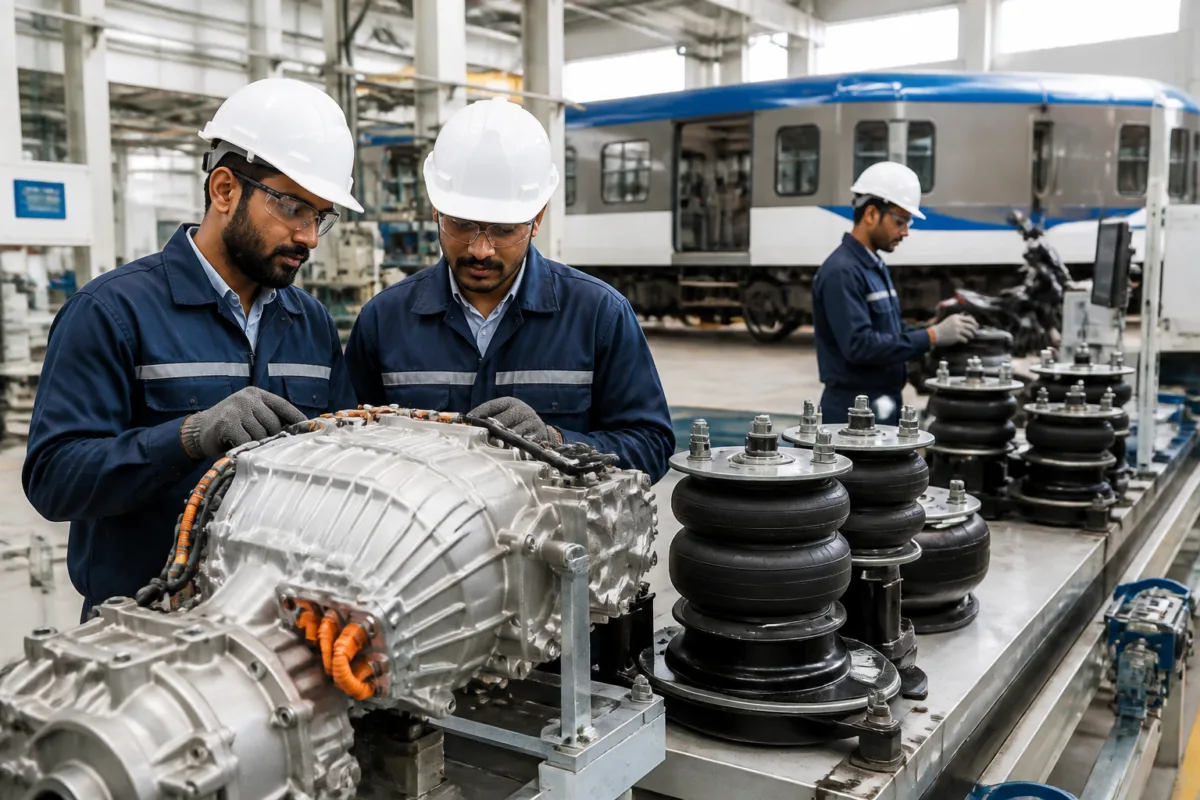
Sona Comstar’s plan to raise annual investment beyond its current ₹500-600 crore as the business expands is more than a company-growth update. It offers a view into the industrial capacity India will need if electric vehicles, railway modernisation and technology-led mobility are to scale together. The company’s investment pipeline covers research and development, capacity expansion, new capabilities and new processes, while its latest products span electric vehicles, railway coaches and two-wheelers.
The comments by Managing Director and Group CEO Vivek Vikram Singh, reported by PTI, place the company’s expansion within a broader shift in the mobility supply chain. Sona BLW Precision Forgings Ltd, commonly known as Sona Comstar, is not limiting its product development to one vehicle segment. Its three products commercialised during the September quarter included a helical limited slip differential for electric vehicles, air springs for railway coaches and rear radar sensors for two-wheelers.
That combination matters because urban mobility is not built around one technology. Cities depend on multiple transport systems operating at different scales: private and shared electric vehicles on roads, railway networks carrying large passenger volumes, and components that make vehicles safer, more efficient or more reliable. A supplier capable of working across these segments can participate in several parts of that transition. But the company’s own comments also show that this opportunity depends on whether Indian manufacturers can develop the design, engineering and production capabilities required by global customers.
Singh said annual investment is currently around ₹500-600 crore and should increase as the company grows over the decade. He said the spending would cover research and development, capacity additions, capability additions and new processes, including the development of entirely new products. The statement does not provide a new investment figure or a specific timetable, but it establishes the direction of travel: future spending is expected to rise with the company’s operating scale.
The company’s recent financial and order numbers provide the immediate context. Consolidated profit rose 31 per cent to ₹223 crore in the September quarter, from ₹170 crore a year earlier. Revenue from operations increased to ₹1,535.84 crore from ₹1,138.29 crore during the July-September period of the previous fiscal year. Sona Comstar also secured new orders worth ₹3,600 crore during the quarter, its third-best quarter in terms of order bookings.
Those orders will not translate into revenue at one uniform pace. Singh said the conversion would depend on the stage of vehicle development and model cycles. This is an important distinction in interpreting order-book announcements. An order indicates future business potential, but the timing of production and revenue depends on when vehicle programmes move from development into manufacturing. For cities and mobility planners, that means industrial readiness cannot be measured only by announced demand; production capacity and programme execution are equally important.
The company’s product mix illustrates that distinction. The helical limited slip differential is associated with electric vehicles, while air springs are used in railway coaches and rear radar sensors support two-wheeler applications. These are different components serving different transport needs. Together, they show how the mobility transition is creating demand not only for complete vehicles but also for specialised systems embedded within them.
Sona Comstar’s battery-electric vehicle revenue, excluding hybrids, grew 129 per cent year-on-year in the second quarter and accounted for 51 per cent of its automotive revenue, according to the report. Singh said the pace of electric-vehicle adoption in India had been faster than the company expected. The figures indicate that electric mobility is already a significant part of the company’s automotive business, although they do not by themselves establish the rate of EV adoption across the entire Indian market.
The company expects India to remain its largest geography by contribution even as it expands internationally. India currently accounts for around 50 per cent of its business, and Singh expects that share to remain in the 50-55 per cent range. He said orders already won would begin converting, North America should see good growth the following year and India would keep pace.
This geographic balance is relevant to the question of how India benefits from global supply-chain diversification. Singh said companies were looking to diversify supply chains away from China and that India could gain significantly, but only if domestic suppliers developed the necessary design and manufacturing capabilities. He specifically identified design capability and manufacturing quality as requirements for Indian suppliers seeking to take on that business.
The implication is that supply-chain relocation is not an automatic consequence of global companies seeking alternatives. It creates an opportunity, but the opportunity must be supported by firms able to meet product, engineering, quality and delivery requirements. Singh also pointed to the need for wider improvement in manufacturing standards across the domestic supplier ecosystem if India is to attract more business and production volumes.
For urban infrastructure, this is a less visible but important layer of capacity. New mobility systems are often discussed through vehicles, corridors, stations and charging infrastructure. Yet their reliability also depends on the availability of specialised components and the ability to manufacture them at scale. A railway coach air spring, an EV drivetrain component or a two-wheeler radar sensor may not be visible to passengers, but each forms part of the technical system on which transport services depend.
The company’s railway-related product is particularly relevant to the built environment because it links an automotive supplier’s expansion to rail equipment. The available information does not specify the railway customers, volumes or deployment locations, so the product should not be treated as evidence of a particular railway project. It does, however, show that the company is extending its commercialised product portfolio beyond automotive applications into railway coaches.
The same caution applies to the company’s acquisition plans. Singh said Sona Comstar was evaluating opportunities to strengthen its capabilities, including in technology-related areas, but that there was nothing reportable at present. He described mergers and acquisitions as something the company was considering seriously while emphasising the importance of deciding not only what to pursue but also what not to pursue. No acquisition, target or transaction has been announced in the supplied report.
This leaves investment and capability-building as the central confirmed themes. Sona Comstar is reporting growth in revenue, profit, orders and battery-electric vehicle business while preparing to increase spending on research, capacity and new processes. Its strategy also reflects the way mobility manufacturing is becoming more technology-intensive: companies are competing not only on production volume but on their ability to design and commercialise components for changing vehicle platforms.
The larger urban question is whether India’s transport transition can be supported by a sufficiently deep domestic supplier ecosystem. The evidence in this case does not establish that the challenge has been solved. It shows a company expanding across EV, railway and two-wheeler applications, while its leadership identifies design capability, manufacturing quality and ecosystem-wide standards as conditions for capturing future demand.
The next developments to watch are therefore concrete rather than speculative: whether the ₹3,600 crore order book converts into revenue as vehicle programmes advance, whether annual investment rises above the current ₹500-600 crore level, how the three newly commercialised products scale, and whether the company reports any technology-related acquisition. These milestones will show whether India’s mobility manufacturing opportunity is translating into sustained industrial capacity.

