


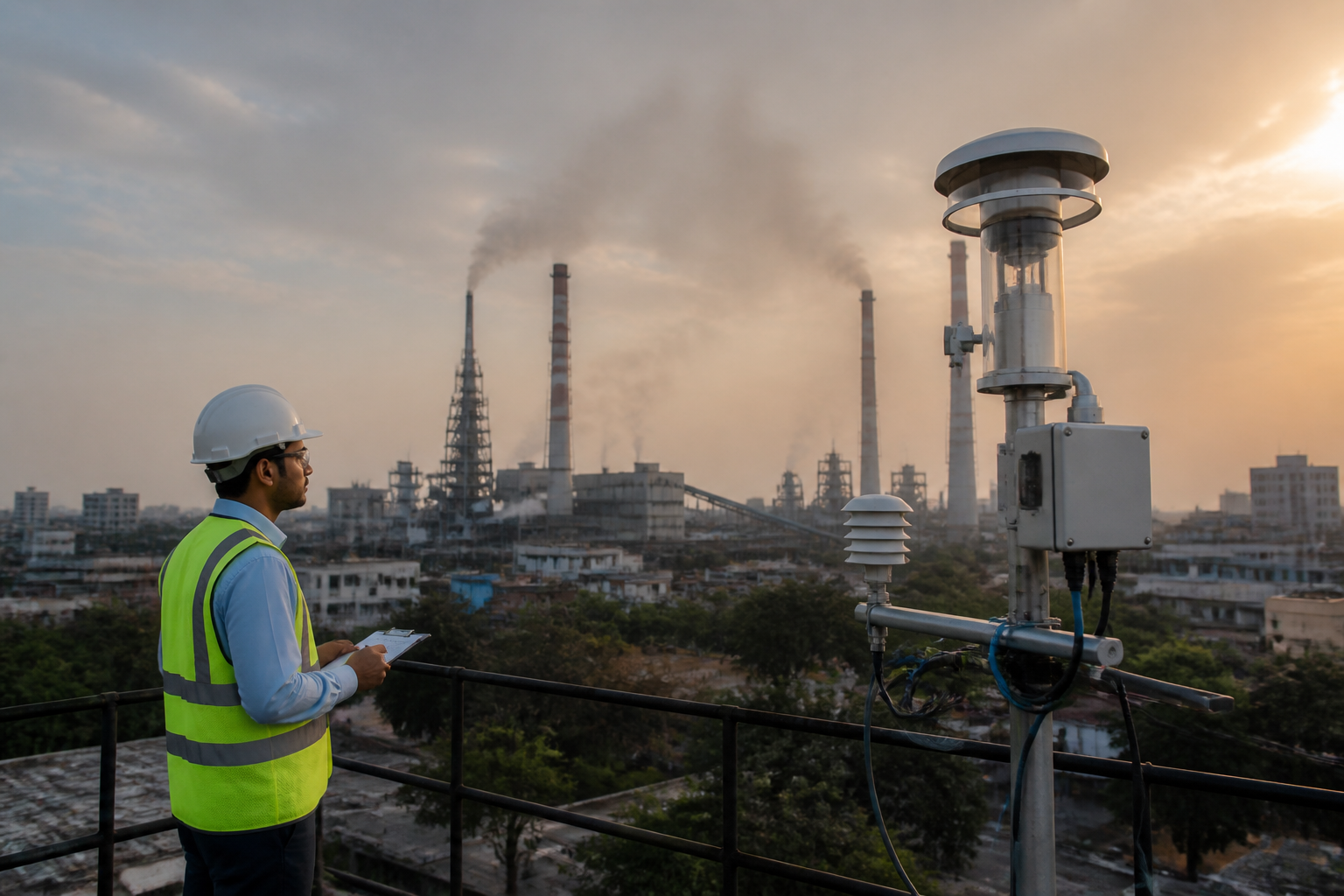
The emissions trading scheme developed in Gujarat is gaining international attention, but its most important test may be closer to home. As Rio de Janeiro examines whether to adapt the approach for industrial particulate pollution, Delhi-NCR has an opportunity to study a model that attempts to make cleaner production economically attractive rather than relying only on inspections, penalties and shutdowns.
The idea began nearly 15 years ago, when economists, engineers and regulators in Gujarat started examining whether factories could be persuaded to cut pollution without fearing closure. The resulting system was piloted in Surat in 2019 by researchers affiliated with the Energy Policy Institute at the University of Chicago and J-PAL, in collaboration with the Gujarat Pollution Control Board.
Its central premise is straightforward. Regulators establish a maximum pollution limit for an industrial cluster and divide that limit into permits. A factory that reduces emissions beyond its target can sell its surplus permits to another plant for which pollution reduction is more difficult or expensive. The overall pollution cap remains in place, while firms receive flexibility in deciding how to comply.
That design differs from the conventional approach described in the report, where industrial pollution control has largely depended on periodic inspections and shutdown notices when plants breached emission limits. The emissions trading model does not remove regulation. Instead, it changes the incentive structure within regulation by allowing cleaner factories to earn from their performance and giving other plants a market-based route to meet their obligations.
The Surat pilot created a comparison between the two systems. It covered 162 of Gujarat’s 317 large coal-burning industrial plants, while the remaining plants continued under conventional regulation. Researchers used the two groups to assess whether the trading system produced different results.
The findings reported from the randomised trial were significant. Participating plants cut particulate emissions by 20% to 30% and reduced pollution-control costs by 11%. Compliance reached 99%, compared with roughly two-thirds under conventional regulation. Researchers estimated that the benefits exceeded the costs by at least 25 times.
The emissions reductions were also sustained during the study. A typical plant operating under conventional conditions emitted around 1,300 kilograms of particulate matter a month. Similar industries operating under the emissions trading scheme reduced emissions to roughly 900 to 1,000 kilograms a month. The 20% to 30% reduction continued across all 10 compliance periods during the study, which ran for nearly two years from April 2019 to 2021.
These numbers matter because they address two concerns that frequently complicate industrial pollution control: whether firms will comply and whether cleaner production will impose costs that make regulation economically difficult. In the Surat experiment, the reported result was not only lower pollution but also lower pollution-control costs and higher compliance.
The system’s institutional design appears to have been important. Michael Greenstone, co-chair of the Emissions Market Accelerator and one of the four researchers who worked with the Gujarat Pollution Control Board, described the approach as having been made, tested and successfully implemented in India. Dr Kaushik Deb, the organisation’s executive director, said the challenge was to persuade industrial units that cleaner air did not have to come at the expense of growth.
Deb said the first reaction from industry was to question the need for another form of regulation. The scheme was then designed so that there were no losers, according to his account. He also said that only one industrial closure had occurred under the system in seven years. Those claims are important to the model’s political and administrative appeal, although they remain statements attributed to the programme’s leadership in the supplied report rather than an independent assessment of every aspect of its implementation.
The reported reach of the programme has expanded beyond the original experiment. It now covers a population of nearly 300 million across the country and is being extended to sulphur dioxide and wastewater pollution. The model has also inspired similar programmes in Maharashtra and Rajasthan, indicating that the institutional experiment is no longer confined to one industrial cluster in Gujarat.
Its international movement adds another layer to the story. Rio de Janeiro has signed a letter of intent to examine adapting the approach to its own pollution challenges. If implemented, the city would become South America’s first emissions trading system for industrial particulate pollution. The proposal therefore represents more than a transfer of technology or regulation. It is an attempt to transfer an institutional mechanism developed in one place to another city facing a different industrial and administrative context.
The route to that global attention also shows how environmental ideas move through institutions. The Gujarat programme became an Earthshot Prize finalist in 2025. The prize, founded by Prince William, identifies and supports the scaling of environmental solutions. According to Bala Srinivasan, co-chair of the Emissions Market Accelerator, the recognition increased global exposure and helped open conversations beyond India, including in Rio de Janeiro. The prize is also preparing to come to Mumbai later this year, potentially bringing further attention to the Indian experiment.
For Delhi-NCR, however, the most relevant question is not whether the Gujarat system can simply be copied. The region’s air pollution problem is more complex than the industrial cluster addressed in Surat. The report itself cautions that the Gujarat model cannot be transplanted without adaptation. Delhi-NCR’s pollution crisis is discussed in the context of repeated winter episodes, restrictions and friction between pollution control and economic activity. An industrial emissions market would therefore address only one part of a wider problem.
That limitation is central to understanding what the Gujarat experience does and does not establish. The Surat trial provides evidence that an emissions trading system can reduce particulate emissions from participating industrial plants while lowering pollution-control costs and improving compliance. It does not, on the evidence supplied, establish that the same mechanism can resolve Delhi-NCR’s overall air pollution problem or manage emissions across every sector.
The institutional responsibilities would also have to be clearly defined. In Gujarat, the pilot operated with the Gujarat Pollution Control Board and researchers from the Energy Policy Institute at the University of Chicago and J-PAL. Any adaptation for Delhi-NCR would require regulators to establish the pollution cap, allocate or manage permits, measure emissions, monitor compliance and maintain confidence in the trading system. The supplied material does not identify a Delhi-NCR framework for doing so, nor does it report a formal decision to introduce such a scheme in the region.
The data from Surat nevertheless changes the terms of the policy debate. A system that achieved 99% compliance in the pilot, compared with roughly two-thirds under conventional regulation, suggests that enforcement may be strengthened when firms are given flexibility in how they reduce emissions. The 11% reduction in pollution-control costs further suggests that compliance does not necessarily have to be treated as a simple contest between environmental protection and industrial activity.
The scale of the reported benefits is also notable. If the researchers’ estimate that benefits exceeded costs by at least 25 times is sustained under scrutiny, the experiment offers a powerful case for testing market-based environmental regulation in other settings. But that conclusion depends on the quality of monitoring, the accuracy of emissions measurement and the credibility of the regulator that maintains the cap. Those implementation details are not peripheral; they determine whether a trading system produces real reductions or only creates a formal market around uncertain pollution data.
The Gujarat experience therefore presents Delhi with a policy question rather than a ready-made solution. Can industrial emissions be reduced more consistently when factories compete to pollute less, instead of responding mainly to inspections and closure threats? The evidence from Surat indicates that this approach can work within the setting studied. The difference between that evidence and a Delhi-NCR application is the institutional and environmental scale that would have to be addressed.
What is established is that the Gujarat emissions trading scheme produced measurable reductions in particulate emissions, lower reported pollution-control costs and higher compliance in a controlled pilot. It has since expanded across states and into discussions abroad. What remains uncertain is whether the model can be adapted to Delhi-NCR’s more complex pollution profile, and whether the necessary regulatory, measurement and enforcement arrangements can be built. Those are the questions that will determine whether an idea made in Gujarat becomes a broader urban pollution-control instrument or remains a successful but context-specific experiment.
