


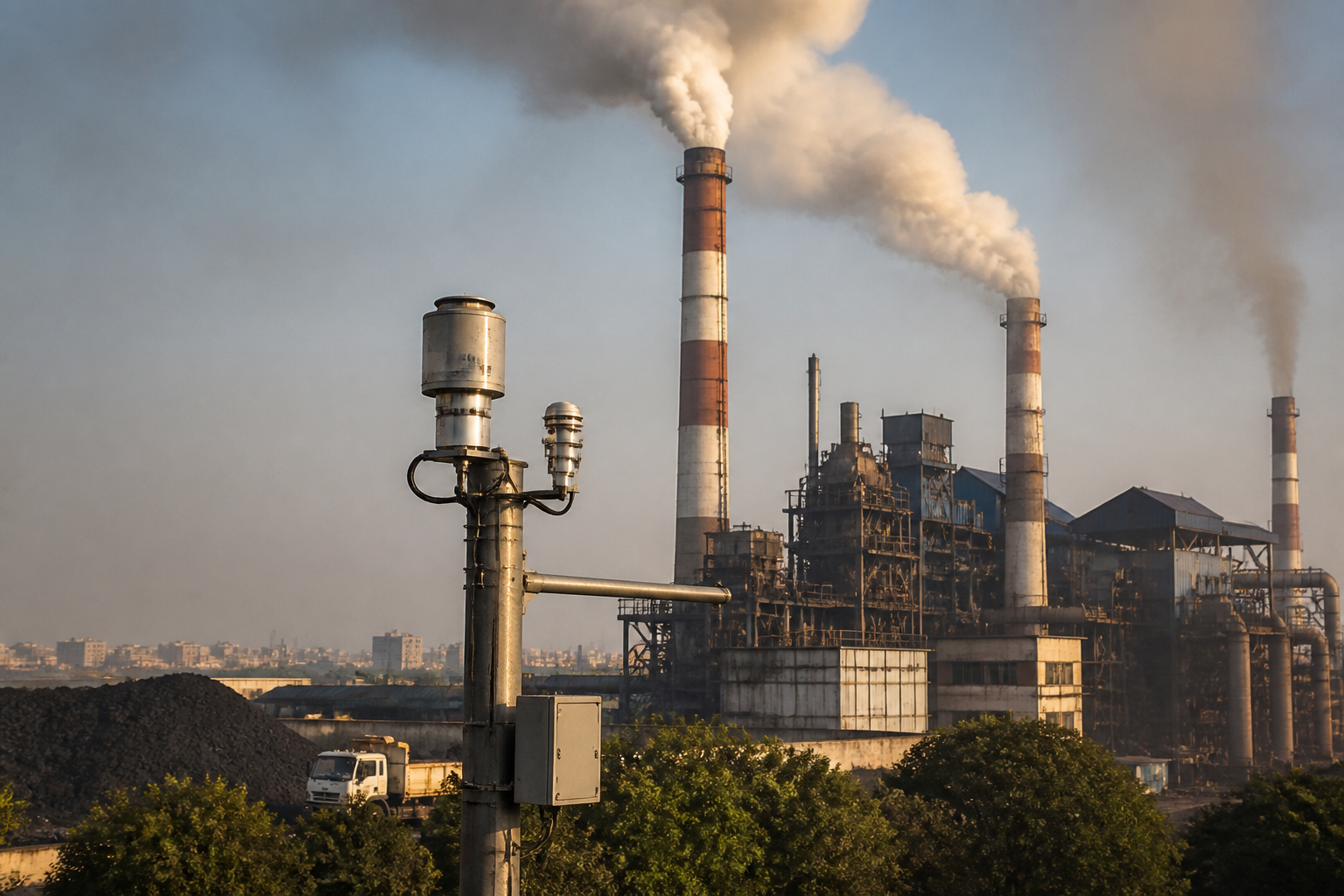
Gujarat’s emissions trading scheme is moving from an industrial experiment in Surat to an international policy conversation, with Rio de Janeiro examining whether the model can be adapted for its own particulate pollution challenge. For Delhi-NCR, where air-quality controls repeatedly collide with industrial activity, the more important lesson is not that one programme can be transplanted wholesale, but that pollution regulation can be designed around incentives as well as penalties.
The scheme emerged from a question that has shaped environmental regulation for decades: can factories be made to reduce emissions without treating shutdowns as the primary enforcement tool? Researchers, engineers and regulators in Gujarat began working on that question nearly 15 years ago. The resulting emissions trading system set a pollution cap for an industrial cluster and allowed factories to trade permits according to their performance.
Under the model, a factory that reduces emissions beyond its target can sell its surplus permits to another plant for which compliance is more difficult or expensive. The overall pollution limit remains fixed, while individual firms receive flexibility in how they meet their obligations. This shifts the regulatory focus from treating every industrial unit identically to creating an economic reason for cleaner performance.
That distinction matters for Delhi-NCR because its pollution problem is spread across multiple sources and jurisdictions. The Gujarat experiment dealt with a defined industrial cluster, while the national capital region faces a wider combination of emissions and seasonal pressures. The supplied evidence does not establish that an emissions market alone could address Delhi-NCR’s air pollution, but it does show why the design of industrial regulation is relevant to the region’s policy debate.
The Surat pilot began in 2019 with researchers affiliated with the Energy Policy Institute at the University of Chicago and J-PAL working with the Gujarat Pollution Control Board. It covered 162 of Gujarat’s 317 large coal-burning industrial plants. The remaining plants continued under conventional regulation, creating a comparison between the emissions trading approach and the existing system.
The results reported from the randomised trial were significant. Participating plants cut particulate emissions by 20% to 30% and reduced pollution-control costs by 11%. Compliance reached 99%, compared with roughly two-thirds under conventional regulation. Researchers estimated that the benefits exceeded the costs by at least 25 times.
The reported emissions figures provide a clearer picture of the change. A typical plant under conventional conditions emitted about 1,300 kilograms of particulate matter a month. Similar industries operating under the emissions trading scheme reduced emissions to roughly 900 to 1,000 kilograms a month. The reduction remained visible across all 10 compliance periods during the nearly two-year study, which ran from April 2019 to 2021.
The durability of that reduction is important because environmental regulation often struggles when compliance depends on periodic inspections. The Gujarat model did not remove regulation or the need for monitoring. Instead, it added a market mechanism that allowed factories to choose the least expensive route to meeting the collective pollution limit. Plants able to reduce emissions at lower cost could benefit financially, while others could purchase permits rather than immediately face a shutdown.
That design also appears to have addressed an institutional problem: the perception among industrial units that environmental regulation is primarily a threat to production. Michael Greenstone, co-chair of the Emissions Market Accelerator and one of the researchers involved in the experiment, described the system as an approach made, tested and successful in India. Kaushik Deb, the organisation’s executive director, said the challenge was to persuade industrial units that cleaner air did not have to come at the expense of growth.
According to Deb, only one industrial closure occurred under the system in seven years. The figure, as reported, points to a regulatory approach that sought to reduce pollution while retaining industrial operations. It does not mean that closures or penalties become unnecessary. Rather, it suggests that compliance can be structured so that firms have an incentive to invest in pollution reduction before enforcement reaches its most disruptive stage.
The programme has since expanded to cover a population of nearly 300 million and is being extended to sulphur dioxide and wastewater pollution, according to the report. These developments indicate that the model is no longer limited to particulate emissions in one industrial cluster. They also raise a more difficult implementation question: whether the same administrative capacity, measurement systems and enforcement credibility can be maintained as the programme expands across pollutants and locations.
That question is particularly relevant to Delhi-NCR. The region’s air pollution crisis is not confined to a single industrial market, and its sources do not fall neatly under one authority. Industrial emissions are only one part of the wider problem described in the report. The Gujarat experience can therefore offer a regulatory lesson, but not a ready-made blueprint.
The institutional structure behind the Gujarat pilot is central to understanding its outcome. The programme depended on collaboration between researchers, the Gujarat Pollution Control Board and participating factories. It also depended on comparing the pilot group with plants that remained under conventional regulation. Without that comparison, it would be harder to distinguish the effect of the emissions trading system from broader changes in industrial behaviour or enforcement.
The Surat results also show that environmental policy is partly a question of administrative design. A limit on total pollution establishes the public objective. Tradable permits determine how firms share the burden of reaching that objective. Monitoring and compliance systems determine whether the market reflects actual emissions. The reported 99% compliance rate suggests that the system performed strongly in the pilot, but the supplied material does not provide further details about its monitoring technology, permit pricing or enforcement procedures.
The model’s international attention has added another layer to its policy journey. Gujarat became an Earthshot Prize finalist in 2025, bringing wider visibility to the programme. The prize’s international exposure helped open conversations beyond India, including with Rio de Janeiro, which has signed a letter of intent to examine adapting the approach. If implemented, Rio would become South America’s first emissions trading system for industrial particulate pollution.
The route from Gujarat to Rio is significant not because it proves that every city can use the same system, but because it demonstrates that a policy developed within an Indian regulatory setting is being considered elsewhere. The model’s value lies partly in its institutional origin. It was designed around the practical problem of persuading existing industrial facilities to reduce emissions, rather than assuming that pollution could be solved only through plant closures or uniform mandates.
For Delhi-NCR, this creates a potentially useful but bounded policy question. Can industrial emissions be regulated through a system that rewards firms for reducing pollution while maintaining a fixed overall cap? The Gujarat evidence suggests that such a system can lower particulate emissions, reduce compliance costs and improve adherence in a defined industrial setting. It does not establish how the approach would perform across Delhi-NCR’s more complex geography, regulatory responsibilities and pollution sources.
The difference between the two settings should not be treated as a technical footnote. Surat’s pilot covered 162 large coal-burning industrial plants within a defined comparison framework. Delhi-NCR is a metropolitan region with multiple jurisdictions and a broader pollution profile. Any adaptation would therefore require decisions about which industries and pollutants to include, how a regional cap would be established, and which authority would oversee compliance. The supplied material does not indicate that such a system has been approved for Delhi-NCR.
The evidence does, however, challenge a familiar assumption in pollution control: that economic activity and cleaner air must always be treated as opposing objectives. In Gujarat, the reported reduction in pollution-control costs and the high compliance rate suggest that flexibility helped participating factories meet environmental obligations more efficiently. The economic mechanism did not replace the environmental target; it changed how firms were expected to reach it.
That is the larger urban governance issue. Air pollution is experienced by residents across city boundaries, but the rules governing industrial facilities are implemented through institutions, permits, inspections and enforcement systems. A regulation’s success depends not only on the strictness of its stated limit, but also on whether firms can understand it, comply with it and face credible consequences when they do not.
The Gujarat experience confirms that an emissions trading scheme can produce measurable reductions in particulate pollution in a controlled industrial setting. It also shows that an incentive-based system can attract international interest and expand beyond its original application. What remains uncertain is whether the model can be adapted to Delhi-NCR without losing the monitoring discipline, comparison framework and administrative clarity that supported the Surat pilot. Those will be the critical issues to watch as India’s environmental policy experiment travels from a Gujarat industrial cluster to other states and cities abroad.
