


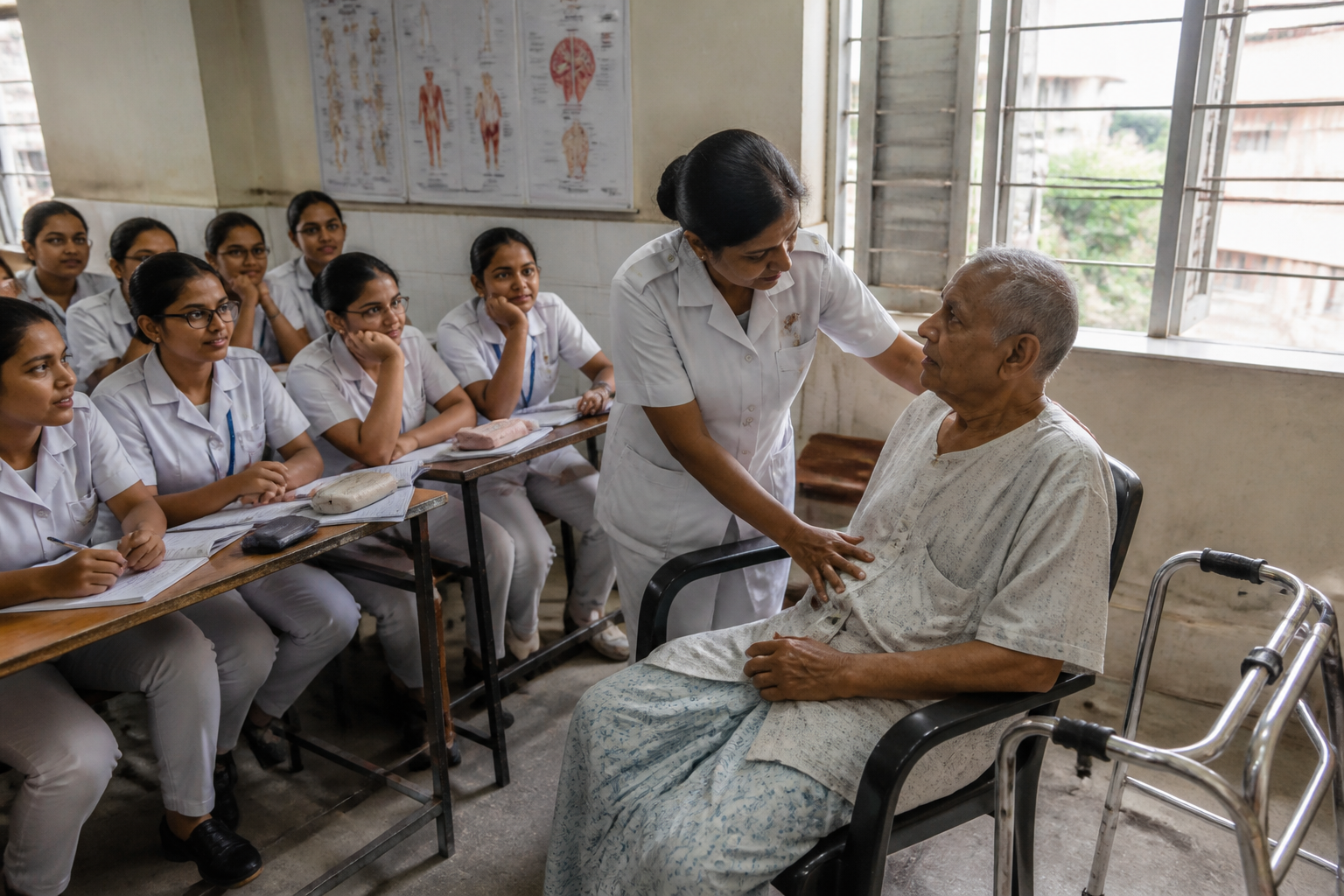
A workshop at Kolkata Medical College has placed elderly care training at the centre of a larger public-health challenge in West Bengal: as the state’s senior population grows and joint families decline, hospitals are increasingly expected to provide not only medical treatment but also the patience, communication and support that many older patients may no longer receive at home.
The workshop was organised jointly by the Regional Geriatric Centre at Kolkata Medical College, its nursing department and the National Institute of Social Defence under the Union Ministry of Social Justice and Empowerment. Held ahead of International Older Persons Day on 1 October, the programme trained nurses from government hospitals in behavioural skills for treating people aged 60 and above.
The central message was that elderly care cannot be reduced to administering medicines. Nurses were told to engage with older patients more empathetically, understand their emotions and communicate in ways that recognise the physical and psychological difficulties associated with ageing. The emphasis on behaviour is significant because hospitals are often the point at which families, caregivers and public institutions meet when an older person becomes dependent on formal care.
According to the report by Sangbad Pratidin – Kolkata, a research officer associated with the National Institute of Social Defence said that West Bengal’s elderly population is increasing because of advances in medical science. At the same time, the decline of joint families and the spread of nuclear households are reducing the availability of family-based care. The result is a growing requirement for trained caregivers, particularly for older people who need support beyond a clinical prescription.
This changes the meaning of elderly care in public hospitals. A senior patient may arrive with more than one illness, difficulty in movement, anxiety, hearing or communication challenges, and dependence on another person for basic tasks. The report does not provide a detailed clinical profile of such patients, but it makes clear that the workshop’s organisers view communication and emotional sensitivity as part of treatment rather than as optional additions to it.
Dr Arunangshu Talukdar, head of the geriatric medicine department at Kolkata Medical College, said communication between nurses and elderly patients needs to be strengthened. He said nurses must be able to understand an older person’s emotions and feelings and appropriately manage and use that understanding while providing treatment. The institutional message is straightforward: a hospital’s capacity is shaped not only by beds, doctors and equipment, but also by the quality of interaction between staff and patients.
Kolkata Medical College is described in the report as having the only geriatric medicine department in eastern India. That position gives the institution a specialised role in training and demonstrating how elderly care can be integrated into public healthcare. It also points to the uneven distribution of geriatric expertise. When specialist capacity is concentrated in one institution, the ability of other hospitals to respond to the needs of older patients depends heavily on general staff training and referral arrangements.
The workshop therefore sits at the intersection of specialised medicine and ordinary hospital operations. Most elderly patients will interact with nurses, attendants and general hospital services before or beyond the narrow moment of consultation with a specialist. Training these frontline workers can influence how quickly concerns are recognised, how instructions are communicated and whether a patient’s distress is treated as a clinical issue or dismissed as an unavoidable consequence of age.
The report also raises a more serious question about the use of physical restraints. It says that some older patients are restrained by tying their hands and legs during treatment because of various physical conditions. Dr Debashis Das, head of the community medicine department at Kolkata Medical College, said there is a policy governing the issue and that such restraint is completely illegal.
This is the most consequential part of the workshop’s message because it moves elderly care from the language of courtesy into the domain of rights and institutional accountability. If a hospital uses restraint, the issue is not only whether staff are sufficiently compassionate. It is also whether procedures, supervision and safeguards are being followed. The report does not identify a specific incident, hospital or number of cases, so it does not establish the scale of the practice. But the warning indicates that training must be accompanied by awareness of rules and accountability for violations.
The institutional network described in the report is divided across different levels of government. The National Institute of Social Defence, under the Union Ministry of Social Justice and Empowerment, works on issues concerning older people across the country. Kolkata Medical College contributes specialised medical and nursing capacity. Government hospitals provide the setting in which these responsibilities become operational. The quality of elderly care therefore depends on coordination between social-welfare institutions, medical colleges, hospital administrations and frontline staff.
The report also refers to a national helpline for senior citizens, 14567, operated by the Union Ministry of Social Justice and Empowerment. It says West Bengal has not been receiving the benefit of the service because a memorandum of understanding was not signed by the earlier government. That claim is attributed to the report and is not independently documented in the supplied material. Its significance, however, lies in the access question it raises: a helpline has limited public value if older residents, families and local agencies cannot connect to it through a functioning state-level arrangement.
The same access problem applies to welfare schemes. The report says that the central government operates several programmes for older people, including Rashtriya Vayoshri Yojana. Under the scheme, elderly people listed below the poverty line may receive items such as walking sticks, spectacles and commodes, among 17 types of necessary equipment. It also refers to special old-age homes for elderly people living below the poverty line.
These provisions show that elderly care is not confined to hospitals. Mobility aids can determine whether an older person can move safely inside a home or reach a health facility. A commode can reduce dependence and improve dignity. Residential care can become essential when family members are unavailable or unable to provide support. Yet the report does not establish how many West Bengal residents receive these benefits, how applications are processed or whether the services are available across districts. Those unanswered administrative questions are central to whether welfare policy translates into practical support.
The shift from joint to nuclear families makes this delivery challenge more urgent. The report identifies a shortage of caregivers as a reason older people are facing difficulties. It does not claim that every nuclear family is unable to care for older relatives, nor does it quantify the number of affected households. But it identifies a structural change in the social organisation of care. When family support becomes less available, the responsibility moves towards hospitals, community services, assisted living arrangements, helplines and trained care workers.
That transfer cannot be managed by hospitals alone. A hospital can diagnose and treat a patient, but it may not be able to provide long-term assistance after discharge. A helpline can receive a call, but its effectiveness depends on referral and response systems. Welfare equipment can be sanctioned, but its impact depends on identification, distribution and maintenance. Old-age homes can provide accommodation, but their availability and standards determine whether they are a meaningful option. The supplied report presents these elements as separate initiatives; together, they form the early outline of an elderly-care system.
The workshop’s focus on nurses is important because nurses are central to the daily experience of hospital care. They are often the staff members who explain procedures, observe changes in a patient’s condition and manage routine needs. Training that improves communication can make treatment easier to understand and may help staff respond more appropriately to fear, confusion or dependence. However, the report does not provide details about the number of nurses trained, the duration of the programme, its curriculum or plans to extend it to other hospitals.
Those details will determine whether the workshop remains a one-time event or becomes part of a wider institutional response. The report records the participation of a specialised medical college, its nursing department and a national social-defence institute, but it does not establish a statewide implementation plan. It also does not provide data on elderly patients in West Bengal, the number of geriatric beds, caregiver vacancies, helpline usage or access to welfare schemes.
What the event does establish is that ageing is becoming a public-service question for West Bengal. Medical progress may allow people to live longer, while social changes may reduce the availability of traditional family care. Public hospitals must therefore deal with a patient group whose needs include clinical treatment, mobility assistance, respectful communication, protection from unlawful restraint and support beyond the hospital’s walls.
The next test will be whether the institutions involved can convert the workshop’s message into routine practice. That would require clarity on training coverage, hospital protocols, the enforcement of restraint rules, access to the 14567 helpline, distribution of welfare equipment and the availability of care facilities. The evidence supplied for this report does not show how far those systems have progressed. It does show why elderly care can no longer be treated as a narrow medical speciality or an issue left entirely to families.
