


Kerala’s new senior citizen welfare framework is significant not simply because the state has signed memoranda of understanding with 12 institutions, but because it attempts to treat ageing as a community, governance and economic question. The proposed model combines healthy ageing, local care systems, caregiver training, research, social security and the use of retired professionals in the silver economy. Its success will depend on whether these ideas become functioning services at the panchayat level rather than remaining a collection of institutional commitments.
The department of senior citizens has entered into MoUs with 12 institutions covering five areas: healthy ageing, community-based care, the silver and care economies, research-driven policymaking, and social security and rights. The participating organisations include health and mental-health institutions, social-science colleges, legal and development bodies, research organisations and groups working in public health and social development.
The arrangement brings together the Institute of Mental Health and Neurosciences, Dementia India Alliance, Public Health and Social Development Foundation, Health Action by People, Rajagiri College of Social Sciences, Kerala Association of Professional Social Workers, Loyola College of Social Sciences, Swasti – The Health Catalyst, Centre for Management Development, Centre for Socio-Economic and Environmental Studies, Bharata Mata Extension for Organic Research and Environment, and the National University of Advanced Legal Studies.
That composition is important because elderly welfare rarely fits within one department. Physical health, dementia, mental well-being, legal protection, social work, income security and household care are closely connected. A medical intervention cannot by itself address loneliness or abandonment, just as a legal remedy cannot replace regular assistance with daily activities. The MoUs, as reported, recognise this overlap by linking institutions with different areas of expertise.
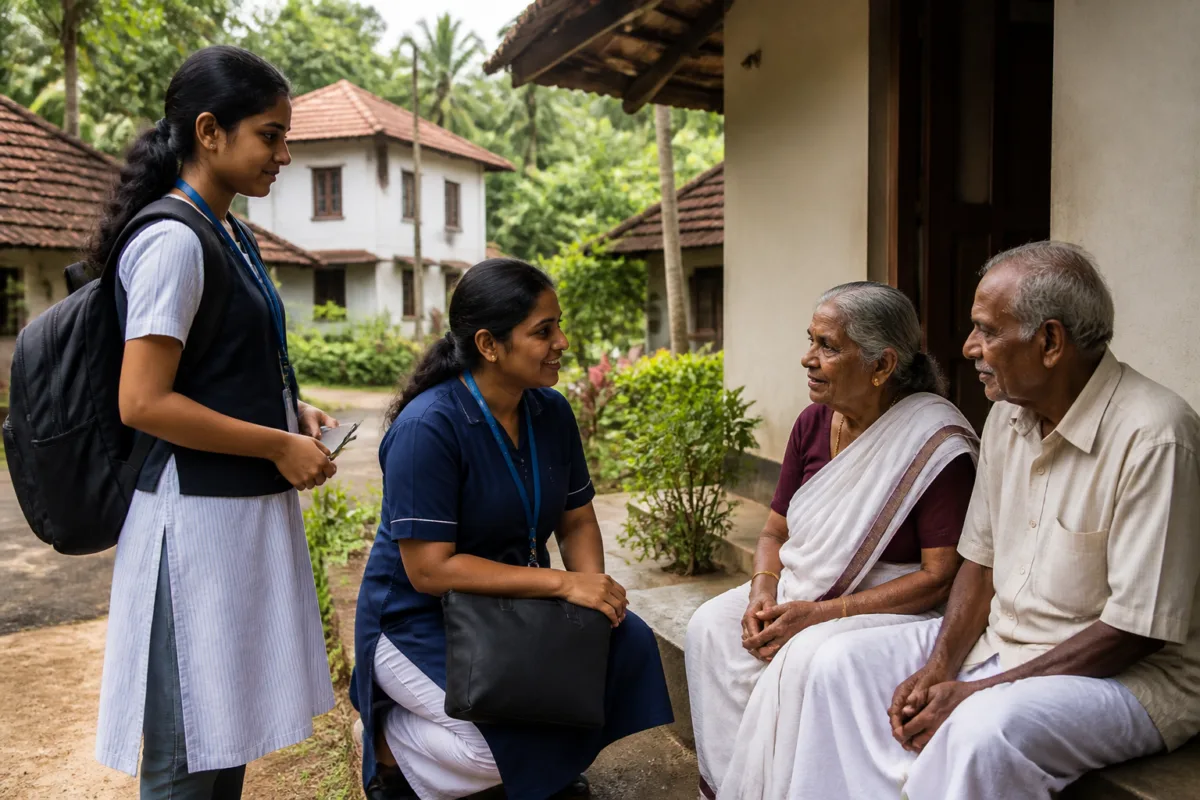
The proposed administrative mechanism is a database of senior citizens requiring care, including information on their mental-health status and medical conditions. The database is to be prepared at the panchayat level and updated periodically. This places local self-government institutions at the centre of identifying need and designing targeted welfare programmes.
A local database can potentially change how elderly welfare is delivered. Instead of relying only on general schemes or families to seek help, local institutions would have a structured picture of residents who require support. However, the available report does not specify the database’s design, privacy safeguards, eligibility criteria, staffing arrangements, funding or the department responsible for maintaining the records. Those details will determine whether the system becomes a usable service-delivery tool or merely another administrative register.
The panchayat-level approach also reflects the geography of care. Elderly residents do not experience welfare through a state department alone. They encounter it through local health workers, neighbourhood networks, public institutions, families and community organisations. A system that identifies care needs locally can, in principle, connect these actors more effectively. The proposed coordination among the government, local bodies, non-governmental organisations and corporate social responsibility initiatives is intended to create that connection.
The framework also places considerable emphasis on caregivers. The government is developing a one-year practical caregiver course, with a syllabus drawing on programmes in Germany, the United Kingdom and Australia and adapted to Kerala’s requirements. The course is intended to be positioned just below nursing in terms of professional training. Caregivers would then be appointed through coordination between the government, local bodies, NGOs and CSR initiatives.
This proposal addresses a practical gap in the care system. Elderly people may need assistance that is more specialised than informal family support but different from clinical nursing. By creating a defined training pathway, the government is attempting to give this work a clearer institutional identity. The course’s proposed duration, its practical orientation and its placement below nursing indicate an effort to build an intermediate layer of care personnel.
The report does not establish how many caregivers Kerala currently needs, how many trainees the programme will admit, what certification or supervision they will receive, or how their employment will be financed. It also does not state whether the course will be available across the state or how rural and urban local bodies will share responsibility. These are not minor operational questions. They will determine whether caregiver training produces a stable care workforce or remains a limited pilot.
The proposed volunteer corps involving Plus Two students adds a different layer to the model. Students would visit elderly people, inquire about their well-being and help address loneliness. The initiative recognises that care is not limited to medical assistance. Social isolation can be an everyday problem, particularly for older people living alone or separated from family networks.
At the same time, a volunteer visit cannot substitute for trained care, clinical support or legal protection. The report does not provide details about the volunteers’ training, safeguarding procedures, supervision or the consent of elderly residents. Those arrangements will be important because contact with vulnerable people requires clear boundaries and accountability. The proposal’s value will therefore depend on how it is integrated with professional and community-based services.
The senior citizen plan also expands the policy frame beyond welfare. Chief minister V D Satheesan said the government’s vision extended to developing a silver economy, including the use of retired professionals’ experience and expertise to mentor startups and industries. This presents older people not only as recipients of assistance but also as contributors to economic and institutional life.
That distinction matters for urban policy. Ageing affects labour markets, housing, transport, healthcare, public spaces and the organisation of households. Retired professionals may continue to contribute through mentoring, teaching, advisory work or entrepreneurship, but the available report does not set out a programme structure or identify the industries and startups that would participate. The silver economy remains a stated direction rather than a defined implementation plan.
The five areas listed in the MoUs provide a useful map of the state’s approach. Healthy ageing addresses prevention and well-being. Community-based care shifts attention from institutions and hospitals towards local support. The care economy focuses on the people and services required to deliver assistance. Research-driven policymaking can improve the evidence base, while social security and rights address protection and entitlements. Together, these areas suggest that elderly welfare is being approached as a system rather than as a single benefit.
Yet coordination is also the central administrative challenge. Twelve institutions bring knowledge and capacity, but they may operate with different mandates, funding sources and reporting systems. The department of senior citizens will need to define roles, measurable outcomes and mechanisms for resolving gaps between agencies. Local self-government institutions, NGOs and CSR initiatives will also need clarity on who identifies need, who provides services, who pays and who remains accountable when support fails.
The legal dimension is another part of the framework. Satheesan warned that strict legal action, including prosecution, would be initiated against people who abandon or evict their elderly parents. The statement places protection from abandonment within the welfare discussion and signals that the government intends to combine support services with enforcement. The report does not identify the number of such cases, the specific legal provisions to be used or the procedures for investigation and prosecution, so the enforcement plan cannot yet be assessed in operational terms.
The available numbers show the scale of the institutional design, but not yet its reach. There are 12 participating institutions, five stated areas of collaboration, a proposed one-year caregiver course and a volunteer corps involving Plus Two students. A database is to be prepared at the panchayat level and updated periodically. These are important components, but they are inputs and planned mechanisms rather than evidence of outcomes.
That distinction should guide the next stage of scrutiny. The key indicators will be whether the database is completed and maintained, how many elderly residents are identified as requiring care, how many caregivers are trained and appointed, how services are distributed across local bodies, and whether the volunteer programme reaches people experiencing loneliness. The report does not provide baseline figures or implementation targets, leaving these as future milestones rather than established results.
Kerala’s initiative therefore raises a wider urban question: how should cities and local governments organise care when families, work patterns and community networks change? The answer cannot rest only on hospitals or residential institutions. It requires local information, trained workers, social protection, safe public systems and ways for older residents to remain connected to community and economic life.
The MoUs establish an institutional platform and outline a more integrated approach to senior citizen welfare. They do not, by themselves, demonstrate that services have improved or that the proposed programmes are fully funded and operational. The developments to monitor are the panchayat-level database, the caregiver course, the appointment of trained personnel, the safeguards for student volunteers and the mechanism through which the 12 institutions will report progress. Those details will determine whether Kerala’s plan becomes a durable care system or remains an ambitious policy framework.

