


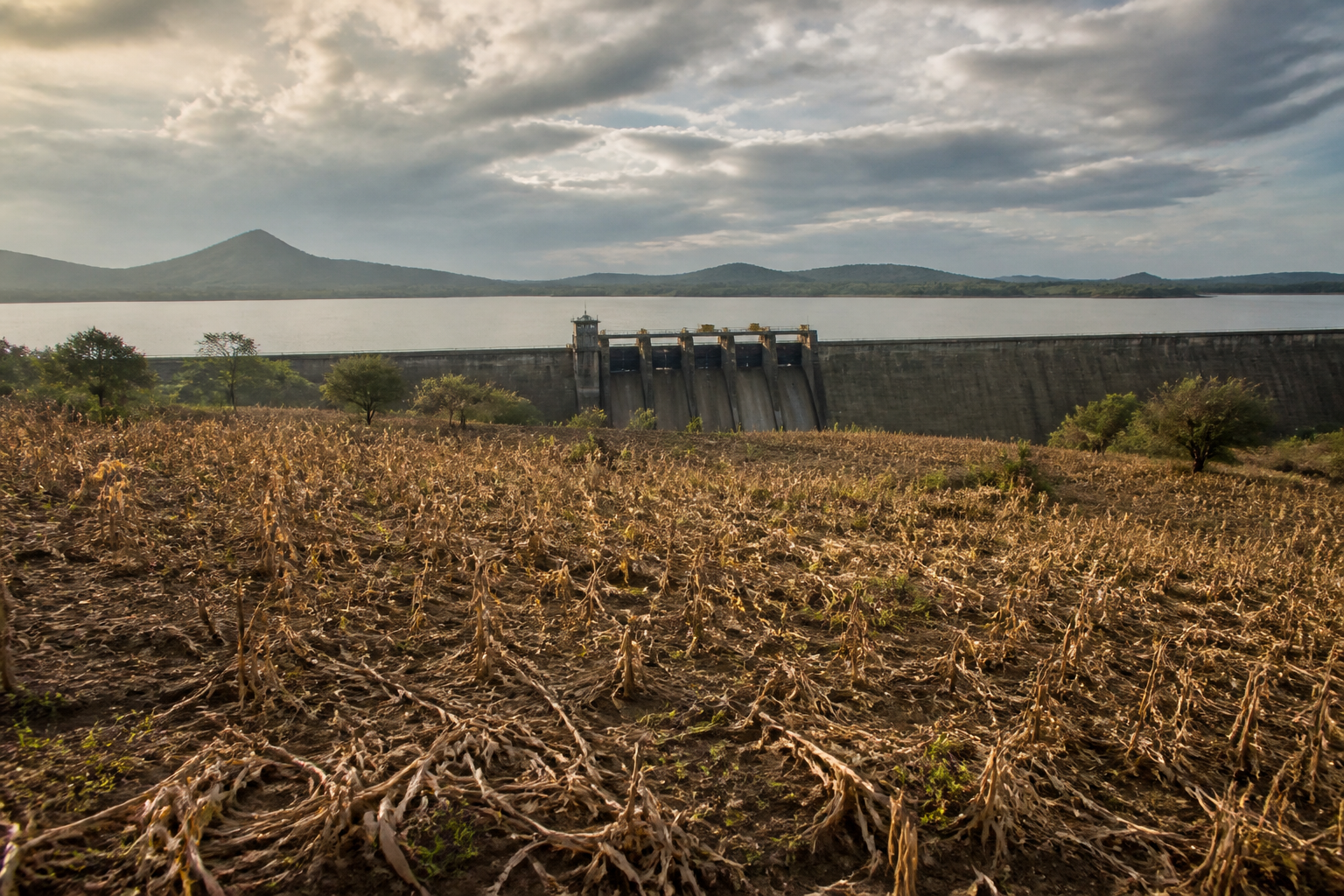
Nashik-region dams are holding 118 TMC of water, or 90% of their combined designed capacity, but that apparent abundance has not protected farmers from a failed kharif season. The contrast exposes a central weakness in water management: reservoir levels measure stored water, while farm livelihoods depend on when rainfall arrives, how much runs off, and when water can be formally allocated.
According to Water Resources Department data cited by the Times of India, the 24 major and medium projects across the Nashik region’s five districts—Nashik, Ahilyanagar, Jalgaon, Dhule and Nandurbar—held 118 TMC against a total designed capacity of 130 TMC as of October 2. Storage was lower than the 97% recorded during the corresponding period last year, but remained substantial in absolute terms.
The regional figure conceals important differences between districts and river systems. Nashik district’s projects held 69 TMC of live storage, equal to 97% of their total capacity of 71 TMC. That was higher than the 92% recorded during the same period last year. Ahilyanagar held 34 TMC, or 81%, compared with full storage last year, while Jalgaon held 15 TMC, or 86%, against 95% a year earlier.
Several major complexes in the region were at or near full capacity. The Gangapur complex held 10 TMC, or 100%, and the Palkhed complex held 8 TMC, also at 100%. Ozarkhed held 3 TMC, the Darna complex held 23 TMC, or 95%, and the Girna Valley complex held 23 TMC, or 98%.
These numbers might ordinarily suggest a comfortable water position. Yet the same season has produced severe losses for farmers growing soybean, cotton, maize, pulses, paddy and onion. The reason, as described by officials and farmers, is the uneven distribution of rainfall rather than a simple absence of rain.
The Water Resources Department said intense rainfall over short periods led to rapid runoff. At the same time, persistent dry spells during critical crop-growth stages left fields vulnerable to wilting and disease. Water that arrives too quickly can fill reservoirs or move downstream without reliably supporting crops during the periods when soil moisture is most important.
The Godavari basin illustrates this mismatch. All dams in the basin, including those in Igatpuri taluka, were reported to be full even though Igatpuri received only 41% of its estimated 3,058 mm rainfall. Since June 1, the basin’s dams had collectively released 58 TMC towards Jayakwadi Dam through the Nandur Madhmeshwar weir. Jayakwadi has a live capacity of 76 TMC.
The releases show that water availability in the region cannot be understood at the level of a single district or reservoir. Nashik’s storage is connected to downstream requirements and basin-level transfers. Decisions taken at upstream projects affect the volume and timing of water reaching other areas, while local farmers continue to face uncertainty over the allocation available to them.
This is also why high storage does not automatically translate into a secure agricultural season. Reservoir water is a governed resource, not an immediately available reserve for every user. Its distribution depends on the condition of individual projects, downstream needs, drinking-water priority, canal operations, groundwater conditions and decisions taken through formal administrative mechanisms.
The next significant decision is expected at the district canal advisory committee meeting, usually held around October 15. The meeting is chaired by the district guardian minister and determines agricultural water reservations based on dam levels and groundwater conditions. Farmers are seeking clarity because the water required for the rabi season will be assessed after the damage to kharif crops has already occurred.
Farmer Ramesh Dusing of Niphad said the kharif crop had been lost and that farmers were now looking towards rabi cultivation. He also said the government had announced drought. His account describes the livelihood dimension of a water-allocation decision that might otherwise appear to be a technical exercise involving storage percentages and canal reservations.
Farmer Kailas Ghuge said the canal advisory committee’s decision would determine agricultural water reservation, while drinking water would receive priority. That priority is institutionally significant. It means that even high storage levels must be assessed against competing needs, and that agricultural availability cannot be inferred solely from the percentage displayed for a dam or basin.
The regional data also reveal why aggregate indicators can be misleading. Nashik district’s projects were at 97% of capacity, but the five-district region as a whole was at 90%. Ahilyanagar and Jalgaon were below their levels from the previous year. Within the Godavari basin, Igatpuri’s rainfall deficit coexisted with full dams and large releases towards Jayakwadi. Each figure is accurate, but none is sufficient on its own to describe water security.
The distinction between live storage and total designed capacity is equally important. The reported 118 TMC refers to combined storage across the region, while individual project figures describe different complexes and capacities. Jayakwadi’s 76 TMC live capacity and the 58 TMC released towards it indicate the scale of interlinked basin management, but they do not establish how much water will ultimately be reserved for each crop or canal command area.
The episode points to a planning challenge that extends beyond Nashik. Water systems are often evaluated through end-of-season storage, rainfall totals or reservoir levels. Farmers, however, experience water through timing: whether rainfall supports sowing, whether dry spells coincide with flowering or grain formation, whether irrigation is available when crops are stressed, and whether a canal reservation is announced early enough to guide the next season.
That gap between hydrological accounting and livelihood security is particularly visible when intense rainfall and dry spells occur in the same monsoon. The region can record reservoirs near capacity while fields suffer from inadequate moisture at critical moments. It can also require downstream releases even as upstream farmers seek certainty over their own rabi allocations.
The immediate institutional question is therefore how the district canal advisory committees will translate storage and groundwater conditions into agricultural reservations. The supplied data establish that the region has substantial water in storage, that basin transfers have taken place, and that kharif crops have suffered serious damage. They do not yet establish the final rabi allocation or whether it will be sufficient for the affected farmers.
The October allocation meeting will be the next concrete milestone. Its decision will show how the administration balances drinking-water priority, basin-level obligations, reservoir storage and the need to provide farmers with water after a season in which rainfall was abundant in bursts but unreliable when crops needed it most.
