


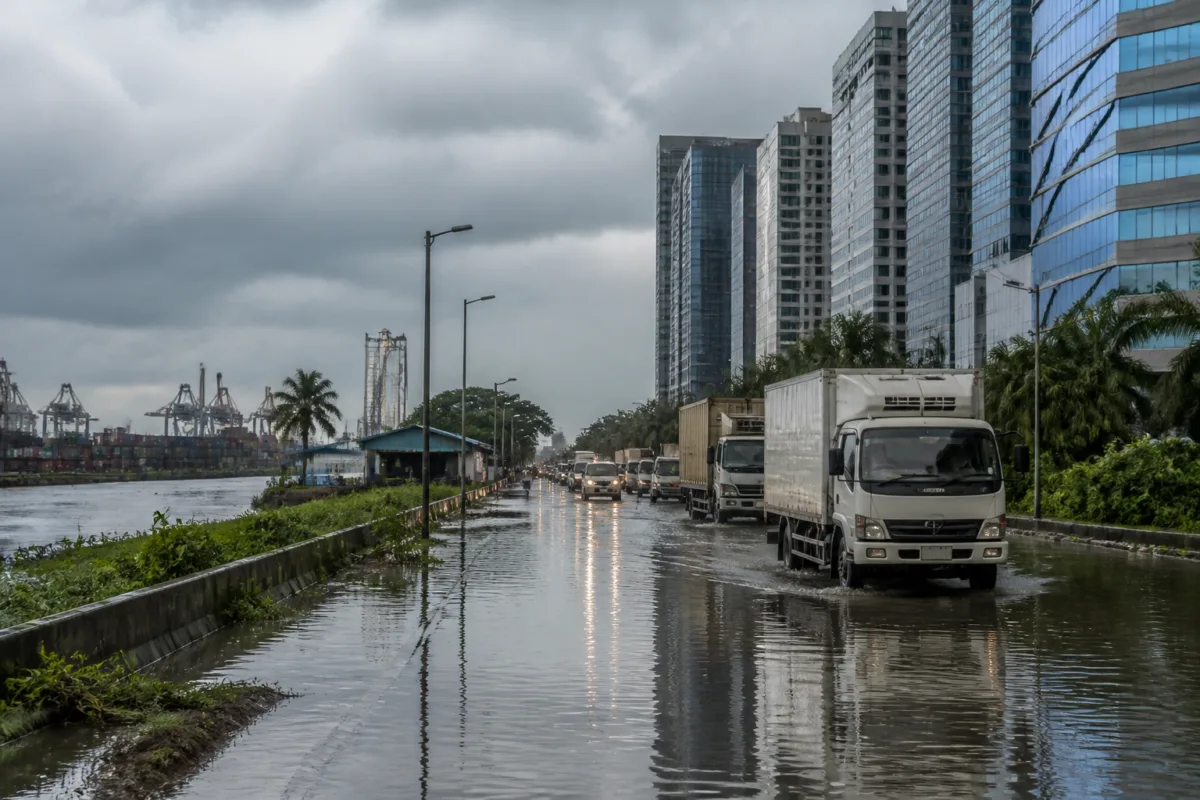
El Nino is no longer being treated by banks as a risk confined to farms and commodity markets. Lenders across Europe, Latin America, Africa and Asia are reviewing loan books, client exposures and repayment structures as droughts, floods, heat stress and supply-chain disruptions threaten the ability of businesses to service debt.
The shift matters because climate shocks are increasingly being translated into financial decisions. Banks are assessing whether borrowers may need grace periods, repayment holidays or debt rescheduling after severe weather events. They are also examining how risks can travel through shipping, logistics, energy, commodities and broader economic activity, even when a company is located outside the regions directly affected by El Nino.
The analysis, reported by NDTV from a syndicated Bloomberg News report, captures an emerging change in the relationship between climate and credit. Weather is becoming part of the question banks ask before lending, monitoring or restructuring debt: not simply whether a borrower owns agricultural land, but whether its revenues, suppliers, transport routes and operating locations can withstand a physical climate shock.
BBVA’s response illustrates the institutional challenge. The Spanish bank, which has a significant client base in Peru, Argentina and Colombia in addition to its Iberian operations, has asked local risk teams to review loan books exposed to El Nino. The bank said debt rescheduling could be considered for its most vulnerable customers and that the data generated through its review would support its management and advisory process.
BBVA has described a two-phase approach. The first involves quantitative analysis using historical data and comparisons between neutral climate conditions and the most intense El Nino events on record. The second involves seasonal meteorological models and monthly updates on key variables, with the aim of creating an early-warning system for extreme weather shocks. The bank said the application was a test and validation of models for future use cases.
This approach shows why climate-risk management is difficult for financial institutions. A borrower’s exposure is not determined only by its registered location or industry classification. A manufacturer may depend on a port vulnerable to disruption. A retailer may rely on agricultural inputs whose prices rise after drought. A logistics company may face higher operating costs because of flooding, heat or altered shipping conditions. The financial impact can therefore emerge through a chain of dependencies rather than a single physical event.
Danske Bank has made this supply-chain dimension explicit, warning that companies headquartered outside El Nino’s immediate path may still be exposed through shipping and logistics. This widens the risk perimeter for banks. Traditional credit assessments often focus on a borrower’s balance sheet, sector and geography. Climate events require lenders to examine the networks that connect borrowers to suppliers, customers, transport corridors and commodity markets.
The risk is particularly visible in agriculture, fishing and livestock farming, where physical damage can quickly affect income. Credicorp, based in Lima, estimated in August that about 9% of its loan book was directly exposed to clients at risk from El Nino-related fallout. Intercorp Financial Services, one of Peru’s largest financial firms, has already introduced special El Nino loan clauses for customers in fishing and agriculture. The available measures include grace periods and rescheduling.
Banco do Brasil’s chief financial officer said the bank was very concerned and closely monitoring the effects of El Nino. At Standard Chartered, risk teams have been asked to conduct granular assessments across significant exposures in Africa, the Middle East and Asia. Karen Wilkinson, the bank’s global head of climate, sustainability and reputational risk, said the lender had conducted portfolio-level analysis across its corporate and investment banking business and was incorporating the findings into client-level climate assessments.
Standard Chartered is also monitoring physical risks such as flooding, storms and heat stress across key operating locations and data centres. That detail is important for urban systems because data centres, offices, transport hubs and industrial facilities are part of the infrastructure through which modern economies operate. A climate shock can therefore affect not only borrowers’ revenues but also the continuity of the systems on which banking and commerce depend.
The regulatory landscape is reinforcing this movement. Banks in the European Union face increasing pressure to disclose climate-related risks under evolving requirements linked to the EU’s Pillar 3 rules. Grace Osborne, a sustainable finance analyst at Bloomberg Intelligence, said the insurance protection gap in European agriculture could increase the likelihood of agricultural loan repayment holidays after severe climate events.
The insurance gap is central to the question of who ultimately absorbs climate losses. When damage is insured, a borrower may have a route to recovery. When insurance is unavailable, unaffordable or insufficient, the loss can move directly to households, businesses, governments and banks. Debt relief may protect borrowers from immediate default, but it can also extend the period during which lenders carry weakened assets.
European bank disclosures show that exposure can be significant without necessarily being dominant at the group level. CaixaBank said sensitive exposures represented about 60% of its lending to agriculture, livestock farming and fishing, while those sectors accounted for less than 1% of its total lending portfolio. The bank therefore described its overall physical-risk exposure as limited. It said it monitors climate risks across sectors and has developed a framework to assess their effect on credit-risk indicators, including the probability of default and loss in case of default.
Santander reported €1.7 billion in agriculture, forestry and fishing loans exposed to physical risk, equivalent to 56% of that portfolio. The bank said it uses different climate scenarios and time horizons, along with event-specific assessments when significant weather events occur. It also cited weekly weather bulletins, monthly El Nino updates, early-warning systems and contingency procedures intended to help teams identify affected areas and assess exposure across portfolios and clients.
These figures reveal a distinction that is often lost in climate-finance discussions. A sector may be highly exposed within a particular loan category but still represent a small share of a bank’s total lending. Conversely, a modest direct exposure can have wider consequences if the affected sector is connected to food prices, employment, trade, transport or public finances. Measuring risk therefore requires both portfolio-level numbers and an understanding of the urban and economic systems around them.
The limits of existing indicators add another layer of complexity. Sebastian Werner, Citi’s head of climate risk scenario design, cautioned that the Oceanic Nino Index, a widely followed measure focused on the central tropical Pacific, does not capture every aspect of the weather cycle. For banks, this means that a single indicator may not be sufficient to model the timing, location or severity of financial losses.
JPMorgan Chase and Citigroup analysts have linked El Nino risks not only to agriculture, commodities and energy, but also to the wider economy. This broader framing moves the issue away from a narrow climate-risk category. Inflation, trade deficits, commodity shortages and disrupted supply lines can affect borrowers that have no direct physical assets in a flood or drought zone.
For cities, the implications lie in these indirect connections. Urban economies depend on reliable food, energy, logistics and financial systems. If a climate shock raises input costs or interrupts transport, businesses may face weaker cash flows before physical damage becomes visible. If lenders respond by tightening credit, the effects may reach construction, small businesses, logistics operators and households through higher financing costs or reduced access to working capital.
At the same time, the measures under consideration show that banks are not responding only through exclusion. Debt rescheduling, grace periods and repayment holidays can give vulnerable borrowers time to recover. But these instruments also require accurate information about the event, the borrower and the likely duration of the disruption. Without granular data and early warning, relief may arrive late, be applied too broadly or fail to distinguish temporary stress from deeper insolvency.
The evidence supplied in the report confirms that banks are building climate risks into lending, monitoring and disclosure processes, but it does not establish how widely debt relief will be used or what its eventual cost will be. It also does not provide a consolidated estimate of losses across the global banking system. What is clear is that El Nino is being used as a live test of whether financial institutions can connect meteorological information with borrower-level credit decisions.
The larger urban question is whether climate resilience will remain a specialised banking exercise or become part of how cities, companies and infrastructure networks plan for disruption. As lenders assess the physical and supply-chain dimensions of weather events, the quality of local data, insurance coverage, transport resilience and business continuity planning will increasingly influence access to finance. The next phase will depend on whether these emerging models can convert early warnings into timely, transparent and financially sustainable support for exposed borrowers.

