


The Delhi University Students’ Union elections were shaped by more than campaign visibility and turnout. They also exposed how a fatal building collapse, unsafe student housing and uneven campus infrastructure compete for attention in a political system where online recognition can matter as much as sustained accountability.
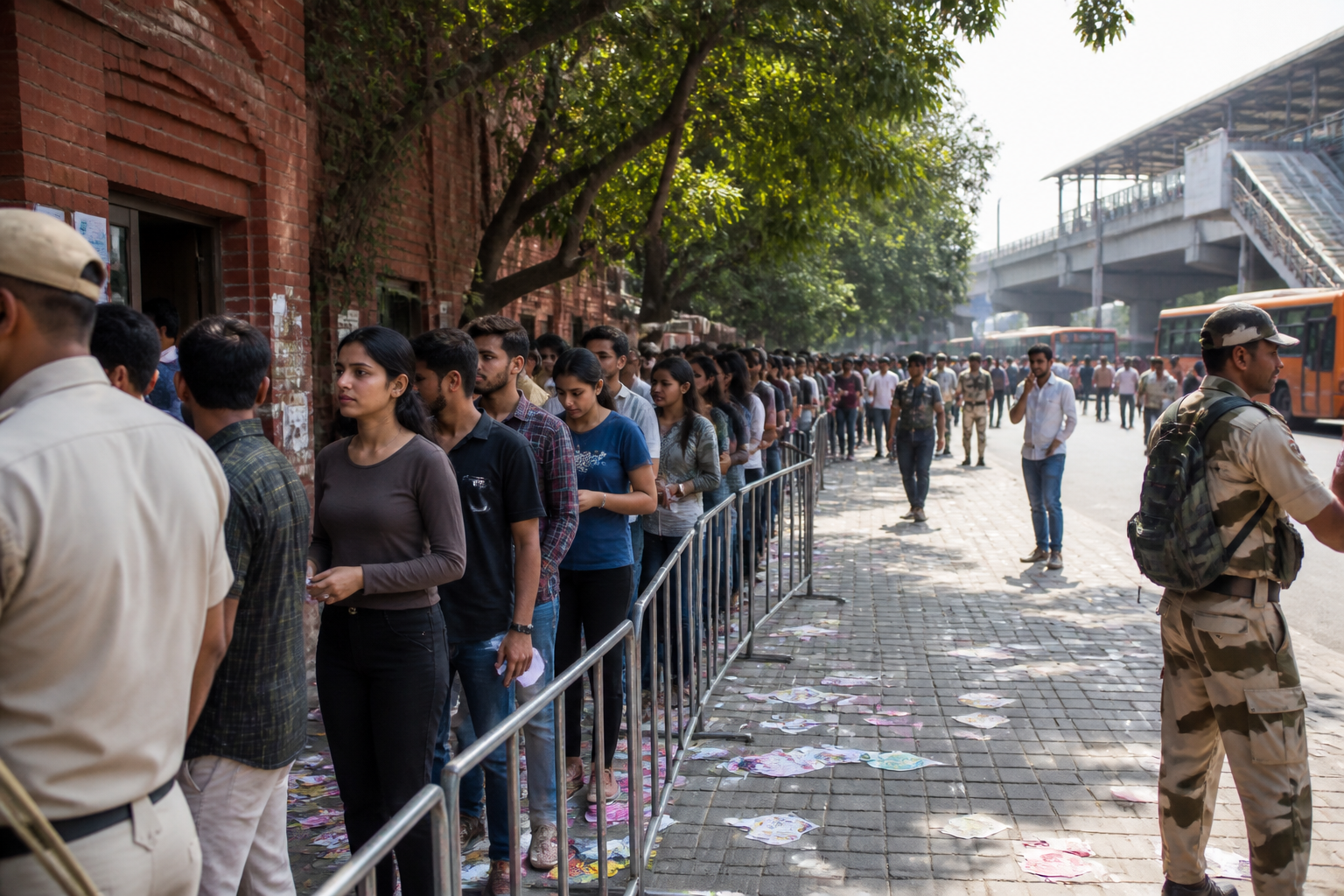
Polling across Delhi University recorded a turnout of 40.46%, higher than the 35.2% recorded in 2024 and 39.36% in 2025, but below the 42% recorded in 2023. The figure shows a modest recovery from the previous two years, yet it also provides a useful measure of the distance between the scale of student concerns and the willingness or ability of students to convert those concerns into a vote.
The election took place against the backdrop of the collapse of a paying guest hostel building in Satya Niketan, near the Durgabai Deshmukh South Campus Metro Station. The Indian Express reported that seven people, including five Delhi University students, were killed. Student groups had gathered at the same location to protest after the collapse, and the incident remained part of conversations on polling day.
But the report also shows that the tragedy did not produce a single political response. Some candidates and parties repeatedly circulated content about it online. Other students questioned whether that visibility represented sustained engagement or campaign opportunism. Kirti, a first-year law student at Law Centre II, said parties had shared reels and appeared active after the collapse, but that the genuineness of online responses was questionable. That distinction is central to understanding the urban issue: visibility can spread a safety concern rapidly, but it does not by itself establish responsibility for inspections, approvals, enforcement or rehabilitation.
The account contains an unresolved timing discrepancy that deserves attention. Its opening describes the collapse as occurring 12 days before polling, while students quoted later in the report refer to the incident as having happened three years earlier. The supplied material does not explain whether the latter reference concerns another event or is a mistaken recollection. That uncertainty does not alter the reported election turnout, but it matters when assessing how quickly the tragedy entered the campaign and how long its political relevance has lasted.
Student housing is an important part of Delhi University’s urban system because the university’s campuses depend on a wider network of paying guest accommodation, rented rooms, hostels, transport links and informal support services. Yet the election-day conversations described in the report suggest that housing safety was not equally prominent across campuses. Vrinda Singh, a second-year law student at Campus Law Centre, said candidates were focusing largely on infrastructure concerns rather than student housing, adding that the issues affecting North Campus differed from those in South Campus.
That difference points to a fragmented campus city. Delhi University is not experienced as one uniform space. Students’ immediate concerns vary according to the physical condition of their campus, access to transport, availability of accommodation and the risks created by the surrounding neighbourhood. The same election can therefore produce different political priorities: infrastructure at one campus, housing safety at another, and online visibility across both.
The report’s details from polling centres reinforce this institutional variation. At Sri Venkateswara College, 215 teaching staff, 150 non-teaching staff and around 50 to 60 contractual staff, including security personnel, were deployed for election duty, according to Principal Prof Vajala Ravi. The college also created ground-floor booths for its 79 students with disabilities, Vice Principal Prof Nandita Narayanasamy said. At Ramjas College, 2,578 of 5,973 students voted in the college and DUSU elections, producing a turnout of around 43%. Miranda House recorded 32% turnout.
These figures are not only election statistics. They show how colleges become temporary administrative systems on polling day, mobilising staff, security, accessible voting arrangements and crowd-management infrastructure. They also highlight the unevenness of participation. A university-wide turnout of 40.46% conceals substantial differences between institutions, while college-level arrangements determine whether voting is convenient, accessible and orderly for different groups of students.
The increased use of electronic voting machines adds another layer to that administrative transition. Chief Electoral Officer Prof Raj Kishore Sharma said around 960 EVMs were deployed, with 40 kept in reserve in case of technical glitches. The report described this as the first year in which EVMs were used in almost all Delhi University colleges, apart from a few where technical issues prevented deployment. Earlier, most colleges used ballot papers for college-level student union elections.
The shift from ballot papers to EVMs is therefore not simply a technology upgrade. It changes the operational demands placed on colleges and the election authority. Equipment must be distributed, tested, secured and supported, while reserve machines must be available when failures occur. The move also makes technical reliability part of electoral legitimacy. The reported reserve of 40 machines indicates that administrators anticipated breakdowns, but the supplied report does not provide a performance assessment or details of how many machines experienced problems.
The campaign itself illustrates a different form of infrastructure: the digital infrastructure through which students recognise candidates. A first-year student at Miranda House told the newspaper that some friends decided to vote after seeing a particular candidate on Instagram. She also raised the issue of women’s representation, saying campaigning remained largely male-dominated and that major parties had fielded male candidates for the President and Vice-President posts.
This matters because digital visibility can reorganise political attention without necessarily improving the information available to voters. Repeated appearances on Instagram, free movie tickets, dinners and hampers containing make-up kits and chocolates may increase candidate familiarity, but they do not tell students whether a candidate can influence building safety, housing regulation, campus maintenance or accessibility. The report does not establish that such tactics determined the result. It does show that recognition and policy substance were operating alongside each other.
The campaign’s focus on infrastructure also raises a question about institutional responsibility. Student representatives may raise concerns, mobilise public pressure and demand answers, but colleges, university authorities, municipal bodies and other regulators control different parts of the built environment. A student election can make a dangerous building politically visible, but it cannot by itself substitute for structural audits, occupancy enforcement, fire-safety compliance or action against unsafe accommodation. The supplied report does not identify which authority was responsible for the collapsed building or what formal investigations or enforcement steps followed.
That absence is significant. The election-day discussion shows that students understood the collapse as a political issue, but the report also records scepticism that previous concerns had produced results. Muskan, a third-year Chemistry student at Sri Venkateswara College, said students had seen issues raised for years without consequences and expected Satya Niketan to be no different. Her comment connects the tragedy to a broader accountability problem: repeated mobilisation can lose credibility when the administrative chain between complaint and remedy remains unclear.
The turnout trend provides a partial counterpoint. Participation rose from 35.2% in 2024 to 39.36% in 2025 and 40.46% this year, although it remained below the 2023 level. The increase may indicate renewed engagement, but the supplied material does not establish why students voted in greater numbers. The report instead presents several possible influences — the Satya Niketan collapse, social media campaigns, freebies, college-specific issues and competition from independent candidates — without assigning a single cause.
The role of independent candidates further complicates the relationship between party visibility and representation. An NSUI worker at Sri Venkateswara College said the contest had become closer because of independent candidates, including Deepanshu Shokeen, who was denied a party ticket. This suggests that formal party machinery remains important, but it does not fully control the field. Candidates outside the main party structures can redirect votes when students see a choice that better reflects campus-level concerns.
The election administration also reveals how much coordination is required to make a university-wide vote function. Security restrictions were tightened in North Campus from 8.30 am, barricades were placed along routes leading to the Arts Faculty and party supporters were barred from entering the campus. At the same time, colleges arranged staff deployment, accessible booths, queues and voting equipment. These measures address immediate election logistics, but they also shape how students experience the campus as a governed public space — one where movement, access and participation are regulated temporarily for a civic process.
The larger urban question is whether student politics can convert visibility into institutional follow-through. The DUSU polls brought together a fatal housing-related incident, campus infrastructure concerns, gender representation, digital campaigning and the mechanics of administering a large election. They also showed that these issues do not carry the same weight across Delhi University’s campuses.
What the evidence confirms is that the Satya Niketan collapse became part of the political conversation, while infrastructure and housing concerns remained unevenly prioritised. What it does not establish is whether campaigning led to any formal safety action, which authorities were held responsible, or whether the higher turnout reflected concern about the tragedy. Those questions require documentary and institutional follow-up beyond election-day accounts. The immediate next milestone reported by the newspaper was counting for the DUSU polls, scheduled for Saturday, while college-level results had already begun to emerge, including an SFI victory for the presidential post at Bhaskaracharya College.
