


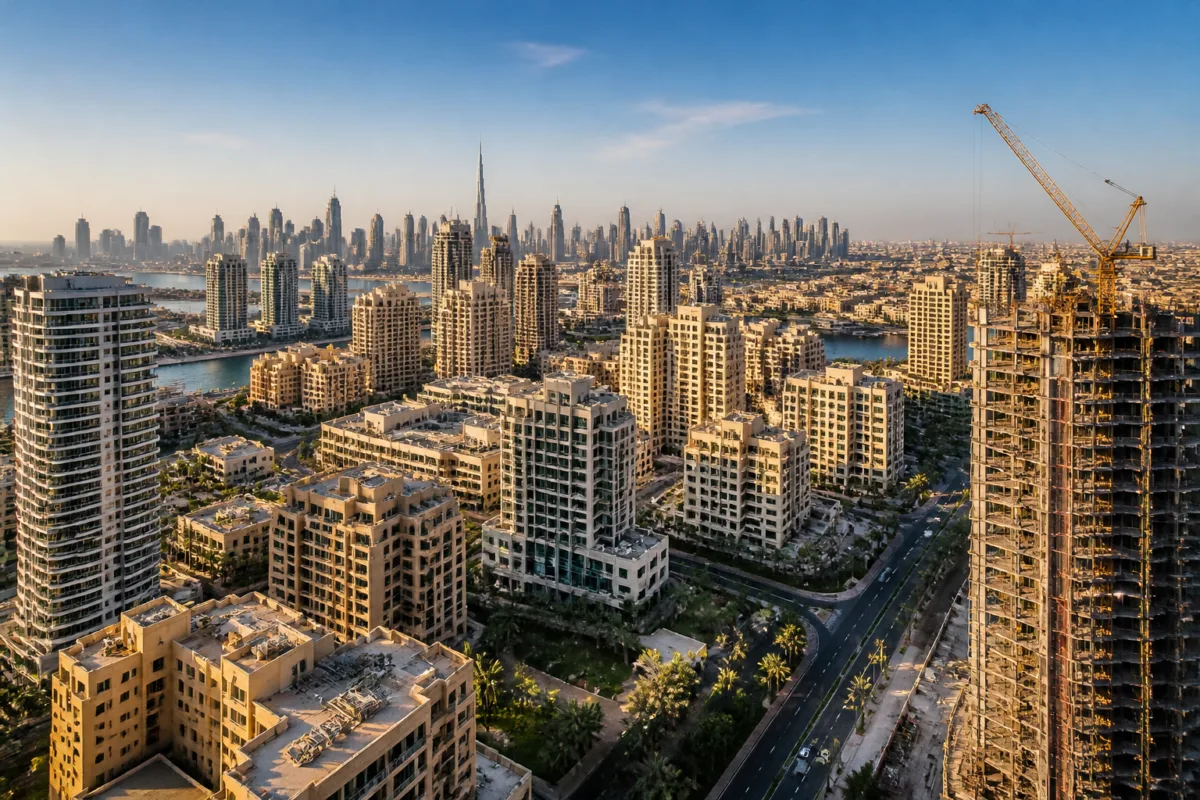
Dubai property prices have reached a four-year high even as the pace of home sales falls below last year’s record, creating a market defined by higher values but slower transaction momentum. Data from Anarock Middle East shows that the average residential property price rose to 1,967 dirhams per square foot between January and October 2026, up 18% from 1,669 dirhams in 2023.
The combination is important because it separates two indicators that are often treated as a single measure of market strength. Prices are still rising, but the number and total value of transactions are not matching the exceptional levels recorded in 2025. Anarock’s figures suggest that Dubai’s housing market remains substantially larger than it was in 2023, while its latest performance points to a moderation after two years of rapid expansion.
Between January and October 2026, 122,583 homes were sold in Dubai for a combined value of 318.4 billion dirhams, according to the report. If the prevailing pace continues through December, the full-year market could record about 145,700 transactions worth approximately 378.5 billion dirhams.
That projected total would still represent growth over 2023. The estimated number of sales would be 23% higher than the 118,815 homes sold in 2023, while the projected transaction value would be 20% above the 314.4 billion dirhams recorded that year. The comparison shows that the current market is not contracting to its earlier scale. Rather, it is operating from a much higher base but below the exceptional peak reached in 2025.
The data also reveals how sharply Dubai’s residential market expanded before the current slowdown. In 2024, 167,288 homes were sold, generating 421.9 billion dirhams in transactions. In 2025, sales rose to 199,497 homes and total value reached a record 535.5 billion dirhams. Compared with 2023, the 2025 increase was 68% in the number of homes sold and about 70% in total transaction value.
The estimated 2026 outcome therefore marks a clear change in pace. If 145,700 sales are recorded, the year would remain ahead of 2023 but fall well below the 2024 and 2025 transaction counts. The projected value of 378.5 billion dirhams would also be lower than both 2024 and 2025. Yet the average price per square foot has continued to move upward, indicating that the market’s price trajectory and sales trajectory are no longer moving in parallel.
This distinction matters for understanding how a property market is functioning. A rise in average prices can coexist with fewer transactions when higher-value properties account for a larger share of activity, when buyers become more selective, or when the pace of new purchases slows without immediately reversing prices. The supplied report does not establish which of these factors is driving Dubai’s 2026 performance. It does, however, show that price growth has continued despite lower overall sales momentum.
The four-year comparison provides the clearest measure of the price movement. The average price of 1,967 dirhams per square foot in the first ten months of 2026 was 298 dirhams higher than the 2023 average of 1,669 dirhams per square foot. That is an 18% increase over the period. The report describes the 2026 average as the highest level in four years, placing the latest price movement within a sustained upward trend rather than presenting it as a single-month spike.
For the housing market, the result is a more expensive entry point even as the number of completed purchases moderates. Buyers are encountering higher average prices than in 2023, while sellers and developers are operating in a market where transaction volumes are no longer expanding at the same rate as during the record year. The data does not provide a breakdown by neighbourhood, property type, buyer category or tenure, so it cannot establish how evenly the increase is distributed across Dubai’s housing stock.
The institutional role in the figures is also significant. Anarock Middle East’s report provides both the price estimate and the transaction projections, allowing the market to be read through three connected measures: average price per square foot, number of homes sold and total transaction value. Looking at only one of these measures would produce an incomplete picture. The price figure points to continuing appreciation, while the transaction data shows a loss of momentum from the 2025 peak.
The projected 2026 value also has to be read carefully. The 378.5 billion dirham figure is an estimate based on the pace recorded between January and October continuing through December. It is not a final full-year result in the supplied report. The same limitation applies to the projected 145,700 sales. The confirmed data available in the report covers the first ten months of the year; the December outcome will determine whether the estimate is reached.
This makes the timing of the data relevant. The report is not comparing a completed 2026 market with a completed 2025 market. It is comparing January-October 2026 performance and a full-year projection with full-year results from earlier years. That does not weaken the direction of the evidence, but it does define what can be stated with certainty: prices have reached 1,967 dirhams per square foot in the first ten months, 122,583 homes have been sold in that period, and the reported annual estimate remains below the 2025 record.
The market’s recent history suggests that Dubai’s housing cycle has passed through two distinct phases. The first was rapid expansion from 2023 to 2025, when sales and total transaction value increased strongly. The second is the current phase, in which prices remain elevated but transaction growth has slowed. The evidence supplied does not identify a single cause for this shift, and attributing it to demand, supply, financing, investor behaviour or regulation would go beyond the report.
What the figures establish is a structural tension between affordability and market value. Rising average prices make ownership more expensive at the point of purchase, while slower sales indicate that the market is not converting higher prices into an even larger number of transactions. The report does not include household income, rents, mortgage costs or supply data, so it cannot measure affordability directly. But the price increase is a clear indicator that the cost of buying residential property has risen over the period examined.
For developers and market observers, the data also shows why transaction value alone can be misleading. Dubai’s 2025 record of 535.5 billion dirhams reflected both a high number of sales and a strong total value. The estimated 2026 value is lower, despite prices per square foot being higher than in 2023. This means the market’s aggregate performance is being shaped not only by prices but also by the number of homes changing hands.
The wider urban question is whether a high-price, lower-volume market can sustain the same level of activity as a record-growth market. The supplied evidence cannot answer that question yet. It does show that Dubai has entered 2026 with significantly higher prices than in 2023, but with projected sales and transaction value below the levels recorded in 2024 and 2025.
The next useful evidence will be the final 2026 sales count and transaction value, along with a more detailed breakdown of where the price increase is occurring. Until then, the Anarock Middle East figures support a precise conclusion: Dubai’s residential property market remains larger and more expensive than it was four years ago, but its extraordinary 2025 sales momentum has not continued at the same pace.

