


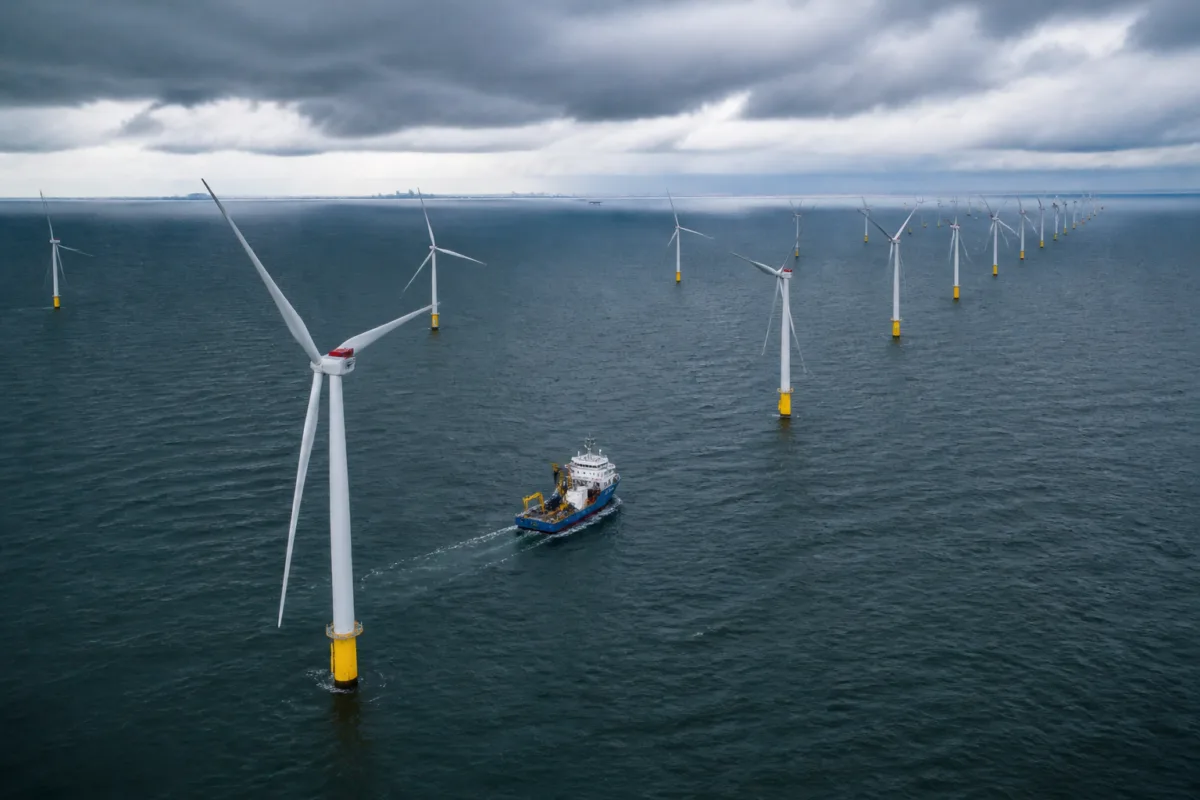
The European Commission’s approval of Belgium’s €2.04 billion offshore wind scheme is more than a financing announcement. It sets out a public framework for building and operating a large renewable-energy asset while sharing electricity-market risks between developers and the state. The model will support the first offshore wind farm in the Princess Elisabeth Offshore Zone in the North Sea, with a planned capacity of up to 735 MW and annual generation of up to 2.6 TWh.
The scheme, reported by Renewable Watch, will run for 20 years. Financial support will be awarded through a competitive bidding process, with the results expected in the fourth quarter of 2027. The arrangement therefore links three separate decisions that often determine whether major infrastructure is built: how much capacity is offered, how developers compete for support and how future price risks are allocated after construction.
That combination is significant because offshore wind is not only an energy project. It is a complex piece of infrastructure that requires long-term capital, marine construction, grid integration and an operating framework extending well beyond the political cycle. The Belgian scheme places the project within a defined geographic and institutional setting: the Princess Elisabeth Offshore Zone in the North Sea, where the supported wind farm is expected to become the first project developed in that zone.
The European Commission’s approval is important because the scheme involves state support. Under the structure described by Renewable Watch, the Commission has cleared the Belgian arrangement under the European Union’s state aid framework. The approval allows Belgium to provide long-term financial support without treating the project as an open-ended subsidy disconnected from market conditions.
The principal mechanism is a two-way contract for difference. Under this arrangement, payments will be made to developers when the reference market price for electricity falls below the price established through their bid. If the market price rises above that bid price, the developers will be required to pay the difference to the Belgian authorities.
This structure changes the nature of public support. It does not simply guarantee that developers will receive a fixed payment regardless of market conditions. Instead, it creates a two-directional settlement mechanism. The state provides protection when market revenues are insufficient, while the public authority receives payments when market prices exceed the agreed reference level.
For developers, the lower-price protection can make it easier to plan a project requiring significant expenditure over a long construction and operating period. For the state, the repayment obligation at higher market prices creates a route for public funds to flow back when market conditions are stronger. The scheme therefore combines revenue certainty with exposure to electricity-price movements rather than removing market risk altogether.
The competitive bidding process is central to that design. Support will not be allocated automatically to a predetermined developer under the information supplied. Instead, developers will compete, and the winning bid is expected to determine the reference price used in the two-way contract for difference. The process is scheduled to produce results in the fourth quarter of 2027, making the bidding outcome the next major public milestone identified in the report.
The project’s stated scale provides the clearest measure of the infrastructure being planned. A capacity of up to 735 MW would make the wind farm a major generating asset, while the expected annual output of up to 2.6 TWh indicates the amount of renewable electricity the project could produce under the stated assumptions. The distinction between capacity and annual generation matters: the first describes the maximum installed power, while the second describes the electricity expected to be generated over time.
The figures also show why the public framework extends for 20 years. The scheme is not limited to construction assistance. It is intended to support both the construction and operation of the first offshore wind farm in the Princess Elisabeth Offshore Zone. A long support period gives the project a framework covering the operational phase, when revenues will depend on market prices and the wind farm’s electricity production.
The Belgian case also highlights the institutional layers behind renewable-energy infrastructure. The national government is responsible for designing and awarding the support scheme, while the European Commission assesses whether the arrangement complies with EU state aid rules. Developers compete for the support, and the final project must then move through construction and operation in the designated offshore zone.
This division of responsibility is not a minor administrative detail. Large infrastructure projects can be delayed or reshaped when authority is divided between national governments, regulators, public financiers and private developers. In the Belgian arrangement, the Commission’s approval establishes that the state aid structure can proceed under the applicable European framework. The competitive award is then expected to determine which proposal receives support and on what bid terms.
The scheme also reflects the continuing challenge of financing renewable energy when equipment, construction and electricity prices can move in different directions. The supplied report does not provide project-cost details, construction dates, grid-connection arrangements or the identity of prospective bidders. It therefore cannot establish the project’s full delivery timetable or the final cost of the wind farm itself. What it does establish is the financial architecture Belgium has secured for the support programme.
That architecture is especially relevant to offshore wind because the project is located in the North Sea rather than on land. The report does not specify the distance from shore, turbine technology, seabed conditions, transmission arrangements or port infrastructure. Those details are important to construction and operation, but they are not established in the supplied material. The confirmed information is limited to the zone, the supported capacity, expected annual generation, duration of support and two-way payment mechanism.
The Belgian announcement can also be read alongside the European Commission’s other renewable-energy decisions. Renewable Watch reports that the Commission approved a €6 billion Italian state aid scheme in March 2026 to support renewable hydrogen production for transport and industry. That programme targets annual renewable hydrogen capacity of 200,000 tonnes and allows production from renewable electricity through electrolysis as well as from biogenic sources through biological, bio-thermochemical or thermochemical processes.
The Italian scheme is separate from the Belgian offshore wind programme. However, the two decisions show the breadth of infrastructure that European state aid policy is being used to support: electricity generation from offshore wind and fuel production for transport and industry. They also demonstrate that public support is being structured around specific technologies, sectors and output objectives rather than presented as a single undifferentiated energy programme.
The difference between the two schemes is also instructive. Belgium’s programme is tied to a physical offshore wind farm in a named marine zone and uses a two-way contract for difference. Italy’s programme, as described in the supplied report, is directed at renewable hydrogen production and sets an annual capacity target. The available material does not identify the financial mechanism used in the Italian programme, so no direct comparison of subsidy efficiency or investor returns can be made.
For cities and the built environment, the relevance lies in the infrastructure chain connecting energy policy to urban systems. Offshore wind farms generate electricity away from population centres, but their value depends on how that electricity is integrated into wider networks and used by buildings, industry and transport. The supplied information does not specify Belgium’s grid arrangements or the final consumers of the power. It does, however, make clear that the project is being treated as a long-duration infrastructure investment rather than a short-term procurement exercise.
The scheme also illustrates why renewable-energy deployment depends on governance as much as technology. The wind resource, turbines and marine location are only part of the project. The support mechanism determines how revenue risk is managed; the bidding process determines how developers compete; state aid approval determines whether public support can legally proceed; and the operating period determines how the project interacts with electricity markets over time.
The evidence currently confirms a clear but limited set of conclusions. Belgium has received European Commission approval for a €2.04 billion state aid scheme lasting 20 years. The scheme is intended to support the construction and operation of the first offshore wind farm in the Princess Elisabeth Offshore Zone, with capacity of up to 735 MW and annual generation of up to 2.6 TWh. Support will be awarded competitively, with results expected in the fourth quarter of 2027, through a two-way contract for difference.
What remains unknown is equally important. The supplied report does not establish the winning developer, final bid price, construction start date, completion schedule, grid connection, turbine configuration or actual public expenditure. Those details will determine how the approved framework performs in practice. For now, the next significant test is whether the competitive process produces a viable bid for the planned offshore wind farm by the expected fourth quarter of 2027.

