


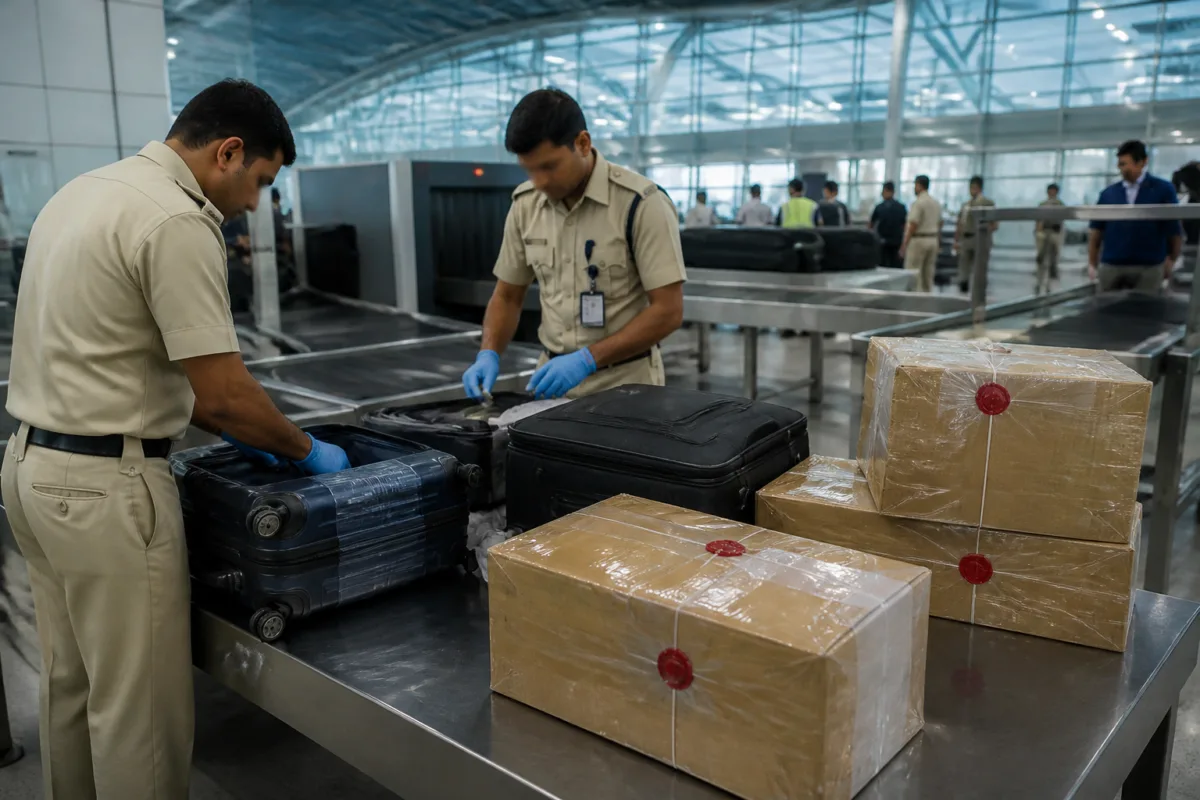
The Directorate of Revenue Intelligence has busted an alleged gold-smuggling network operating across Gujarat, tracing foreign-origin gold brought through Ahmedabad and Surat airports to an illegal melting facility in Vadodara and a jewellery outlet in Ahmedabad.
Three people have been arrested under the Customs Act, 1962, after a coordinated operation that began on October 16 and continued for 42 hours, according to a release issued by the agency. Investigators said the syndicate handled about 13 kg of foreign-origin gold valued at Rs 19.41 crore and was linked to a Dubai-based supplier.
The operation involved surveillance followed by searches at multiple locations. DRI officials said they uncovered a chain involving air passengers, handlers, intermediaries, an illegal melting-facility operator and a jewellery trade channel. The agency also identified the handler or financier, the operator of the melting unit and other key persons during the investigation.
According to the DRI, passengers were routed from different foreign airports to Sardar Vallabhbhai Patel International Airport in Ahmedabad and Surat International Airport. The gold was allegedly concealed in several forms, including wires coated with rhodium, material embedded in the inner linings of trolley bags and gold paste hidden inside trolley-bag shells.
After arrival, the gold was allegedly handed to handlers outside the airports and moved through intermediaries to the Vadodara facility. Investigators said the material was melted there before being supplied to a jewellery shop in Ahmedabad for cash transactions.
The searches resulted in the seizure of about 890 grams of gold and the recovery of evidence connected to 6.41 kg of illegally melted gold, the agency said. Further searches at the jewellery shop led to the recovery of undocumented foreign-origin gold bars and records relating to transactions involving approximately 5.8 kg of smuggled gold. This quantity was allegedly routed through a separate handler linked to the syndicate’s Dubai-based financier.
The case places three types of urban infrastructure at the centre of the investigation: international airports used for passenger movement, commercial premises used for processing and sale, and road-based links connecting airport arrivals with facilities and markets in other cities. The DRI said the operation exposed how these locations were allegedly connected into a single movement and disposal network.
Customs officials said gold becomes illegal when it is not declared at the Red Channel, when a passenger carries more than the permissible limit or when the required purchase and source documentation is unavailable. By avoiding customs duty, smugglers can generate margins running into lakhs, officials said.
The department also said passengers in earlier cases had been lured with a share of the proceeds or free foreign travel. Efforts are continuing to identify and dismantle organised groups involved in gold smuggling, according to a senior Customs official.

