


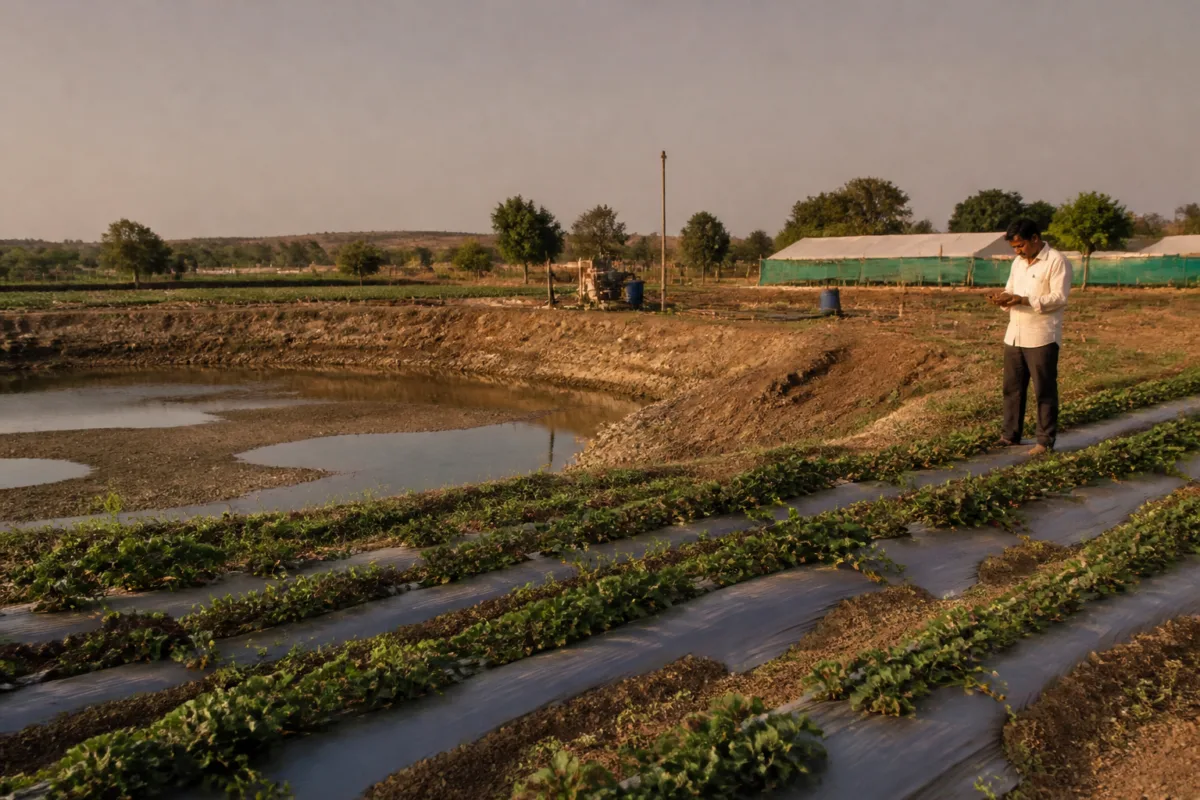
Dhar’s strawberry belt was built on a promising shift from conventional crops to high-value horticulture. Now, a weak monsoon and declining borewell levels are exposing how vulnerable that transformation remains. In Rupakheda and neighbouring villages, temporary ponds may run dry in December, just as the strawberry harvest begins and farmers face the highest irrigation demand of the season.
The crisis is not limited to one crop. Farmers in Rupakheda, Tilgara, Jawda and Multhan have invested in strawberries, blueberries, raspberries, roses, guava and other premium flowers after moving away from wheat, gram, maize and soybean. That diversification had turned a conventional farming belt into an emerging horticulture cluster. But the same crops that offer higher value also require dependable water at precise stages of cultivation. When irrigation fails, the financial exposure is considerably greater than it would be for a lower-investment crop.
The Times of India report said Dhar is among 12 districts in Madhya Pradesh where deficient rainfall has raised concerns over crop losses. Chief Minister Mohan Yadav directed officials on October 21 to focus on affected areas. The state received 908.4 mm of rainfall against a normal 949 mm, a shortfall of around 4%, while 34 districts recorded normal rainfall. Dhar was listed among the districts with deficient rainfall, alongside Indore, Ujjain, Ratlam, Jhabua, Alirajpur, Betul and Chhindwara.
The state-level rainfall figure, however, does not fully describe the problem facing farmers in the affected belt. Jamnalal Patidar, a farmer from Rupakheda in Badnawar tehsil, told the newspaper that the village received barely 15-16 inches of rainfall against a requirement of at least 35 inches. With borewell levels also declining, farmers are relying on water stored in temporary ponds. That storage is expected to run out in December, leaving growers uncertain about the months when their most valuable crops need irrigation.
This timing is particularly damaging for strawberry growers. Harvesting starts in December, but farmers told the newspaper that only about 10% of the produce is picked that month. Around 90% is harvested from January onwards, when water availability is expected to become more precarious. An average grower has already invested about Rs 2.5 lakh per acre in strawberry cultivation. If irrigation ends in December, fruit development and quality could suffer, yields could decline and growers may struggle to recover their production costs.
The figures show why this is more than a temporary crop setback. According to the Dhar horticulture department, 266 farmers cultivate strawberries across 110 hectares in the Rupakheda-Tilgara-Jawda-Multhan belt. Sixteen growers cultivate blueberries on four hectares, while one farmer grows raspberries on 0.25 hectare. In Rupakheda, nearly 90% of farming families have shifted towards flowers and protected cultivation.
That shift has also created physical infrastructure that ties local livelihoods to the horticulture economy. The village has 44 polyhouses covering more than 1.44 lakh square metres and 13 shade-net houses covering another 42,000 square metres. These facilities represent an investment in a different production model, but protected cultivation does not eliminate the need for water. It changes the growing environment; it does not remove the dependence on reliable irrigation.
The distinction between open-field and protected cultivation is now central to the local risk pattern. Neeraj Sawaliya, deputy director of horticulture in Dhar, said open-field strawberries were more vulnerable and might not survive until March if irrigation became scarce. Crops under protected cultivation, he said, were unlikely to be affected to the same extent. The statement indicates that infrastructure can moderate climate and water stress, but the protection is uneven and does not cover every farmer or every crop.
Flower cultivation has already been disrupted. Nearly half the farmers in Rupakheda reportedly skipped flower cultivation for the coming season even though plants were ready in nurseries. Jamnalal Patidar said farmers had prepared lakhs of plants expecting demand but lacked enough water to transplant them. Farmers spend at least Rs 6-7 to prepare each plant from a mother plant before transplanting during the September and October planting cycles. The water shortage has therefore put nursery expenditure at risk before the crop can generate revenue.
The effects extend across different harvest calendars. Rose growers could lose a high-demand sales window around Valentine’s Day in February if they cannot establish their crops. Guava growers are concerned about both the November-December harvest and the February-March harvest. Farmers estimate that as much as 80% of the second guava harvest could be affected if irrigation water is unavailable. These overlapping cycles mean the water crisis can continue producing losses across several months rather than appearing as a single failed harvest.
The institutional response described in the report is focused on immediate crop management. The horticulture department has advised farmers to consider peas, chilli and tomato in view of the water shortage. That advice may help some growers adjust their planting decisions, but the evidence in the report also points to a deeper administrative challenge: the horticulture transition has expanded faster than the local water system’s demonstrated ability to withstand a deficient monsoon.
The issue is not simply that farmers chose water-intensive crops. Their shift was described as a response to higher-value opportunities enabled by technology, protected cultivation and experimentation. Once a cluster develops around such crops, water insecurity affects more than individual fields. It threatens nursery operators, growers, labour demand, local trading activity and the supply of produce to markets. The report does not quantify these wider economic effects, but the concentration of horticulture infrastructure and the scale of farmer participation show how exposed the local economy has become to irrigation failure.
There is also a difference between rainfall adequacy at the state level and water security at the farm level. Madhya Pradesh’s overall rainfall deficit was around 4%, yet the reported shortfall in Rupakheda was much larger against the village’s stated requirement. This gap matters for planning. Aggregate rainfall numbers can indicate a broad seasonal condition, but they cannot by themselves establish whether a specific crop belt has enough stored water, groundwater or irrigation capacity to carry crops through their production cycles.
The report also underlines the limits of groundwater as an informal buffer. Borewell levels are declining, according to farmers, while the horticulture department’s assessment distinguishes between crops that may withstand scarcity better and those likely to fail. Without an assured source of irrigation after December, farmers are being forced to calculate whether continuing a crop is financially rational after substantial investment has already been made.
Dhar’s horticulture belt therefore presents a wider question for India’s agricultural and urban transition: can high-value, technology-assisted production expand sustainably in areas where water storage and irrigation remain seasonal and uncertain? The story does not establish that the crop shift itself caused the shortage, nor does it provide a complete assessment of groundwater extraction, pond capacity or government relief. What it does establish is that the economic promise of diversification depends on water systems capable of supporting the full crop cycle.
The immediate milestones are clear. Farmers will confront the first major test when stored pond water is expected to run out in December, while strawberry harvesting continues into January and beyond. Rose demand is expected to rise around February, and the second guava harvest is due in February-March. The extent to which open-field crops survive, whether protected cultivation remains comparatively resilient and whether officials provide a more assured irrigation response will determine whether Dhar’s horticulture experiment experiences a temporary setback or a deeper reversal.

