


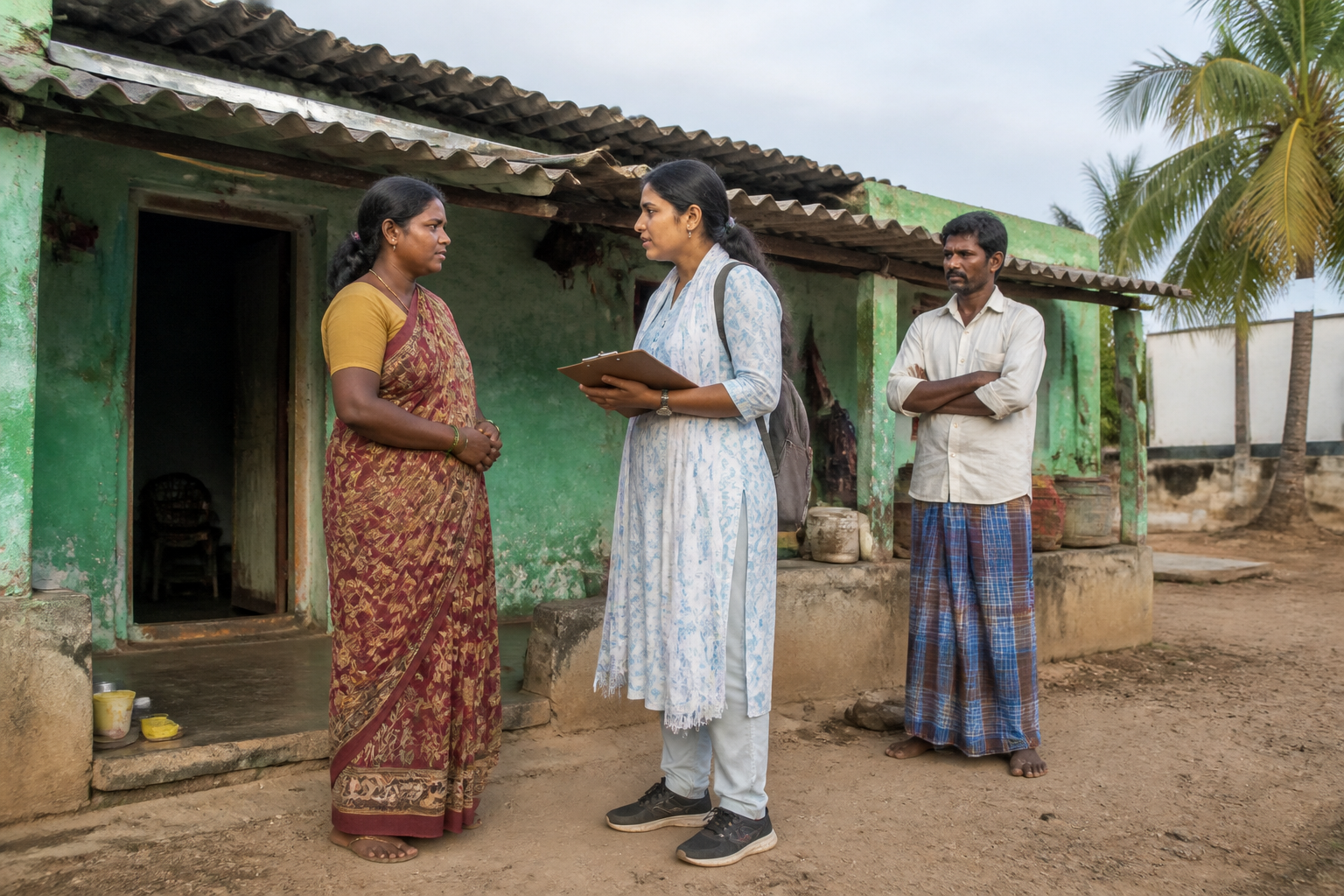
A demand for a fresh, house-to-house survey of Devadasi women in Karnataka has exposed a deeper governance problem: the people counted by the state determine the people who can be seen in official records, represented before the courts and considered for rehabilitation. The Vimochita Devadasi Women and Children’s Forum has alleged that the latest survey covers only about 23,000 women, while an earlier government survey had identified 46,660.
The difference is not a minor statistical variation. It raises questions about who was included, who was excluded and which eligibility rules were used. At a press conference in Bengaluru, forum state coordinator Yamanurappa Koppal said the newer exercise was intended to identify people left out of the earlier survey but had itself excluded some women. The forum’s central demand is that the state remove the age limit and conduct a comprehensive re-survey covering all Devadasi women.
The report does not independently establish the reasons for the difference between the two counts. However, the competing figures show why welfare surveys are not simply administrative exercises. A survey is also a gateway to recognition. When a person is absent from the relevant list, the state’s subsequent planning, budgeting and delivery systems may not fully account for her household. In this case, the forum says that women below the age of 45 were not considered in the latest survey, creating a specific concern about how the survey’s design may have narrowed the population being recorded.
## When enumeration becomes a welfare decision
The forum has also challenged information that the Karnataka government submitted to the Supreme Court on the Devadasi system. According to the organisation, the state’s submission relies mainly on departmental records and limited verification and does not reflect the actual social conditions of Devadasi women and their families. It has asked the government to review the information and submit corrected details to the court where necessary.
That demand links field-level enumeration to institutional accountability. If the information placed before a court is based on incomplete records, the concern is not only whether a number is accurate. It is whether the administrative process has captured the lived circumstances of the people represented by that number. The forum has said that an independent local investigation should be conducted where there are complaints that the practice continues in some areas.
The organisation has specifically argued that the statements of Devadasi women, their children and other family members should form an important basis of the survey. This is a significant methodological demand. Departmental records can identify households already known to the administration, but testimony from affected families may reveal exclusions, changes in household circumstances or forms of vulnerability not visible in existing files. The supplied report does not describe the state’s survey methodology in detail, so it is not possible to assess how far such testimony was included in the latest exercise.
The dispute therefore concerns both the final count and the process used to produce it. A lower number could reflect a genuine change in the population, a different definition, incomplete coverage, an age-based exclusion or some combination of these factors. The forum’s demand for a door-to-door scientific re-survey is aimed at resolving that uncertainty through a broader field exercise rather than relying only on existing departmental information.
## The urban governance connection
Although the issue affects communities across Karnataka, it has a direct connection to the way cities and urban administrations understand vulnerability. Bengaluru was the site of the press conference, but the demands made by the forum concern state-level records, district-level implementation and household-level access to services. The case illustrates how social protection is often administered through dispersed institutions rather than through a single urban programme.
The proposed rehabilitation package includes housing, pensions, education, healthcare, employment and social security for Devadasi women and their families. Each of these areas involves a different administrative responsibility, but the household experiences them together. A family that is recognised in one departmental record may still face difficulty accessing another service if databases, eligibility rules or verification processes do not align.
Housing is especially important within this framework because it is not merely a physical asset. The forum has included housing among the measures required for rehabilitation, alongside income support, education and health services. The source report does not specify the number of households requiring housing, the form of assistance proposed or the funding arrangements. Those details would be necessary to evaluate whether a rehabilitation package exists beyond the level of demand.
The same limitation applies to pensions, employment and social security. The forum has called for an integrated package to be implemented effectively, but the report does not identify a responsible nodal department, delivery timeline, budget or monitoring mechanism. That absence does not disprove the existence of government schemes. It does show that the public information supplied with the demand does not establish how the proposed package would operate in practice.
## What the numbers reveal—and what they do not
The two figures cited by the forum are the clearest evidence in the report. The earlier government survey identified 46,660 Devadasi women, while the recent survey reportedly includes 23,000. The latter figure is roughly half the former, but the comparison cannot by itself establish that the population has declined by half. The surveys may differ in scope, eligibility criteria, timing or verification methods.
That is why the age criterion is central to the dispute. Koppal alleged that women below 45 were not considered in the survey. If accurate, this would mean that the exercise did not cover all women identified under the earlier framework. But the report does not provide the wording of the survey guidelines or the government’s explanation for the age limit. A final assessment would require access to the relevant survey documents, the affidavit or information submitted to the Supreme Court, and the state’s current methodology.
The numbers also reveal the limits of treating a beneficiary list as a complete account of social reality. Lists are produced through categories, forms and verification procedures. Those tools are necessary for administration, but they can also leave people outside the system when the categories do not match their circumstances. The forum’s call for testimony from women, children and family members reflects the argument that household-level evidence must supplement departmental records.
The report also contains an allegation that the practice continues in some areas. It attributes this to complaints cited by the forum and does not independently verify them. That distinction matters. A demand for a local investigation is not proof that the practice continues, but it is a claim that the state’s administrative understanding may be incomplete and requires field-level examination.
## From survey correction to institutional responsibility
The forum has said that if an investigation confirms that the information in the affidavit submitted to the Supreme Court is incomplete or incorrect, responsible officials should face action under applicable rules. This places responsibility on the quality of the state’s reporting process, not only on the eventual design of welfare schemes.
The issue also raises a question about how governments should correct records when an affected community disputes the official count. A re-survey would need a clearly stated scope, transparent eligibility criteria and a process for recording people who were excluded from earlier exercises. The forum has asked for a scientific door-to-door process, but the report does not state whether the government has accepted that demand or announced a timetable.
For cities, districts and state departments, the immediate lesson is that welfare delivery depends on the reliability of the underlying administrative record. A housing or pension programme cannot reach households that are not identified, while a court submission cannot fully represent social conditions that the survey process did not capture. The chain from enumeration to rehabilitation is therefore institutional: field workers collect information, departments maintain records, the government reports to courts and schemes are expected to reach families.
The available evidence confirms a dispute over the size and coverage of Karnataka’s Devadasi survey, as well as a demand for corrected information and a comprehensive rehabilitation package. It does not establish the state’s response, the reasons for the numerical gap or whether the alleged age exclusion formed part of the official methodology. Those are the developments that require monitoring: publication of the survey criteria, clarification of the government’s court submission, an official decision on re-surveying and details of any housing, pension, education, health, employment and social-security package.
