


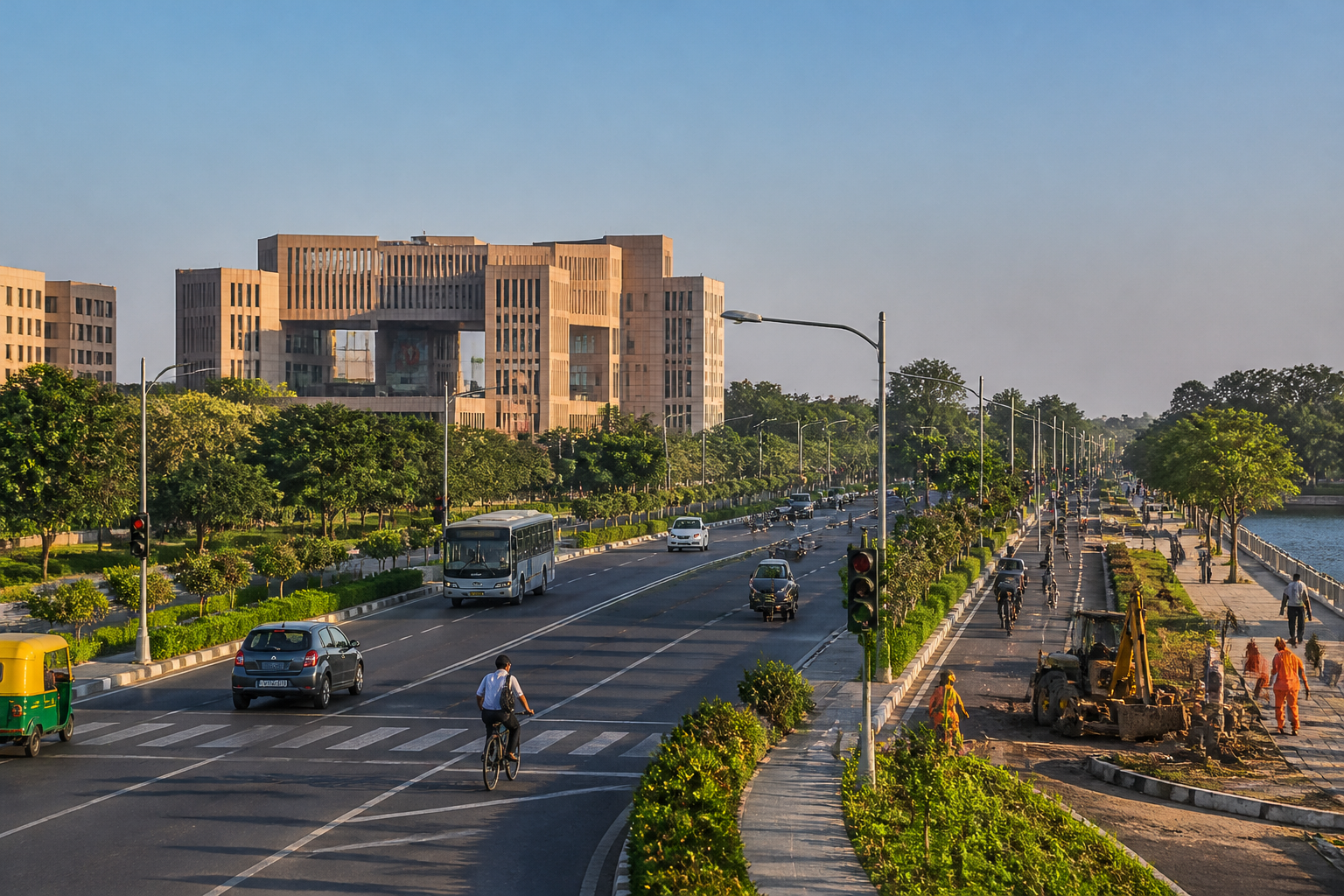
The Gandhinagar civic election manifesto released by the BJP presents the city’s next five years as a programme of technology-led services, expanded public infrastructure and more uniform civic provision. Its promises range from artificial-intelligence laboratories in municipal schools and AI-based traffic signals to smart roads, a sports complex, heritage tourism, decentralised services and upgraded infrastructure in villages brought within the municipal corporation.
The breadth of the Sankalp Patra is significant because it treats Gandhinagar’s future not as a single infrastructure project but as a collection of linked urban systems. Roads, schools, public spaces, waste management, data infrastructure, sports facilities and village services appear in the same civic vision. The central question raised by the manifesto is therefore not only what the city wants to build, but how a municipal corporation will coordinate, finance and operate such a wide range of facilities.
The BJP announced the manifesto for the 2026 civic election in the presence of Gujarat deputy chief minister Harsh Sanghavi. Voting is scheduled for October 11 and counting for October 13. The party already has an overwhelming majority in the Gandhinagar Municipal Corporation. It won 41 of 44 seats in the 2021 election, while the Congress won two and the Aam Aadmi Party one. Both Congress councillors subsequently joined the BJP.
That political context gives the document a particular administrative significance. The manifesto comes from the party that controls the corporation and is seeking to define the next five-year municipal agenda. At the same time, the supplied details describe commitments rather than completed projects, approved budgets or published implementation schedules. The eventual test will be whether the proposals are translated into prioritised municipal programmes with clear responsibilities and timelines.
The transport and road proposals form one of the most extensive parts of the manifesto. The BJP has promised AI-based traffic signals and identified Ch Road, Roads 2 and 3, and the Gh-7-Pethapur stretch for development as smart roads. It has also proposed the phased conversion of urban roads to concrete, modernisation of sector approach roads, and improved traffic facilities and safety on key routes.
These proposals bring together several different kinds of intervention. Smart signals concern traffic management and the use of technology in daily operations. Concrete roads concern construction and long-term road treatment. Sector approach roads and traffic safety relate to the physical network used to enter and move through the city. Treating them as one programme could help connect investment in road surfaces with junction management and user safety, but the manifesto details supplied in the report do not specify costs, construction phases, performance measures or the agency responsible for each intervention.
The technology agenda extends beyond transport. AI laboratories and smart classrooms are proposed for municipal schools, alongside digital learning, STEM and robotics-based education. A Namo Library and the integration of village libraries into the municipal corporation are also promised. Data centre development is included as a way to strengthen Gandhinagar’s digital infrastructure.
Together, these proposals suggest that the manifesto views civic technology as both a public-service tool and an urban-development objective. AI laboratories and digital classrooms concern municipal education. AI-based signals concern city operations. Data centres concern the infrastructure needed to support a technology-oriented economy. Yet these are not interchangeable investments. A school laboratory requires equipment, teachers and maintenance, while a traffic system requires operational integration and ongoing monitoring. The manifesto announces the direction of travel, but the supplied report does not establish how these systems would be connected or funded.
The education proposals also indicate an attempt to extend municipal responsibility beyond conventional physical services. The inclusion of STEM, robotics and digital learning places schools within the city’s broader technology identity. The proposed libraries similarly connect civic education infrastructure with the villages incorporated into the corporation. Whether these facilities can deliver equal access across established urban sectors and newly incorporated areas will depend on their location, staffing and operating arrangements, none of which are specified in the manifesto details reported.
Sports infrastructure is another major pillar. The BJP has promised a modern sports complex in Gandhinagar for the Commonwealth Games, a cricket stadium at Randheja and a sports complex at Pethapur. The plan also includes separate gyms for women and modern training facilities for young athletes. These proposals distribute sports infrastructure across Gandhinagar and nearby incorporated areas rather than limiting it to one central facility.
The proposal for separate gyms for women is notable as a service-design commitment, while the training facilities indicate an emphasis on athlete development rather than only spectator venues. However, the report does not provide information on land, capital expenditure, operating models or the status of any Commonwealth Games decision connected to the proposed complex. The distinction matters because a stadium, a community sports complex and a training facility serve different users and require different management systems.
The manifesto’s cultural and public-space proposals add another layer to the city’s development plan. It promises a city centre and performing arts facility, a modern town hall, redevelopment of Meena Bazaar and an upgrade of the Gh-5 open-air theatre. Tourism proposals include a themed double-decker air-conditioned bus service under Gandhinagar City Darshan and the development of Ambapur Vav as a heritage site.
These commitments frame public space as both civic infrastructure and an economic and cultural asset. The city centre, town hall, market and theatre would serve everyday municipal and community functions, while the bus service and heritage site would create a visitor-oriented layer. The proposal to develop Ambapur Vav also indicates that heritage is being positioned within the city’s tourism strategy. The source report does not state whether heritage conservation plans, transport routes or visitor projections have been prepared.
Environmental and service-delivery commitments appear through the proposed Waste to Best wonder park, the redevelopment of Sector-1 lake and wider greening measures. The lake plan includes a walkway, landscaping and recreational facilities. The manifesto also proposes theme-based plantation and the greening of public spaces.
Waste management and public-space improvement are often presented as visible urban outcomes, but they depend on less visible systems. A waste-themed park requires collection and processing arrangements behind the public-facing facility. A lake walkway requires not only landscaping but continued maintenance and management of the surrounding water body. The manifesto identifies these projects as part of a greener city vision, while the details available do not establish the operational framework that would sustain them.
The most direct equity question in the manifesto concerns villages incorporated into the municipal corporation. The BJP has promised urban-level roads, streetlights, drainage, water and other civic infrastructure for these areas. This is a commitment to extend municipal standards beyond the established city, but it also highlights the administrative challenge created when rural settlements become part of an urban local body.
The promise covers basic infrastructure that residents experience most directly: access roads, lighting, drainage and water. It therefore has a more immediate service-delivery character than proposals such as a data centre or a performing arts facility. The report does not provide the number of incorporated villages, existing service levels or the proposed sequencing of upgrades. Without those details, the manifesto establishes the intended direction but not the scale of the service gap or the resources required to close it.
The BJP’s control of the GMC gives the manifesto continuity with the existing municipal administration, but the range of promises also creates a prioritisation challenge. The document includes road construction, traffic technology, school modernisation, libraries, data centres, stadiums, gyms, cultural buildings, tourism, waste management, lake redevelopment, greening and village infrastructure. These projects span multiple municipal functions and may require coordination with state-level departments and other public institutions.
The supplied report does not identify the proposed funding model, budget allocations, tendering arrangements or implementation deadlines. It also does not state which promises are new commitments and which may extend existing programmes. Those gaps do not invalidate the manifesto, but they define what readers and residents would need to monitor after the election: approvals, project reports, tenders, land arrangements, budget provisions and operating responsibility.
Gandhinagar’s civic election is therefore presenting voters with a broad urban-development proposition. The manifesto combines the language of a technology-driven city with the practical requirements of roads, drainage, water, waste management and public-space maintenance. It also attempts to connect the capital’s planned urban identity with villages, heritage sites, schools and sports facilities.
What the document confirms is the BJP’s stated five-year direction for Gandhinagar. What remains uncertain from the available information is how the commitments will be ranked, financed and delivered. The next significant evidence will come from the corporation’s approved plans, budgets and implementation schedules after the October 11 poll and October 13 counting.
