


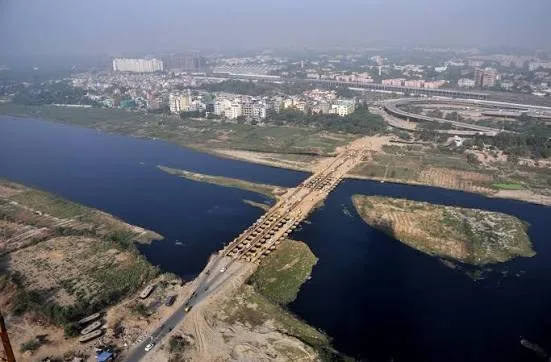
The Delhi government is planning a 52-km riverfront along the Yamuna with cycle tracks, walking paths, sports grounds and recreational spaces, while linking the public-space project to efforts to improve the river’s water quality.
Officials said the government is moving a proposal for a memorandum of understanding with the Sabarmati Riverfront Development Corporation to adapt Ahmedabad’s riverfront model to Delhi. The project would be divided into two phases by the Wazirabad barrage.
The first phase would cover the stretch from Palla to Wazirabad and is being taken up on priority, while the second phase would extend from Wazirabad to Kalindi Kunj near the Okhla barrage. Consultants are being engaged to guide the project, officials said. The first phase is expected to serve as a model for the larger riverfront plan.
Delhi Water Minister Parvesh Sahib Singh said the riverfront could take shape during the current government’s tenure if the plans proceed as envisaged. He said the intended outcome was a clean, green and world-class public space where residents could undertake morning walks, yoga and other recreational activities.
Singh recently visited the Sabarmati riverfront in Ahmedabad with officials from the Delhi Jal Board and the Irrigation and Flood Control department. He said Delhi would adopt the best practices of the Gujarat project while adapting them to the Capital’s requirements. The proposed plan is therefore not a direct replication of Ahmedabad’s riverfront, but an effort to use that project as a reference for Delhi’s river and floodplain context.
The riverfront proposal is being presented alongside measures to address sewage and pollution in the Yamuna. The minister said the river would become visibly cleaner in about two-and-a-half years. Of Delhi’s 37 sewage treatment plants, 28 have been upgraded over the past 18 months, according to him.
The government is also developing new treatment plants intended to add 250 million gallons per day of capacity, with the stated aim of ensuring that all sewage generated in the city is treated. The Yamuna flows for approximately 52 km through Delhi, while the 22-km stretch between the Wazirabad and Okhla barrages remains a major focus of pollution-control efforts.
The plans would combine river-edge public infrastructure with sewage-treatment expansion, but the source report does not provide the proposed cost, land-acquisition details, construction schedule or specific locations of the planned facilities. It also does not state when the proposed memorandum of understanding will be finalised.
As part of the government’s stated effort to encourage public participation, Singh announced plans for huts along the Yamuna’s banks where residents could celebrate birthdays. He said he would celebrate his own birthday near the river on November 7. The next formal steps are the proposed MoU, consultant-led planning and the development of the first phase from Palla to Wazirabad.

