


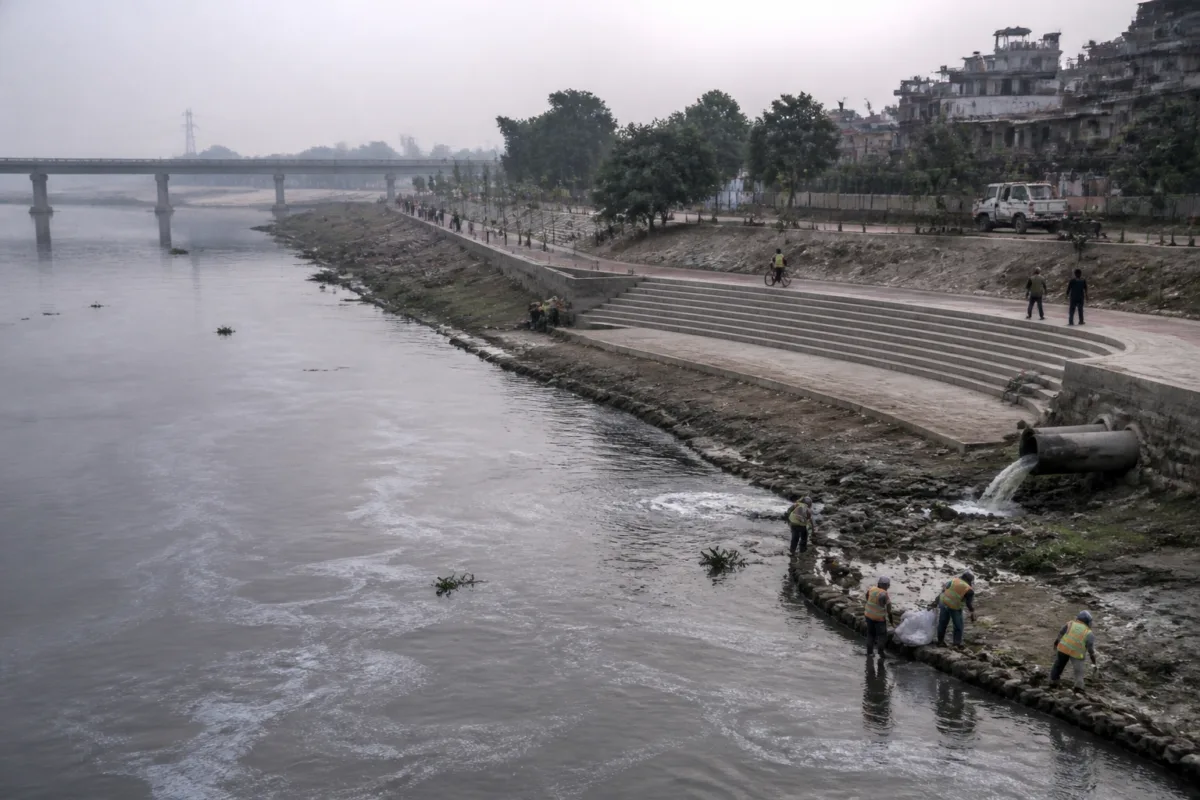
The Delhi government’s proposed Yamuna riverfront is being presented as a public-facing transformation, with spaces for walking, cycling, sports, recreation and even a planned “Birthday with Yamuna” campaign. But the project’s credibility will depend less on the visibility of its promenades than on whether the city can first address the sewage flows that have left a 22-kilometre stretch of the river severely polluted.
Water Minister Parvesh Verma has said the government plans to develop the Yamuna riverfront in two phases, with the Wazirabad barrage dividing the project. The first phase will cover the stretch from Palla to Wazirabad, while the second will extend from Wazirabad to the Okhla barrage. The government is currently appointing consultants and has proposed signing a memorandum of understanding with the Sabarmati Riverfront Development Corporation to study the Gujarat model and adapt its stronger features to Delhi’s requirements.
The announcement combines two different urban tasks. One is the creation of a riverfront as public infrastructure: cycle tracks, walking paths, sports grounds and recreational areas along the river. The other is the less visible but more consequential work of intercepting sewage, upgrading treatment plants and expanding the city’s capacity to process wastewater. The source report indicates that both are being pursued, but it also makes clear that the river’s visible recovery will take considerably longer than the launch of public-facing amenities.
The proposed “Birthday with Yamuna” campaign is intended to create a direct relationship between residents and the river. Under the initiative, temporary or designated huts would allow people to cut cakes and celebrate birthdays on the riverbanks, while participants would also be encouraged to undertake at least one cleaning activity, such as picking up an empty bottle. The idea follows a recent cleaning drive at the Yamuna’s ghats, which the minister said was joined by around 35,000 people, including government ministers and members of the public.
This approach treats public participation as part of river management. The government wants residents to visit the ghats, use the riverfront and help keep it clean. That can make the river a more visible part of Delhi’s everyday civic life. However, participation-led cleanliness drives operate at the surface level of the problem. They can remove visible waste and build civic ownership, but they cannot substitute for the sewage networks, treatment capacity and enforcement systems needed to prevent untreated or inadequately treated wastewater from entering the river.
The government’s own account points to the scale of that infrastructure challenge. Verma said 28 of Delhi’s 37 existing sewage treatment plants had been upgraded over the previous one-and-a-half years. Even after those upgrades, the city reportedly has a shortfall of 250 million gallons per day in sewage-treatment capacity. New plants are being built to address the gap, and the minister said treatment capacity could reach 100 per cent once the work is completed.
That figure is central to the riverfront plan because the condition of the Yamuna is closely connected to the performance of the city’s wastewater system. A riverfront can be designed, landscaped and opened to citizens, but its long-term public value depends on whether the river remains polluted. If the treatment system does not keep pace with sewage generation and the functioning of drains and treatment plants is not sustained, the riverfront risks becoming an attractive edge around a continuing environmental failure.
The spatial division into two phases also reflects the scale of the project. The Yamuna flows through Delhi for 52 kilometres, while the 22-kilometre stretch between the Wazirabad and Okhla barrages is described in the report as severely polluted. This means the most degraded section is not a small, isolated site but a substantial part of the river’s urban course. The government’s plan therefore involves more than the improvement of a single ghat or public plaza. It covers a connected river corridor with different land uses, drainage conditions, flood-management requirements and public-access possibilities.
The Wazirabad barrage’s role as the dividing point is significant for project administration and sequencing. It creates two broad stretches for planning, but it does not divide the river’s ecological or hydraulic systems into independent units. Water quality in one section can be affected by conditions upstream and downstream. A public riverfront strategy will therefore need to be coordinated with the agencies responsible for water supply, sewage treatment, irrigation, flood control and riverbank development. The report specifically refers to discussions involving the Delhi Jal Board and the Irrigation and Flood Control Department, indicating that the project already crosses departmental boundaries.
The proposed agreement with the Sabarmati Riverfront Development Corporation adds another institutional layer. The Delhi government intends to study the Sabarmati model rather than simply reproduce it, according to the minister. That distinction matters because riverfront development models are shaped by local geography, water flows, land ownership, flood risk, pollution loads and the availability of public finance. A design that works in one city cannot automatically resolve another city’s wastewater and river-management problems.
The available information does not establish the project’s final cost, land-acquisition requirements, construction schedule, consultant appointment date or the precise locations of proposed public facilities. It also does not provide a detailed implementation framework for maintaining the riverfront after construction. Those details will determine whether the announcement becomes a coordinated citywide programme or remains a collection of separate construction and beautification works.
Verma has said that residents could begin to see the riverfront’s new form before the next election if the plan proceeds as intended. He has also said that the Yamuna’s water may take around two-and-a-half years to appear clean, after several sewage-treatment upgrades and new plants are completed. These timelines place the project within two different clocks: a political and public-visibility clock for riverfront works, and an infrastructure clock for sewage treatment and water-quality improvement.
The distinction is important for evaluating progress. A new walking track, sports ground or landscaped ghat may be completed before the river’s pollution levels visibly improve. Conversely, treatment capacity may expand without producing an immediately visible transformation if drains, sewer connections or plant operations remain inadequate. The government’s stated target of full sewage-treatment capacity offers one measure of progress, but the source material does not provide details on how performance will be monitored or how treated water quality will be assessed.
The larger urban question is whether Delhi can make the Yamuna both accessible and functional as a public environmental asset. For decades, the river has been physically present but poorly integrated into everyday urban life. The proposed campaign seeks to change that relationship by encouraging people to celebrate, walk, cycle and volunteer along the river. The riverfront plan seeks to change the physical relationship through public spaces and recreational infrastructure. The sewage programme is intended to address the underlying utility system.
These elements will need to move together. Public access without pollution control can expose residents to an unhealthy environment and weaken confidence in the project. Pollution-control works without public access can remain invisible and fail to build lasting civic engagement. The government’s current announcement connects the two, but the evidence supplied so far is stronger on the broad vision than on the detailed delivery mechanism.
Delhi’s Yamuna riverfront plan has therefore moved beyond a simple beautification proposal. It is being framed as a combination of river restoration, sewage infrastructure, public space and citizen participation. The government has announced a two-phase geography, a proposed study of the Sabarmati model, consultant appointment, sewage-treatment upgrades and a capacity target. The next decisive milestones will be the formalisation of the inter-agency plan, the appointment of consultants, the proposed memorandum of understanding and measurable progress in closing the reported 250-million-gallon-per-day treatment gap.

