


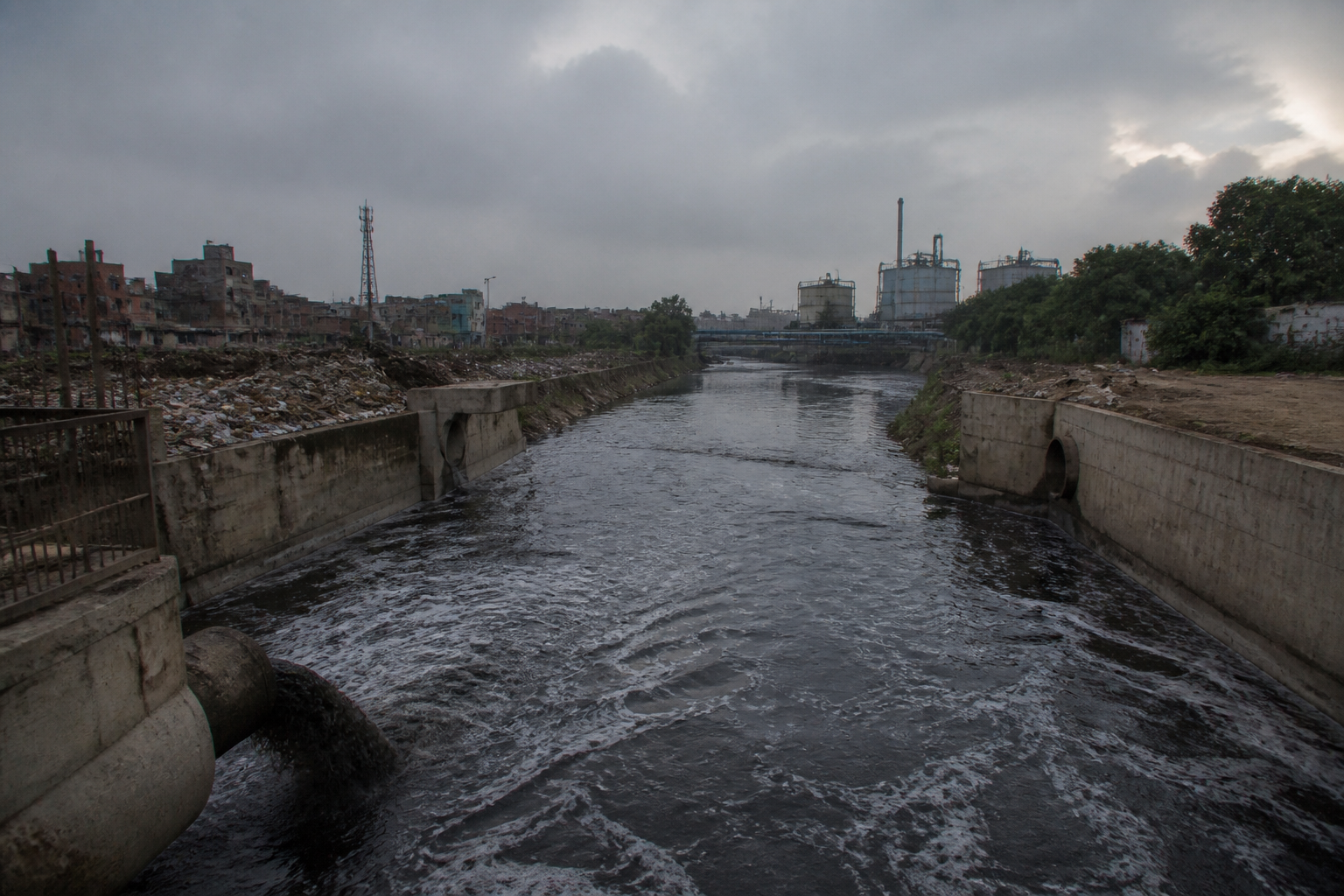
A report filed before the National Green Tribunal has exposed a persistent weakness in Delhi’s sewage system: 249 million litres a day of sewage remains outside the city’s treatment system, while 12 of its 22 sewage drains are still untapped. The findings show that the Yamuna’s pollution is not only a question of treatment-plant capacity, but also of whether sewage is actually connected, intercepted, transported and treated across the city.
The observations were submitted by amici curiae Katyayni Chaubey and Vikrant Badesra in an ongoing NGT matter concerning compliance with the Municipal Solid Waste Management Rules, 2016, and other environmental issues. Their note, dated September 16, also addresses liquid waste management in Delhi and the rejuvenation of the Sahibi river, known as the Najafgarh Drain within the city.
The report places the Yamuna at the centre of the issue because it is the ultimate recipient of liquid waste generated in Delhi. Its assessment links the river’s continuing poor condition to untreated sewage entering waterbodies through gaps in the city’s drainage and sewerage network.
The capacity paradox
Delhi generates 3,636 million litres of sewage a day, according to the observations. Sewage treatment plants operated under the Delhi Jal Board have an installed capacity of 3,702 MLD. On paper, that capacity is higher than the sewage generated. However, only 3,387 MLD of the installed capacity is being utilised, leaving a reported gap of 249 MLD between sewage generation and sewage entering the treatment system.
This distinction is central to understanding Delhi’s treatment problem. Installed capacity is a measure of what treatment plants can handle under their design specifications. It does not establish that all sewage generated in the city reaches those plants. Sewage can remain outside the treatment chain when households lack sewer connections, drains are not intercepted, conveyance systems are incomplete, or stormwater infrastructure is used to carry wastewater.
The report also questions the Delhi Jal Board’s claim of more than 91.5% sewage treatment plant utilisation. The amici said the claim was difficult to reconcile with the high pollution levels recorded in the Yamuna. They stated that the mismatch could indicate under-performance by commissioned plants, unaccounted or illegal discharge bypassing the treatment chain, or sewage flowing through untapped sewage and stormwater drains. The report stressed that these possibilities require examination rather than presenting them as conclusively established causes.
The numbers show why a capacity-led assessment is insufficient. Even if Delhi has nominal treatment capacity close to or above its sewage generation, the city’s water quality depends on the entire chain working together: household connections, local sewers, trunk infrastructure, drain interception, treatment plants and sludge management. A failure at any point can leave sewage untreated despite the existence of plant capacity elsewhere in the network.
Untapped drains and missing connections
The observations identify 12 untapped sewage drains among 22 drains carrying a combined flow of 5,196.44 MLD of sewage. According to the report, the untapped drains result in the direct and continuous discharge of untreated sewage into receiving waterbodies. Ten stormwater drains are also being used for sewage disposal.
This creates a structural problem for a city that separates sewage and stormwater systems in its planning framework but does not always maintain that separation on the ground. When stormwater drains carry sewage, the pollution pathway can remain outside the formal sewage-treatment network. The existence of treatment plants therefore does not guarantee that wastewater from all neighbourhoods is being routed to them.
The household connection gap adds another layer. Against a target of 40 lakh household sewer connections, only 23.5 lakh had been achieved, leaving 16.5 lakh households without connections. The Delhi government had earlier set June 2028 as the deadline for connecting these households.
The connection figures show that sewage management is also a service-access issue. A household without a sewer connection cannot send its wastewater into the city’s formal treatment system, regardless of the treatment capacity available at a plant. The report’s numbers consequently shift attention from plant construction alone to the slower and more distributed task of connecting properties and extending functioning networks across urban areas.
The figures also indicate the scale of the remaining work. The reported shortfall of 16.5 lakh household connections is several times larger than a limited local upgrade. It involves network expansion, property-level connections, coordination with roads and other utilities, and a system for ensuring that newly connected sewage reaches treatment facilities rather than leaking into open drains.
Treatment compliance and sludge management
The report states that 29 sewage treatment plants comply with Delhi Pollution Control Committee standards, while seven are non-compliant. The amici sought disclosure of the seven plants and the specific parameters on which they fail to comply.
That request is significant because a plant’s presence or utilisation rate does not by itself establish environmental performance. Compliance depends on the quality of treated effluent and whether the plant consistently meets the applicable standards. Without disclosure of the parameters of non-compliance, the public record does not show whether the deficiencies relate to one pollutant, multiple parameters, intermittent performance or broader operational failures.
The observations also sought a plan for the proposed 600-tonne-per-day sludge management capacity for 26 sewage treatment plants that currently lack functioning sludge-management facilities. Sludge is a residual product of sewage treatment and requires its own handling and disposal arrangements. The report’s inclusion of sludge management shows that the treatment chain does not end when wastewater passes through a plant.
A system that treats liquid sewage but lacks functioning sludge facilities can shift part of the environmental burden to another point in the urban system. The supplied report does not establish the precise consequences at each of the 26 plants, but it identifies the absence of functioning sludge-management facilities as an unresolved infrastructure gap requiring a plan.
What the Yamuna evidence reveals
The observations record water-quality analysis showing high biochemical oxygen demand, nil dissolved oxygen and alarmingly high faecal coliform levels in the Yamuna. These indicators are consistent with a heavily polluted river receiving substantial organic and sewage contamination, as described in the report.
The amici said the water-quality findings were difficult to reconcile with the reported 91.5% utilisation of sewage treatment plants. Their conclusion was not that one specific failure had already been proven, but that the discrepancy required examination of several possible pathways: under-performing plants, bypasses, illegal discharge, untapped sewage drains and stormwater drains carrying sewage.
This is the institutional question raised by the report. Different agencies can report progress using different operational measures: treatment capacity installed, capacity utilised, connections completed, drains intercepted or plants meeting standards. Each number may be accurate within its own definition, while the river continues to show the cumulative outcome of failures between those points.
The report therefore points towards the need for a joined-up accounting of sewage. Such an accounting would have to connect the volume generated in households and institutions with the volume collected, conveyed, treated, compliant with standards and safely managed as sludge. The supplied material does not state that such a unified accounting system currently exists, but the gap between the reported utilisation claim and river-quality evidence makes the need for closer reconciliation clear.
The Najafgarh Drain and inter-state coordination
The observations describe the Najafgarh Drain as the degraded course of the Sahibi river. They state that it has become heavily polluted through untreated sewage, solid waste and effluents. The drain is therefore treated not simply as a local Delhi channel but as part of a wider river system requiring coordination beyond the city.
The amici proposed a joint Delhi-Haryana-Rajasthan mechanism for rejuvenating the Sahibi river. Their suggested measures included sewage interception, restoration of the natural channel, removal of encroachments and continuous water-quality monitoring.
The proposal reflects the administrative geography of urban water pollution. Delhi’s sewage flows may be generated within municipal boundaries, but the receiving water system does not stop at those boundaries. A drain, river or downstream waterbody can connect multiple jurisdictions, while responsibility for treatment, enforcement and restoration remains divided among governments and agencies.
The need for a joint mechanism, as proposed in the observations, also shows why isolated projects may not resolve the problem. Intercepting one drain or upgrading one plant can improve a local segment, but river restoration depends on reducing pollution across the connected system and monitoring whether improvements persist.
What remains unresolved
The report establishes a substantial difference between sewage generated in Delhi and sewage entering the treatment system, as well as gaps in drain interception, household connections, plant compliance and sludge management. It does not, by itself, establish which of these factors contributes the largest share of pollution in the Yamuna.
The immediate institutional tasks identified by the amici are specific: prepare a firm action plan for tapping untreated drains; disclose the seven non-compliant sewage treatment plants and their parameters of non-compliance; develop the proposed sludge-management capacity; and create a mechanism for the Sahibi river’s rejuvenation.
The 2028 deadline for completing the remaining household sewer connections is another milestone, but the report’s evidence suggests that connection numbers will need to be considered alongside actual sewage flow, treatment performance and water-quality outcomes. The central issue is not merely whether Delhi has built enough treatment capacity. It is whether the city can account for every major pathway by which sewage moves from homes and drains to the Yamuna.
The NGT proceedings will determine how these gaps are examined and what action plans are sought from the responsible authorities. Until the untreated drains, missing connections, non-compliant plants and sludge facilities are addressed as one connected system, Delhi’s treatment capacity figures will continue to sit uneasily beside the Yamuna’s pollution data.
