


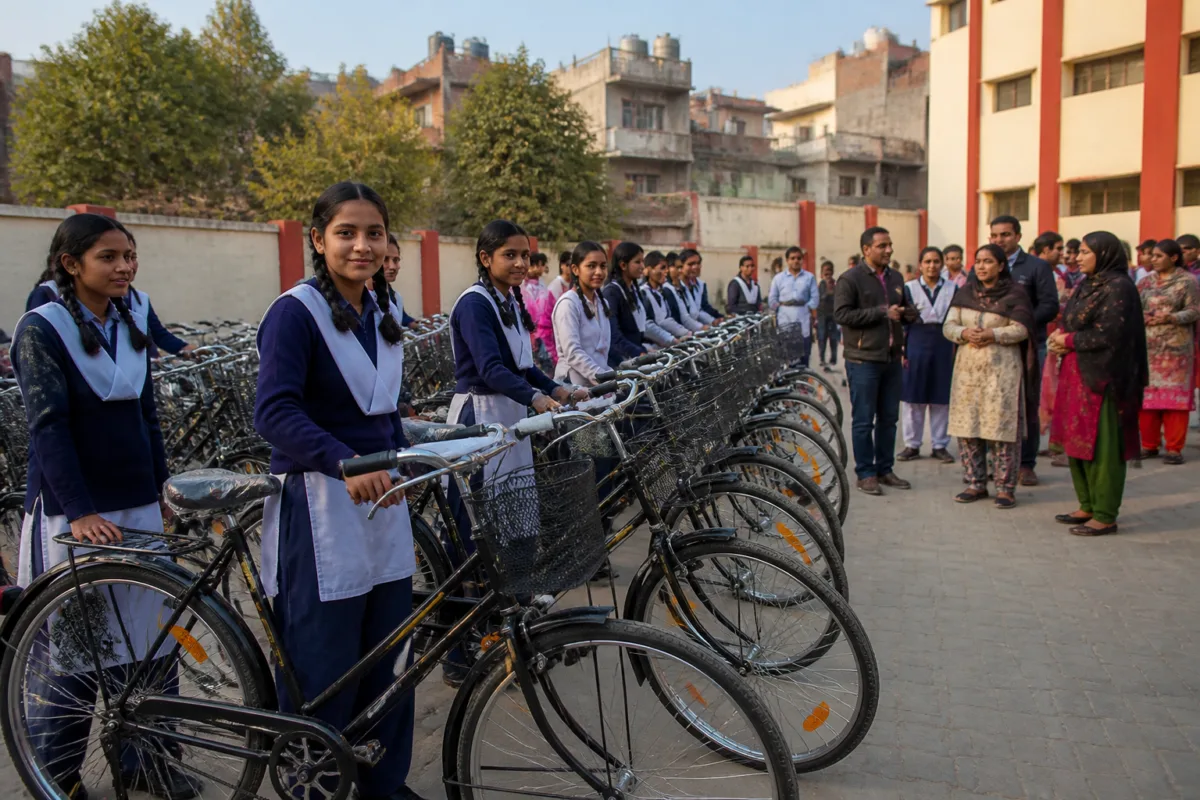
Delhi’s Vidya Vahini bicycle scheme is being presented by the government as an education-access intervention, but the figures and timelines in the available account require clarification before the programme’s scale can be firmly established. The Delhi government says bicycles are being distributed to Class IX girls in government schools to reduce the effect of distance and limited transport on school attendance and continuation.
The programme has already moved beyond the announcement stage. According to Millennium Post, 28,000 bicycles had been distributed by October 15, while the government aimed to distribute 40,000 bicycles by the end of October. The report also says that distribution to the remaining beneficiaries was scheduled for completion by November 2026. These milestones are not fully reconciled in the supplied account, particularly because the report does not state how the 40,000-bicycle target relates to the larger beneficiary estimates cited elsewhere.
The Delhi government has allocated Rs.90 crore for the initiative. Distribution is being conducted through district-level programmes, with Chief Minister Rekha Gupta, Education Minister Ashish Sood, Cabinet ministers, MPs and local MLAs participating in events in their respective constituencies. The administrative model described in the report therefore combines a citywide education intervention with constituency-level public distribution events.
That structure matters because the scheme is not simply a transfer of bicycles. It is an attempt to address the everyday link between mobility and access to public education. For a Class IX student, the distance between home and school can affect the practical ability to attend regularly, particularly where families face transport costs or where other mobility options are limited. The government’s stated objective is to ensure that distance and lack of transportation do not interrupt girls’ education.
Sood described the bicycle as “not just a gift or a means of transport” but as “a wheel of empowerment and self-reliance”. He said the scheme was intended to prevent girls’ education from being halted by distance or lack of transport. Those statements establish the government’s policy framing, although the supplied report does not provide attendance, retention or completion data to show whether the bicycle distribution has already produced measurable educational outcomes.
The scheme was launched by Gupta on July 31 at the Sports Complex in East Vinod Nagar. The initial event involved more than 3,000 Class IX students. At the launch, the Chief Minister announced that nearly 1.40 lakh girl students would receive bicycles in a phased rollout, with the programme intended to continue in subsequent years.
The available numbers point to a significant programme, but they do not describe one consistent target. The report refers to an immediate aim of 40,000 bicycles, a wider expectation that 1.30 lakh girl students enrolled in Delhi government schools would receive bicycles, and the launch announcement of nearly 1.40 lakh beneficiaries. It does not explain whether these figures represent different phases, revised estimates, separate school cohorts or different categories of eligible students.
The timelines also need confirmation. The government is reported to have aimed to distribute 40,000 bicycles by the end of October, while distribution to the remaining beneficiaries is described as scheduled for completion by November 2026. The source does not clarify whether the November date refers to the same 40,000-student phase or to the larger rollout. Since the report was published in October 2026, the distinction is important for assessing whether the programme is on schedule.
This uncertainty does not remove the urban significance of the initiative. Cities often treat school access as an education question while the daily journey to school is shaped by transport availability, distance, household resources and neighbourhood connectivity. A bicycle can function as a low-cost mobility asset, but its usefulness depends on the route a student must travel, road conditions, traffic safety, secure parking and the ability to maintain the vehicle.
The supplied report does not provide details on how beneficiaries were selected, whether bicycles are accompanied by safety equipment or maintenance support, or whether the government has mapped the distances between students’ homes and schools. It also does not state how the programme will account for students who cannot cycle, who face unsafe routes or whose schools are already accessible through other forms of transport.
Those omissions are relevant to evaluating the scheme as public policy. The government’s stated purpose is to remove transport-related interruptions to education, but the report provides no baseline against which that goal can be measured. The number of bicycles distributed is an implementation output. It is not, by itself, evidence of improved attendance, reduced dropouts or greater continuation into higher classes.
The programme’s proposed continuation in subsequent years also raises an administrative question about recurring responsibility. A phased rollout requires the government to identify eligible students, procure and distribute bicycles, maintain beneficiary records and monitor whether the assets remain usable. The supplied material confirms the distribution effort and its stated objectives, but it does not describe the monitoring framework, procurement process or budget beyond the Rs.90 crore allocation.
The scheme also sits within a broader political and administrative presentation of public spending. Sood contrasted the initiative with expenditure on publicity campaigns, saying the government had chosen direct investment in girls’ futures over “multi-crore ad campaigns”. He pointed to the confidence and happiness of students receiving bicycles as the programme’s real advertisement. These are statements from the minister and should be understood as the government’s justification for the scheme, rather than independent evidence of its impact.
The immediate evidence confirms that Delhi has begun distributing bicycles under Vidya Vahini and that the intervention is aimed at Class IX girls in government schools. It also confirms a Rs.90 crore allocation, 28,000 bicycles distributed by October 15 according to the report, and a launch date of July 31. What remains unresolved is the programme’s final beneficiary count, the relationship between the 40,000-bicycle milestone and the larger targets, and the applicable completion date.
A government notification, beneficiary breakdown or updated departmental statement would be needed to establish those points. Until then, Vidya Vahini can be understood as a major urban mobility and education-access initiative whose implementation scale is not yet consistently documented in the supplied material. Its longer-term significance will depend on whether distribution is matched by safe routes, continued usability and evidence that transport constraints have actually reduced interruptions to girls’ education.

