


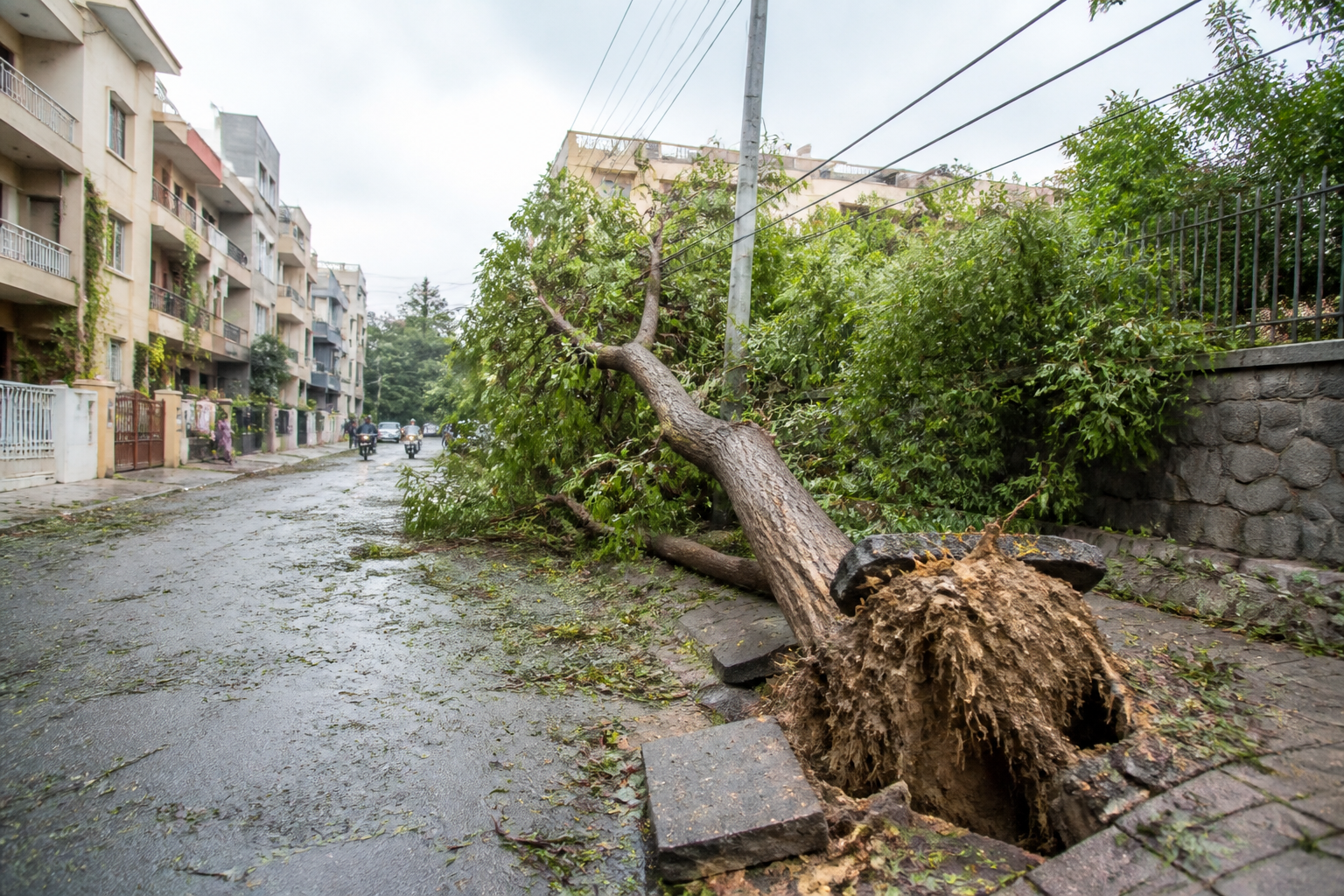
The Delhi High Court’s stay on an order requiring an 80-year-old Rohini resident to plant 21 trees has brought an unusual dispute over one fallen neem tree into a larger question about how urban environmental rules are enforced. The case is not only about whether a tree was illegally felled; it is also about the limits of administrative power, the design of Delhi’s tree-protection law and the coordination failures that can turn a storm-damaged tree into a prolonged legal dispute.
The tree was planted outside Gurmail Singh Bhatia’s home in 1991. Bhatia, a retired Class I Union government officer, told the court that he had nurtured it for 35 years before a severe dust storm and thunderstorm uprooted it on May 11, 2024. Wind speeds during the storm reached up to 77 km/h. Part of the neem tree was left hanging over live electric wires, creating an immediate safety concern.
According to Bhatia’s plea, he approached the Municipal Corporation of Delhi’s horticulture division for assistance. He said the civic body took about two months to respond, eventually cutting the fallen tree into pieces and removing the material along with roughly two-thirds of the stem. Around one-third remained at the site and, according to his submission, continued to rot.
The delay and the eventual handling of the tree are important because the dispute began as a question of public safety and municipal response. It later became a forest-department proceeding against the property owner. Bhatia said his estranged younger son, with whom he was already involved in a partition dispute, subsequently complained that he had illegally felled the tree. The forest department’s tree officer then issued notice to Bhatia, requiring him to appear in December 2024.
In August 2026, the tree officer found Bhatia preliminarily in violation of the Delhi Preservation of Trees Act and directed him to plant 20 tall saplings at a nearby location and one additional tree at the original site. The order required native species, a minimum height of six feet and a collar girth of at least 10 centimetres. It also required Bhatia to maintain, water and ensure the complete survival of the saplings for seven years, replacing any that died.
That scale of obligation is central to the legal dispute. The original tree was one neem tree outside a residence. The administrative direction converted the alleged violation into responsibility for 21 trees, including seven years of maintenance. Bhatia had told the forest department that his medical condition would make it impossible for him to look after the proposed plantation.
The forest department defended the order by relying on Section 31 of the Delhi Preservation of Trees Act. As described before the High Court, the provision gives tree officers quasi-judicial and legal powers, including the ability to summon witnesses, issue search warrants under the Code of Criminal Procedure and direct persons to undertake alternate plantation. Section 24 provides for penalties for violations of the Act, including disobeying an order of a tree officer.
Justice Amit Mahajan questioned whether those powers extended as far as the direction issued to Bhatia. The judge orally asked the state, “How can you pass such an order? You’re not a court.” The court also described the Act as “badly drafted” and questioned the authority to compel someone to plant trees if that person did not agree. The High Court stayed the deputy conservator of forest’s direction and sought a response from the Delhi government’s forest department.
The case therefore exposes a distinction that is often blurred in urban environmental enforcement: the difference between protecting existing trees, penalising an unauthorised act and imposing a new public or private environmental obligation. Each objective may be defensible in principle, but the legal authority, procedure and proportionality for each can be different. The court’s intervention suggests that these distinctions may not be sufficiently clear in the current statutory framework.
It also highlights the fragmented chain of responsibility around urban trees. The MCD’s horticulture division was the agency approached after the tree fell near live wires. The forest department’s tree officer later initiated proceedings under the Delhi Preservation of Trees Act. The case thus moved between civic maintenance, public safety and environmental regulation, without the supplied material establishing how responsibility was allocated during the two-month period before the site was attended to.
That institutional sequence matters for residents. When a tree is damaged by a storm, the immediate concern may be falling branches, electrical hazards or obstruction of a road or entrance. Residents may not know which agency has authority to remove the danger, document the condition of the tree or determine whether the damage was natural or the result of illegal action. If the first response is delayed, the physical evidence can change and the eventual dispute can become harder to resolve.
The plantation requirement also raises a practical enforcement issue. The order did not simply specify that trees be planted. It required native species, minimum physical dimensions and complete survival for seven years, with replacement of trees that died. Those conditions indicate an attempt to make compensatory plantation meaningful rather than symbolic. At the same time, they create a long-term compliance burden that may be difficult to administer, especially when imposed on an individual whose health and capacity are disputed.
The court has not, based on the supplied material, finally ruled on the validity of the Delhi Preservation of Trees Act or on whether Bhatia violated it. The stay is an interim development. The High Court has sought the forest department’s response, and the legal question remains whether the tree officer’s statutory powers authorise the specific plantation and maintenance directions issued in this case.
The broader urban question is not whether compensatory plantation should exist. Delhi’s tree-protection system needs enforceable mechanisms if it is to respond to unauthorised felling and preserve urban canopy. The case instead asks who should bear responsibility when a tree falls during an extreme weather event, how the event should be investigated, what role the municipal body should play and what limits apply when an environmental authority imposes a remedial order.
Until the High Court receives and considers the Delhi government’s response, the case confirms only that the 21-tree direction is stayed and that the court has raised concerns about the statutory basis for it. The next significant development will be the forest department’s response and the court’s examination of the powers available to tree officers under the Delhi Preservation of Trees Act.
