


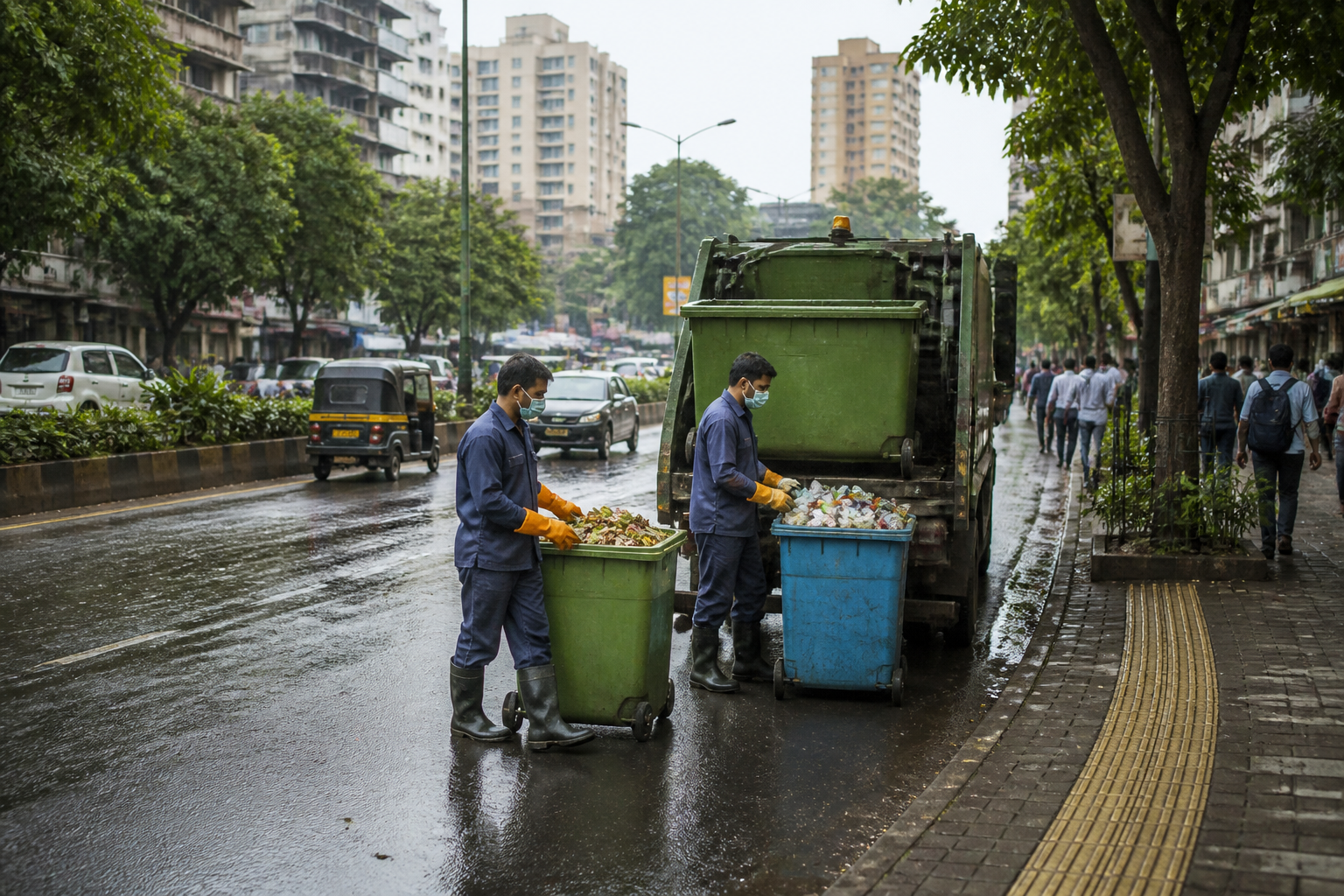
Thane’s new waste management plan places a 10-year municipal contract worth Rs 3,300 crore at the centre of the city’s effort to fix daily cleanliness services. The Thane Municipal Corporation has divided the city into three zones and plans to assign each zone’s integrated sanitation work to one contractor, with half of monthly payments linked to measured performance.
The tender covers activities that are currently handled through separate systems and contractors, including door-to-door waste collection, transportation, manual and mechanised road sweeping, market cleaning, special sanitation in slum areas, public awareness and waste segregation. The proposed arrangement is expected to become operational in the new year, following approval of the proposal by the general body and the issue of the tender.
The scale of the contract reflects the scale of the municipal challenge. Thane Municipal Corporation covers 128 square kilometres and has a population of more than 2.7 million, according to the report. The city’s housing complexes, industrial activity, information-technology sector and continuing development work also bring an estimated three to four lakh people into the city every day. Together, residents and daily visitors generate approximately 1,500 to 1,600 metric tonnes of solid waste each day.
At present, door-to-door collection, waste transportation and road sweeping operate through separate arrangements. Bell-ringing collection vehicles and waste carriers are also deployed on a rental basis. The municipal administration has attributed the decision to create an integrated system to shortcomings in the existing arrangement. The proposed contract is intended to place the complete chain of cleanliness services in each zone under one accountable agency rather than leaving individual activities distributed across multiple systems.
The payment structure is the most significant administrative change in the proposal. Contractors will not receive the full fixed amount automatically. Fifty per cent of the monthly payment will be provided for specified costs, while the remaining 50 per cent will depend on performance criteria. The administration has said that daily records of the contractor’s work will be maintained and that deductions will be made for deficiencies before payment is released.
This approach changes the contract from a simple service-procurement arrangement into a performance-monitored municipal system. Its effectiveness will depend on what is recorded, who verifies the records and how quickly deductions are imposed when services fail. The report does not specify the detailed performance indicators, inspection technology, public reporting mechanism or dispute-resolution process that will govern these payments. Those details will be important because cleanliness is experienced street by street, while contracts are administered through files, measurement books and payment approvals.
The first zone will include Diva, Mumbra and Kalwa, with an estimated 10-year expenditure of Rs 1,103 crore. The second will cover Majiwada-Manpada, Vartak Nagar and Lokmanya-Sawarkar Nagar, where the projected cost is Rs 1,169 crore. The third will comprise Uthalsar, Naupada-Kopri and Wagle areas, with an estimated cost of Rs 1,027 crore.
The combined zone-wise estimates total Rs 3,299 crore, broadly corresponding to the stated overall tender value of Rs 3,300 crore. The average annual commitment across the city works out to about Rs 330 crore, while the reported daily waste generation would place the average annualised municipal commitment at roughly Rs 566 per tonne of waste generated. This is only a simple comparison between the proposed contract value and the reported waste volume; it does not establish the actual cost of collection, transport, sweeping, processing or disposal.
The proposed system is also designed around four streams of waste: wet waste, dry waste, health-hazardous waste and waste requiring special care. The contractors are expected to collect segregated waste and achieve 100 per cent processing of the collected material. That objective makes segregation a critical operational link. Collection vehicles, households, markets, housing societies and processing facilities would all need to follow compatible procedures for the target to have practical meaning.
The contract’s geographic design may help the municipal corporation identify responsibility more clearly. Each contractor would be responsible for the complete cleanliness system within a defined area, allowing complaints and service failures to be mapped to a specific zone. It could also make coordination easier between collection, transportation and road cleaning, which are currently described as separate arrangements. At the same time, assigning an entire zone to one agency concentrates operational responsibility and makes contract supervision more important.
The three zones differ in their urban form and service demands. Diva, Mumbra and Kalwa include dense settlements and fast-growing urban areas. Majiwada-Manpada, Vartak Nagar and Lokmanya-Sawarkar Nagar include established neighbourhoods as well as areas shaped by new construction and housing growth. Uthalsar, Naupada-Kopri and Wagle include central, residential and industrial-influenced parts of the city. The supplied report does not provide separate waste-generation figures or service-cost benchmarks for these zones, so the fairness of the allocations cannot be assessed from the available information.
The proposal is described as being based on Chennai’s model, but the report does not set out which specific elements of Chennai’s system Thane plans to adopt. It also does not provide details of the proposed workforce, fleet size, transfer infrastructure, processing facilities or final disposal arrangements. These omissions matter because collection and sweeping are only the visible parts of a waste-management chain. The city’s stated goal of processing all collected waste will depend on capacity beyond the roadside collection system.
The institutional question is therefore larger than whether the tender is awarded. The municipal corporation will have to act as contract manager, service auditor and public authority. Daily records may create a formal basis for payment deductions, but the value of those records will depend on consistent inspections and transparent standards. If records measure only the movement of vehicles or completion of assigned tasks, they may not fully capture uncollected waste, missed lanes, overflowing community points or poor segregation.
The proposed 50:50 payment structure gives the administration a financial tool to respond to inadequate performance. It also creates a need for clearly defined responsibilities between the corporation and the contractors. The supplied material does not state whether citizens will be able to view performance scores, submit complaints linked to payment decisions or track corrective action. Without such information, the system’s accountability remains largely internal to the municipal administration.
The tender also raises a question about the long-term balance between outsourcing and municipal capacity. Thane currently uses separate contractors and rented vehicles for several services. The new model would consolidate these functions under three contractors for a decade. A long contract can provide continuity in fleet deployment, staffing and service planning, but it can also make changes more difficult if the original service design proves inadequate. The report does not provide details of termination clauses, review points or mechanisms for revising the arrangement during the 10-year period.
For residents, the immediate test will not be the size of the tender but the reliability of ordinary services: whether waste is collected from homes, whether roads and markets remain clean, whether slum areas receive regular attention and whether segregated waste remains separated after collection. For the corporation, the test will be whether a large expenditure commitment produces measurable improvement rather than simply transferring fragmented responsibilities into a larger contract.
Thane’s proposal confirms the scale of the city’s waste challenge and the administration’s attempt to address it through zone-based consolidation and performance-linked payments. What remains uncertain is how performance will be defined, verified and disclosed, and whether the promised 100 per cent processing target is supported by adequate downstream infrastructure. The next important milestones will be the tendering process, appointment of the three contractors and publication of the operating standards under which the new system is expected to begin.
