


The Delhi Jal Board’s proposed 10-year sewer overhaul is not merely a large infrastructure allocation. It is an attempt to change how one of the capital’s most difficult public services is managed: by placing an entire sewer network zone under a single operator, linking payments to performance and using digital monitoring to track work from inspection to completion.
The board has given in-principle approval to a ₹17,969.93-crore programme under which Delhi would be divided into eight zones. One operator in each zone would be responsible for sewer lines, manholes, pumping stations and complaints. The stated objective is to move away from reactive, complaint-based repairs towards planned preventive maintenance.
That proposed shift matters because sewerage is a network service whose failures are experienced locally but often produced by institutional fragmentation. A blocked line, overflowing manhole or malfunctioning pumping station may be visible to residents as a single problem, while responsibility is distributed across different divisions, contractors and officials. The model announced by the DJB seeks to make the operator responsible for the network as a whole within a defined area.
The scale of the system explains the administrative challenge. The DJB currently maintains 11,212 km of sewer lines, 6.68 lakh manholes and 145 pumping stations. These assets are spread across a large and densely occupied city, making maintenance dependent not only on new construction but also on regular inspection, timely cleaning and coordination between field teams and control rooms.
The proposed arrangement would give each of the eight operators a wider responsibility than carrying out isolated repair jobs. According to the DJB, the system would include geotagged inspections and real-time monitoring through a central command centre. The proposed use of these tools indicates a move towards recording the location and status of assets and complaints rather than relying only on reports generated after a failure.
Water Minister Parvesh Sahib Singh described the reform as an effort to fix responsibility for service failures. “For a Delhi resident, it should not matter which officer, division, or contractor is responsible for a sewer,” he said. “If there is a problem, the system should know about it, someone should be responsible for fixing it, and the work should be tracked till it is completed.”
The statement captures the central governance issue in the proposal. A public utility is judged by residents through the reliability of the service, not through the internal distribution of administrative duties. When responsibility is divided without a clear mechanism for tracking outcomes, residents may be required to navigate the system themselves. The proposed zone-based model attempts to make the utility’s internal structure less consequential for the person reporting a problem.
However, assigning responsibility is only one part of making a network perform. The DJB has said that contractor payments would be linked to performance, with the aim of achieving faster complaint resolution and fewer sewage overflows. This would change the basis on which contractors are paid, at least in principle, from completing specified tasks to meeting service outcomes.
The effectiveness of that arrangement will depend on how performance is defined and measured. The supplied announcement does not specify the proposed response times, service-level standards, penalties, inspection frequency or process for independently checking contractor performance. Those details will be important because a monitoring system can record activity without necessarily proving that the underlying network is functioning reliably.
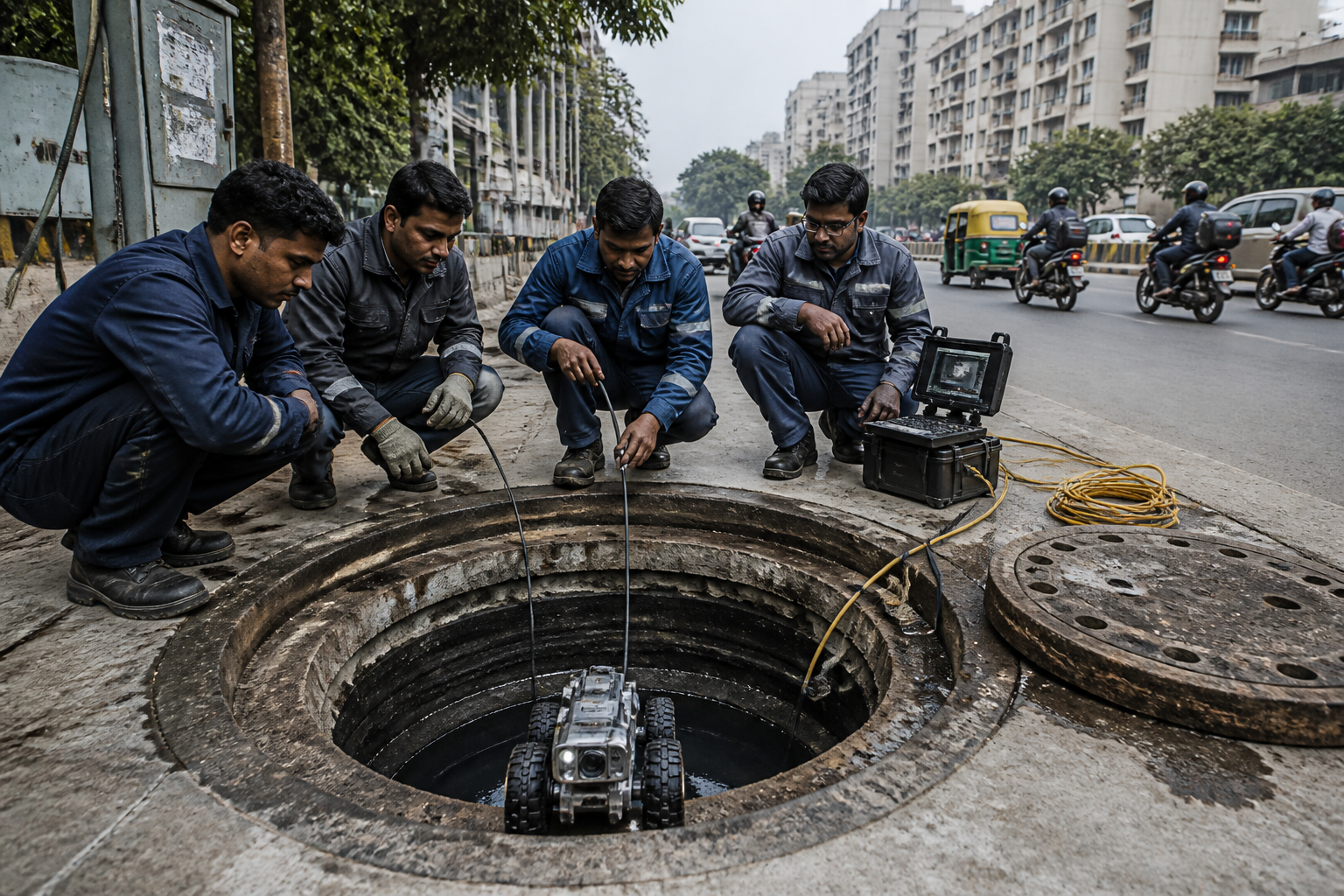
The proposed 100% mechanical and robotic cleaning of sewers is another significant feature of the programme. It signals an effort to standardise the cleaning process and reduce dependence on manual entry into sewer infrastructure. The DJB has presented mechanical and robotic cleaning as part of the new system, alongside monitoring and preventive maintenance.
The announcement does not provide a project-wise implementation schedule for the cleaning programme or identify the technologies and operating protocols that would be used. It therefore establishes the direction of the proposed reform, but not yet the operational details by which its results can be assessed. The next stages of approval, contracting and implementation will determine how the principle is translated into field practice.
The sewer programme is being proposed alongside a separate ₹6,044.05-crore project to refurbish water supply infrastructure in south Delhi. That project will cover 247 square kilometres and 2,44,381 domestic consumers. Its inclusion in the same set of DJB approvals shows that the board is addressing both sides of the urban water utility: the movement and supply of potable water, and the collection and management of wastewater.
The south Delhi project would introduce smart meters, bulk flow meters, chlorine sensors and pressure sensors. According to the official statement, these systems are intended to support real-time monitoring, accurate metering and water auditing. In institutional terms, the project is designed to produce better information about how water enters, moves through and is consumed across the network.
That information has a direct bearing on utility management. Domestic metering can provide a basis for recording consumption, while bulk-flow measurement can help compare water entering a defined part of the system with the quantities recorded at consumer connections. Pressure and chlorine monitoring can provide operational information about the condition of supply. The source material does not state how these measurements will be used for billing, leakage control or service guarantees, so those implications remain to be established.
What links the two projects is the attempt to make invisible network conditions more visible to the utility. Sewer lines, manholes, pumping stations, pipelines and pressure conditions are largely underground or dispersed across neighbourhoods. Residents usually encounter them only when a service fails. Geotagged inspections, central monitoring and sensor-based measurements are intended to give the utility a more continuous view of its assets and operations.
This is also why the programme should be understood as a management reform rather than only a construction or refurbishment package. The sewer proposal does not simply promise additional infrastructure. It proposes a different allocation of responsibility, a different maintenance cycle and a different relationship between contractors and the public utility. The water supply project similarly combines physical refurbishment with systems for measuring and monitoring network performance.
The DJB’s announcement, however, is an in-principle approval. It does not establish that the 10-year programme has already been fully contracted, funded or implemented. It also does not provide a zone-wise rollout plan, the names of future operators, procurement conditions or milestones for the south Delhi project. These are important distinctions in a programme whose stated value runs into thousands of crores of rupees.
For residents, the practical test will be whether the proposed structure makes it easier to report a problem and more likely that it is resolved within a defined time. For the utility, the test will be whether the new model can connect asset-level information with maintenance decisions and contractor payments. For administrators, it will be whether a single operator for each zone improves coordination without creating a new concentration of responsibility that is difficult to supervise.
The evidence currently confirms the scale and direction of the reform: Delhi’s sewer network is to be managed through eight proposed zones, with one operator responsible for each zone; cleaning is to be mechanised and robotic; inspections and complaints are to be monitored through digital systems; and south Delhi’s water infrastructure is proposed for refurbishment with new metering and sensing equipment. The remaining questions concern the programme’s rollout, performance standards, procurement and implementation. Those details will determine whether the announcement becomes a durable change in how Delhi’s water utility functions.
