


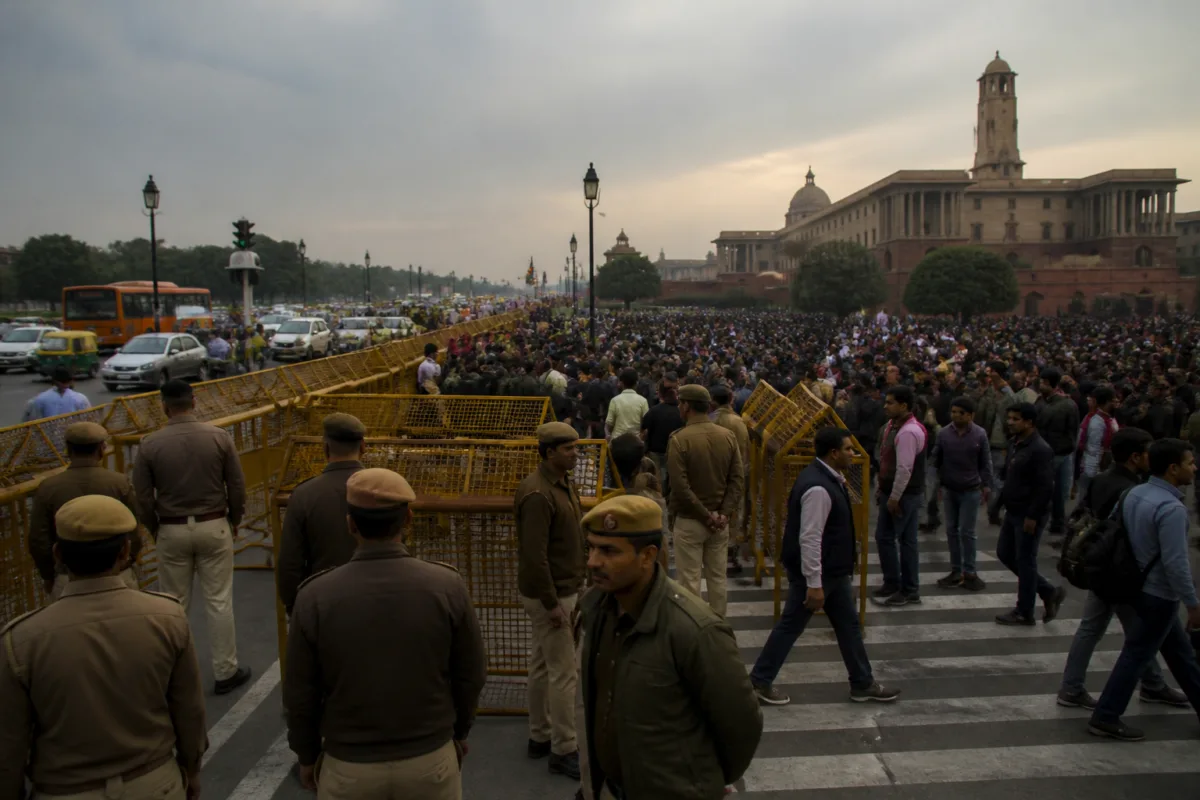
The Supreme Court has said that the constitutional right to protest does not permit a group to occupy a designated protest site indefinitely, stressing that other citizens must also have access to public spaces to demonstrate. The court linked the issue to the rights of businesses, daily-wage workers and other people whose livelihoods are affected by prolonged demonstrations in Delhi.
A bench comprising Chief Justice of India Surya Kant and Justices Joymalya Bagchi and V. Mohana made the observations while hearing petitions related to recent demonstrations against the Chief Election Commissioner. The court said that if one group continued to occupy a protest site for an extended period, other groups could be denied their constitutional right to protest.
“You cannot occupy a place forever. Where will farmers, workers and trade unions go? Where will homeless people go?” the Chief Justice said during the hearing, according to the report. The bench also said that protest sites should be allotted for a fixed period rather than allowing an indefinite occupation.
The court directed a business organisation seeking restrictions on demonstrations to include the protesting groups and organisations as parties to its petition. It issued notices seeking responses and said it could not decide the matter without hearing the protesters’ side. The bench also asked why additional time was not being granted for demonstrations, noting that requests for other protests may also have been made for the same location.
The hearing brought competing urban rights into focus. Senior advocate Mukul Rohatgi, appearing for business interests, told the court that trade had suffered losses running into thousands of crores and sought a two-month restriction on demonstrations, particularly during the festive season. Traders said areas around the protest locations were home to about 5 million people and that shops in Connaught Place had remained closed, affecting businesses and employees.
The bench, however, questioned whether protesters alone could be held responsible for business losses, pointing out that government restrictions on roads could also affect commercial activity. Solicitor General Tushar Mehta said shops had been forced to close in some situations and that protests could become violent. He argued that demonstrations should not be called without official permission when they deprive others of their livelihoods.
The Delhi Police Commissioner defended the decision to remove Jantar Mantar from the list of designated protest locations in an affidavit filed before the court. The police said Jantar Mantar was a public road and common passage and should not have been treated as a protest site. The affidavit identified Ramlila Maidan in central Delhi, CBD Ground in east Delhi and Burari Ground in north-west Delhi as other locations for demonstrations.
Police also told the court that no one had been arrested or detained during the October 10 protest. An affidavit filed by Joint Commissioner of Police (Crime) Surendra Kumar said that Mamata Banerjee and others were taken to a police station after allegedly violating directions issued under Section 163.
The court also criticised the conduct of lawyers during the proceedings. The Chief Justice asked them to present their arguments one by one instead of turning the courtroom into what he described as a “fish market”. The bench said that, going forward, petitions concerning protests and alleged police excesses would be grouped into nine broad categories, with separate hearing dates for each category.
Separately, the Chamber of Trade and Industry wrote to the Delhi Police Commissioner seeking a ban on rallies, sit-ins, marches and demonstrations in central and old Delhi, including Connaught Place, Jantar Mantar, Ramlila Maidan, India Gate, Rajghat and Delhi Gate, until November 11. The Supreme Court’s proceedings will continue after the protesting organisations and other parties respond to the notices.

