


Delhi PG safety has become a city-wide concern after two different tragedies left two neighbourhoods dealing with the same consequence: people no longer trust the buildings around them. In Hauz Rani, the June 3 fire at the Flourish Stay B&B killed 23 people, including 14 foreign nationals. In Satya Niketan, the collapse of a five-storey paying guest accommodation killed seven people, including five students and two labourers. The fires and rubble have been cleared, but the urban damage continues in the form of empty rooms, departing students, disrupted local businesses and families questioning whether affordable accommodation is safe enough to occupy.
These are not identical incidents. The Hauz Rani fire concerned a budget accommodation facility allegedly operating far beyond the terms of its licence. The Satya Niketan collapse raised questions about an ageing building, additional floors, construction activity and the safety of neighbouring structures. Yet both cases reveal how Delhi’s private accommodation markets function when demand for low-cost, well-located rooms grows faster than the city’s ability to inspect, regulate and provide safer alternatives.
In Hauz Rani, the change is visible in the neighbourhood’s commercial life. The narrow lanes had served foreign relatives accompanying medical tourists. They stopped at tea stalls, bought supplies from local shops and used budget B&Bs while visiting hospitals nearby. After the fire, several homestays and B&Bs were sealed, police barricades remained around the site and footfall declined. Although the barricades have since been removed and some shops are seeing business return, the neighbourhood has not fully recovered its earlier rhythm.
The report describes flats in a building opposite the B&B being left locked from outside after residents moved away because of smoke. Auto-rickshaw movement has resumed, but accommodation businesses remain affected. For shopkeepers and drivers, safety enforcement has therefore produced an immediate economic consequence: when accommodation closes, the customer base that supports small businesses also disappears. The recovery of a neighbourhood is not limited to reopening a road or removing a barricade. It also depends on whether residents, visitors and institutions are willing to return.
The investigation into the B&B illustrates how a regulatory permission can become detached from actual operations. The property was licensed for six rooms but was allegedly running at least 25 rooms across four floors, a basement and an improvised rooftop facility. The Delhi Police chargesheet alleges that the property had been illegally expanded, lacked a fire no-objection certificate and had no emergency fire exit. Investigators said the fire began in the kitchen after an oil fryer was allegedly left unattended. Smoke travelled up the central staircase, trapping guests on upper floors.
The first distress call was received at 8.48am. Firefighters reached the location seven minutes later and rescued 48 people between 9am and 11.30am. The narrow and congested lanes made access difficult. By noon, the fire was under control, but 23 people had died. The chargesheet names the owner, manager-cum-accountant and cook as accused. These details place the tragedy within a chain of alleged decisions: expanding the property, increasing accommodation capacity and operating without basic safety provisions in a dense urban setting.
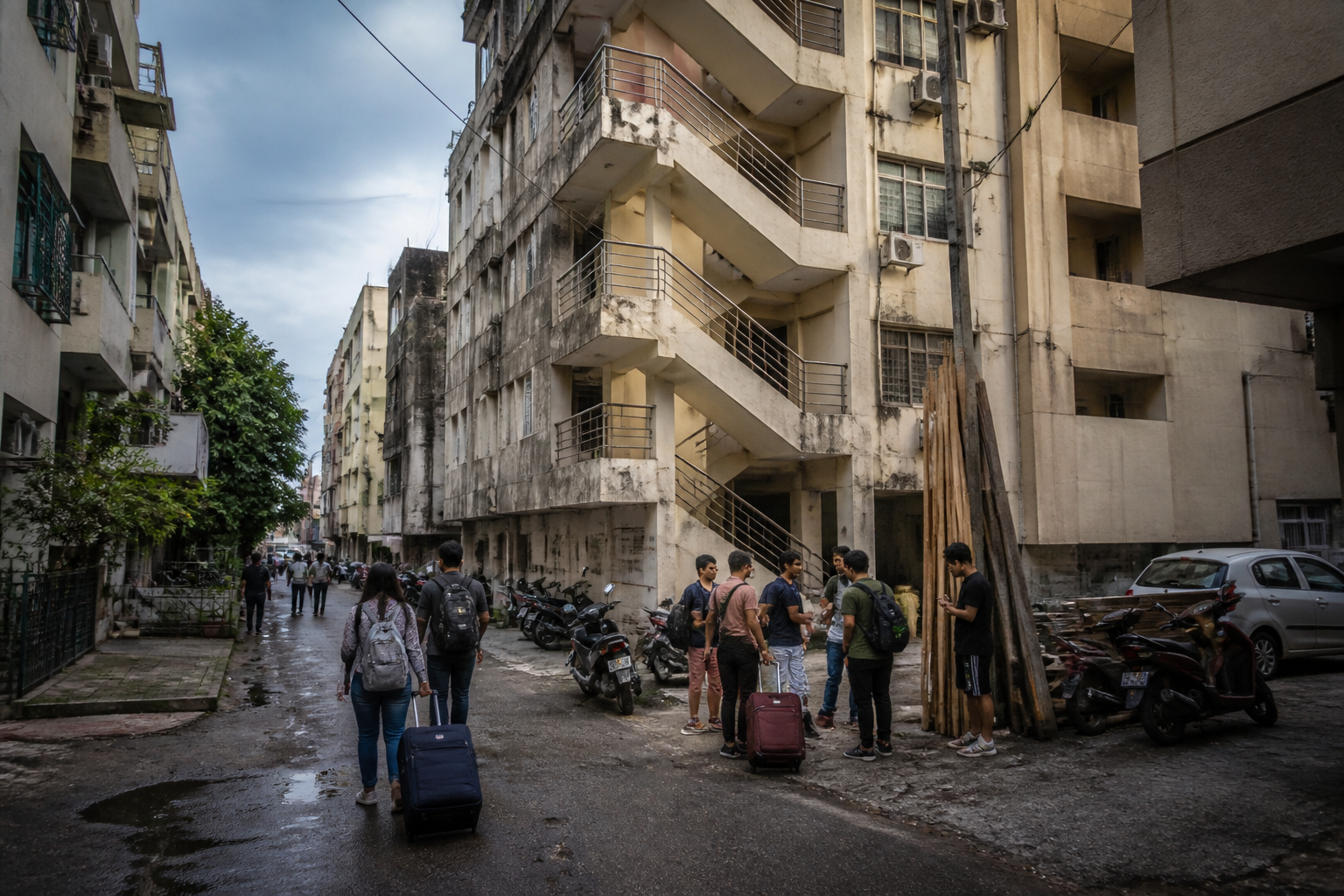
Satya Niketan presents a different but connected problem. The neighbourhood is closely associated with students seeking private accommodation near Delhi University colleges. After the collapse, students reported concerns about poor ventilation, dangerous staircases and inadequate fire-safety provisions in adjoining buildings. One neighbouring structure was being vacated for demolition, while others were identified as unsafe. Some students left immediately, moved to relatives’ or friends’ homes, or spent nights inside college campuses after being forced out of their paying guest accommodation.
The financial calculation behind those decisions is stark. One student cited in the report pays Rs 8,000 for accommodation, already considered low for Delhi. The room has neither ventilation nor air conditioning, and the student’s parents now want him to move. Leaving, however, is not cost-free. A safer room may be farther from college, more expensive or unavailable. Students from other states may not have family homes in Delhi to return to. The choice is consequently not simply between one building and another; it is between housing that is affordable and housing that can be trusted.
The shortage of institutional accommodation intensifies that dependence on private paying guest facilities. Around 71,600 new undergraduate students were admitted in 2026-27, while Delhi University has around 7,000 hostel seats, according to figures cited by officials in the report. The gap creates a large private housing market around college clusters. That market is essential because the university’s formal hostel capacity cannot absorb the number of students seeking accommodation. It is also vulnerable because thousands of tenants are making decisions in a fragmented market where information about structural condition, fire safety, ventilation and occupancy limits may not be easily available.
This is the point at which the two tragedies converge. In Hauz Rani, a facility serving people who needed inexpensive lodging allegedly expanded beyond its permitted capacity. In Satya Niketan, students rely on private rooms because formal accommodation is insufficient. In both neighbourhoods, location and affordability shape demand, while safety is treated as a condition to be checked later, after an incident. The resulting risk is not necessarily visible to a tenant at the time of moving in. A room may be close to a hospital or college and fit within a family’s budget, while the building’s compliance history remains unknown.
The administrative response now being discussed attempts to address that information and enforcement gap. Students have demanded a dedicated web portal requiring PG owners to disclose rents, facilities, meal plans and structural-safety details. They have also sought pre-monsoon audits, structural certifications and regular fire-safety inspections. Urban development minister Ashish Sood has promised comprehensive legislation and regulations for PG accommodation within two months. The proposed framework is expected to include mandatory licences, zone-wise rent bands, structural and fire-safety audits and a central portal listing rents, amenities and compliance.
The significance of these proposals lies in their attempt to move regulation from the aftermath of a disaster to the point at which accommodation is offered. A licence would need to reflect actual capacity, not only the original use of a property. Structural certification would need to account for buildings that have accumulated additional floors or undergone construction activity. Fire inspections would need to examine exits, staircases, access for emergency vehicles and the practical movement of smoke through dense buildings. A public portal could also reduce the information imbalance between property owners and tenants, although the supplied material does not establish how the proposed system will be enforced or funded.
Delhi University colleges have already been required to respond as temporary shelters. Classrooms and other facilities were used to house displaced students, with mattresses placed in health centres, staff rooms and guest rooms. Colleges arranged food and counselling, while student volunteers searched for classmates who might have been living in the collapsed building. This emergency response shows how a housing failure can quickly become an institutional crisis. Colleges may provide temporary relief, but they are not a substitute for a regulated and adequate city-wide student housing system.
The two neighbourhoods also show that the effects of unsafe accommodation are distributed well beyond those inside a building. Families absorb relocation costs. Students lose stability during the academic year. Shopkeepers lose customers. Transport workers lose passengers. Colleges take on emergency responsibilities. Residents in adjoining structures experience fear even when their own buildings have not failed. The physical incident may be confined to one property, but the social and economic consequences spread through the surrounding urban network.
The available evidence confirms three immediate facts. First, unsafe accommodation can result from different forms of regulatory failure, including alleged overcapacity, illegal expansion, missing fire clearances, ageing structures and construction activity. Second, the shortage of formal housing alternatives makes it harder for students and other low-income residents to leave risky buildings. Third, a disaster can permanently alter a neighbourhood’s reputation and everyday economy, even after rescue operations end.
What remains uncertain is whether the proposed PG regulations will produce routine inspections, accurate public records and credible penalties for non-compliance. The report also does not establish how many private accommodation buildings across Delhi face similar risks. Those questions will determine whether the response remains a reaction to two tragedies or becomes a broader system for making affordable urban housing safer. For now, Hauz Rani’s empty accommodation units and Satya Niketan’s packed bags point to the same unresolved problem: in a city where proximity and price govern housing choices, building safety cannot remain an invisible condition of renting a room.
