


The Commission for Air Quality Management (CAQM) has ordered government and private offices in Delhi and five adjoining National Capital Region districts to limit physical attendance to 50 per cent from November 5 to 20, while restricting dust-generating demolition and outdoor construction across the NCR.
The directions, issued on October 30 under Section 12 of the CAQM Act, 2021, are intended to reduce emissions before pollution levels typically reach their seasonal peak in the first half of November. Employees not attending offices physically will be required to work from home during the 16-day period.
The work-from-home order covers the National Capital Territory of Delhi, Gurugram, Faridabad and Sonipat in Haryana, and Ghaziabad and Gautam Buddha Nagar in Uttar Pradesh. State government offices and private establishments in these areas have been directed to ensure that no more than half of their workforce is physically present.
Industrial establishments and essential services where working remotely is not feasible have been exempted from the attendance requirement. The Delhi government, NCR state governments and other concerned implementing agencies have been directed to ensure compliance.
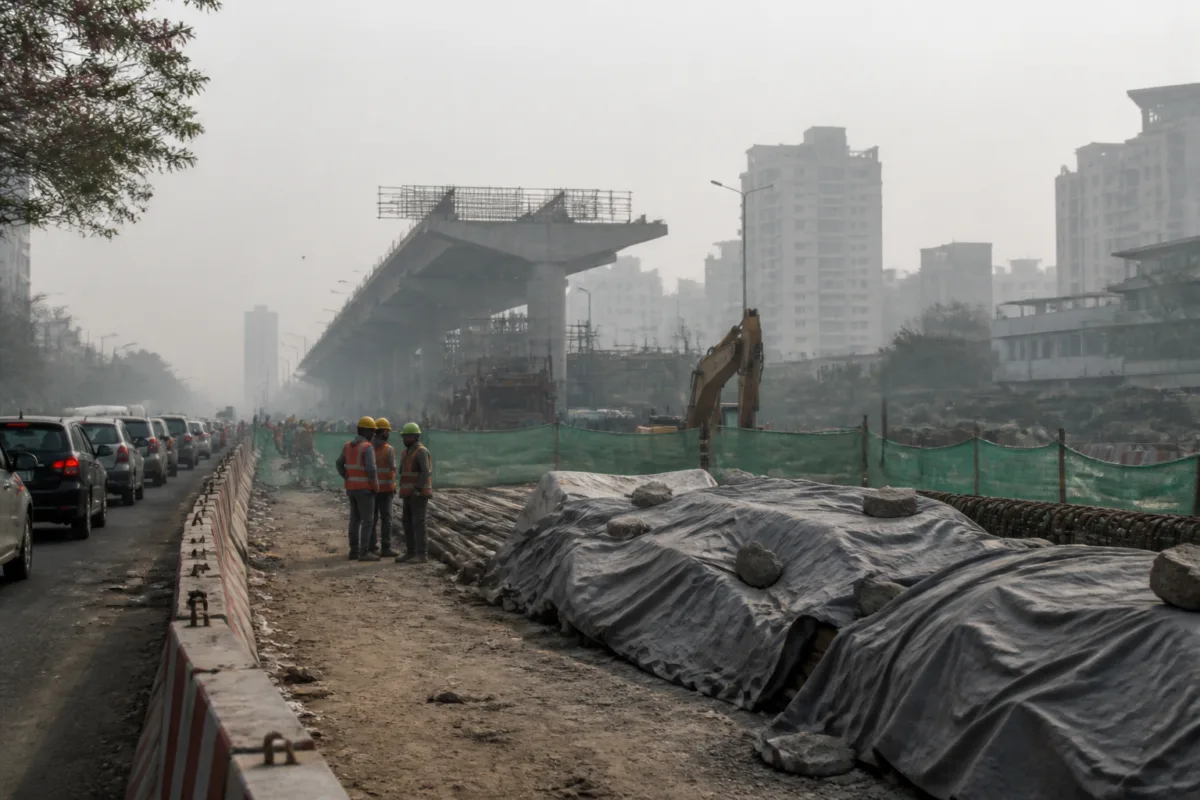
The separate construction restrictions will apply across the entire NCR during the same period. They cover dust-generating demolition and outdoor civil construction, including linear public infrastructure projects such as highways, roads, flyovers, overbridges, power transmission lines, pipelines and telecommunications infrastructure.
Projects linked to railways, Metro services, airports, inter-state bus terminals, hospitals, water supply and sanitation will be allowed to continue. Construction associated with national security, defence and projects of national importance has also been exempted from the restrictions.
The restrictions follow an analysis by the CAQM of daily Air Quality Index data from November 2018 to 2025. The commission said the data showed a recurring pattern of high pollution during the first half of November, with air quality reaching the ‘Severe’ and ‘Severe+’ categories on several occasions.
According to the commission, local emissions, crop residue burning and biomass combustion contribute to pollution during this period. Low wind speeds, a shallow atmospheric boundary layer and reduced vertical mixing can further limit the dispersal of pollutants and increase the accumulation of emissions.
Unlike measures under the Graded Response Action Plan, which are generally linked to prevailing or forecast AQI levels, the latest directions will operate during a fixed period irrespective of daily air quality readings. CAQM described them as preventive and time-bound measures intended to reduce emissions at source.
The order comes as Delhi-NCR prepares to implement its wider winter pollution-control plan. The plan includes restrictions on polluting vehicles, stricter enforcement of pollution certificates and measures intended to discourage private vehicle use. CAQM had invoked Stage I of GRAP across Delhi-NCR on October 21 after air quality deteriorated to the ‘Poor’ category.
The office attendance and construction restrictions will remain in force from November 5 through November 20, subject to the exemptions and implementation directions issued by CAQM.

