


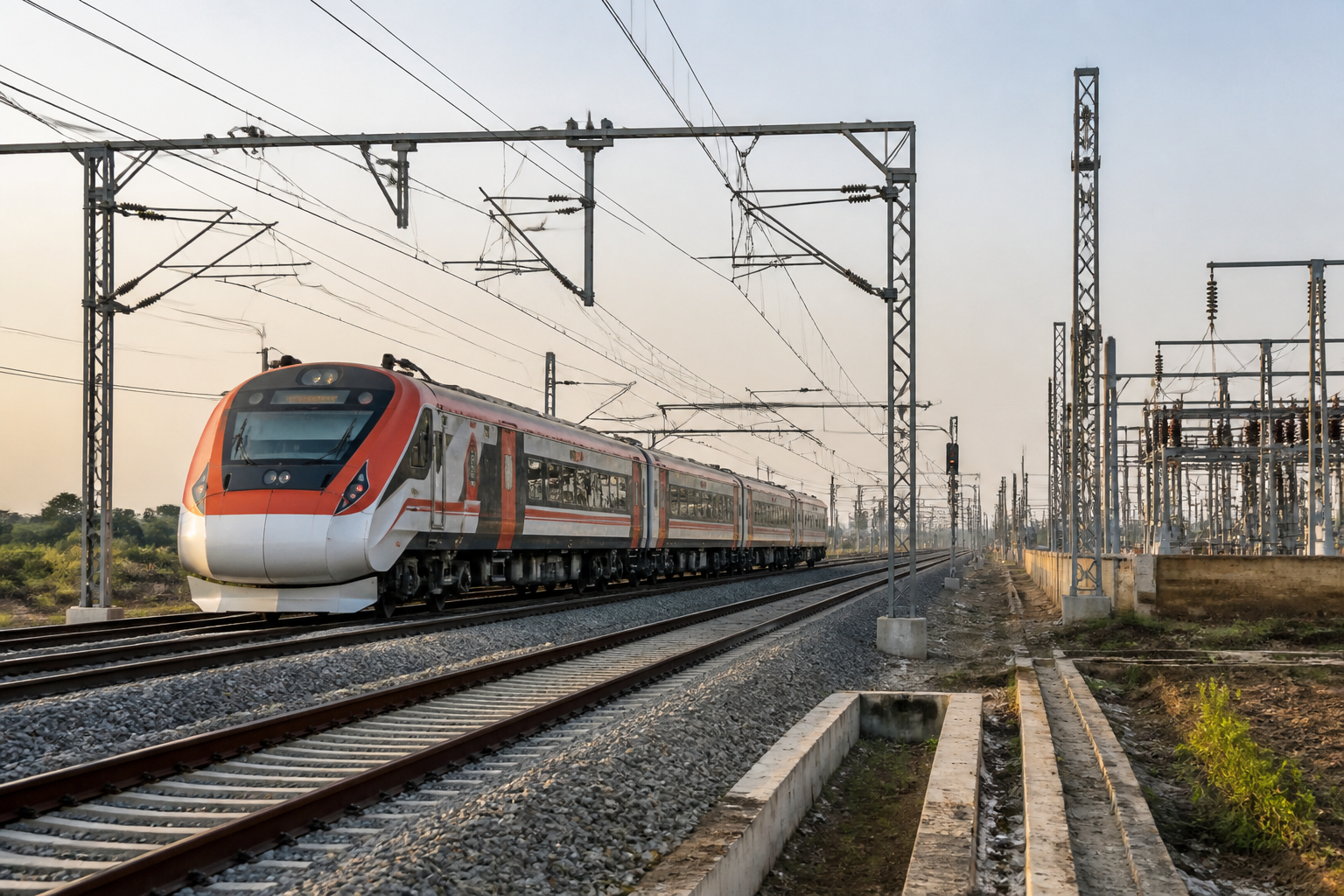
The Chhata traction substation in Uttar Pradesh has been commissioned with forward charging as part of preparations to enable trains to operate at up to 200 kmph on the Palwal–Mathura section of the Delhi–Mumbai rail corridor, North Central Railway said.
The substation, located at Chhata railway station in the Agra division, will help provide the electrical supply required for high-speed train operations. Traction substations receive high-voltage electricity from the state power grid, convert it and supply it to overhead equipment that powers electric locomotives.
Work to upgrade the approximately 84-route-km, or 336-track-km, Palwal–Mathura section is in its final stage. The project involves civil, electrical, signalling and telecommunications, and mechanical works to prepare the railway infrastructure for operating speeds between 160 kmph and 200 kmph.
Besides Chhata, traction substations at Kosi Kalan, Sholaka and Mathura have also been commissioned, according to North Central Railway. Work at Hodal is in its final stage. The railway has set a target of completing work at Vrindavan, Kotwan, Hodal and Ajhai by the end of September.
North Central Railway chief public relations officer Shivam Sharma said the work is being undertaken under Mission Raftaar, which aims to bring the travel time between Delhi and Mumbai below 12 hours. The railway has also begun modifying the overhead equipment system for high-speed operations, including the installation of super masts designed to withstand higher tension.
The traction power system is being expanded so that trains can receive voltage according to operational requirements. Railway officials said traction substations are a key part of this system, while sectioning posts and sub-sectioning posts help control and distribute overhead electrical supply between substations and across operating sections.
The Palwal–Mathura stretch is an important link between the National Capital Region and the railway network serving Mathura and Agra. Raising operating speeds on the section requires more than faster trains: electrical supply, overhead equipment, signalling, track conditions and other railway systems must work together within the same operating framework.
The latest commissioning marks a specific infrastructure milestone, but the railway has not announced a start date for regular passenger services at 200 kmph on the section. The immediate next steps are completion of the remaining traction-power and associated infrastructure works by the stated September target and preparation of the section for higher-speed operations.
