


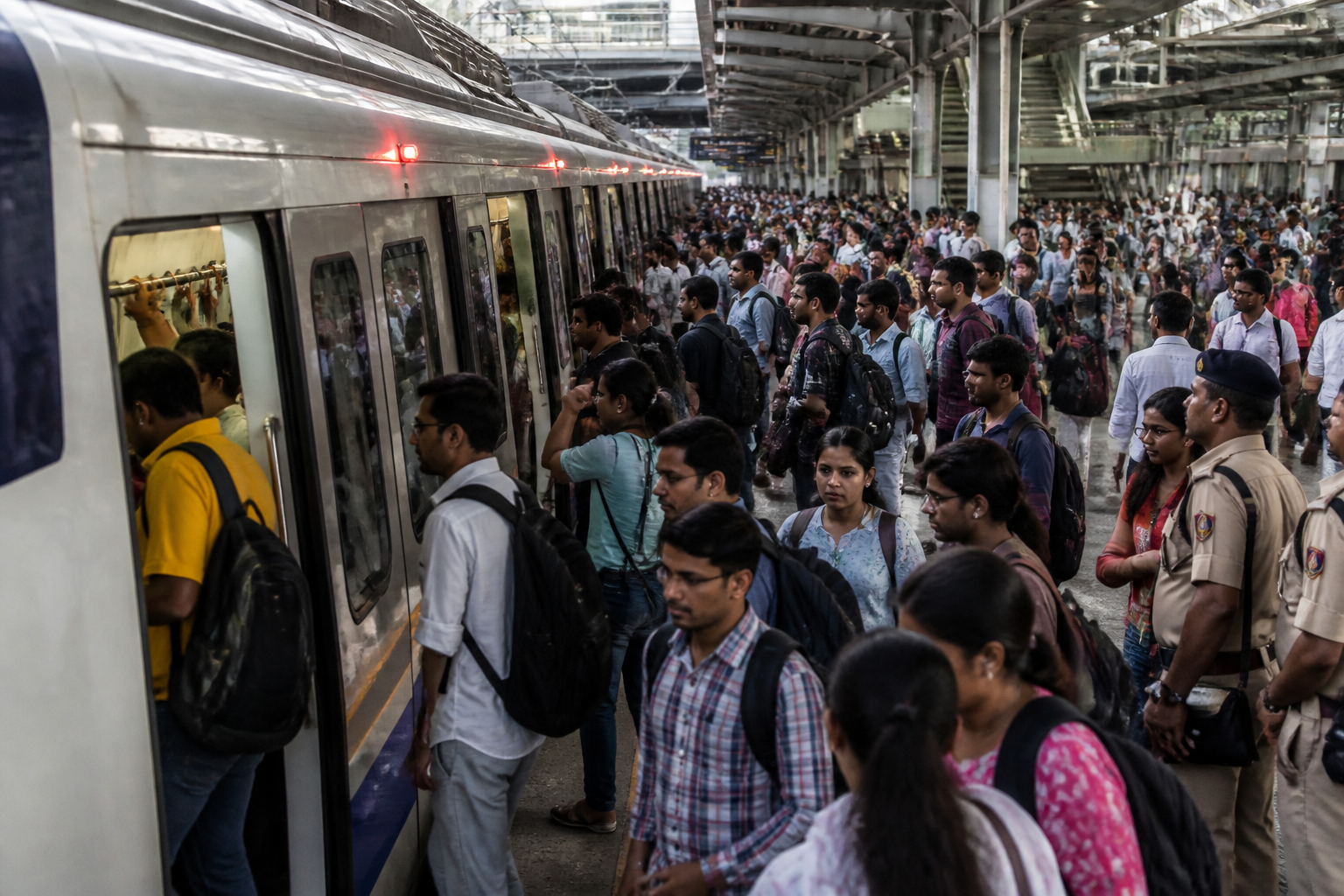
Delhi Metro ridership reached a record 82,44,903 passenger boardings on September 17, as a strike by contractual Delhi Transport Corporation drivers entered its fourth day and pushed more commuters towards the rail network. The number is more than a daily milestone: it provides a clear snapshot of how quickly the capital’s transport hierarchy changes when one part of the public system loses capacity.
The Delhi Metro Rail Corporation’s figures show that the September 17 total exceeded the previous record of 81,88,115 boardings, recorded on August 8, 2025, by 56,788. It was also higher than the 81,01,159 boardings recorded on August 27 this year. Within a single day, passenger boardings rose from 80,71,630 on September 16 to 82,44,903 on September 17, an increase of more than 1.7 lakh boardings.
That sequence matters because the record did not occur in isolation. It followed a disruption in bus operations and a response by the Metro operator to the expected increase in demand. DMRC increased train trips by 20 across its network on September 16 and operated eight additional trains according to operational requirements. On September 17, the enhanced arrangement continued, with eight extra trains deployed between 8 am and 8 pm, particularly during peak-hour periods.
The evidence therefore points to a two-part event: a sudden loss of capacity in the bus system and a rapid attempt to absorb displaced demand through Metro services. The record ridership figure measures passenger boardings, not necessarily unique individuals. A commuter using the network several times may generate more than one boarding, so the number should be read as a measure of system usage rather than a direct count of people.
The immediate trigger was the ongoing strike by private agency drivers working for the DTC. According to the report, the drivers’ demands included higher wages and medical and social security benefits. The source does not provide the number of services withdrawn, the precise reduction in bus capacity or the strike’s settlement status. Those limits are important: the Metro record establishes increased rail usage during the disruption, but it does not by itself quantify the full scale of the bus shortage or identify how many former bus users shifted to the Metro.
Even with those limits, the episode demonstrates the operational relationship between Delhi’s two major mass-transit modes. Buses and the Metro do not serve identical routes or passenger needs, but they operate within the same daily mobility market. When bus availability declines, the effects can quickly appear at Metro stations, on trains and at interchange points. The September 17 figures show that the rail network had enough operational flexibility to carry additional demand, at least during the period covered by the reported response.
The scale of the network explains both the Metro’s ability to absorb passengers and the significance of the pressure placed on it. DMRC operates around 416 km of network and 303 stations, including the Noida-Greater Noida corridor and Gurugram’s Rapid Metro. The system is therefore not limited to Delhi’s administrative boundary; its ridership is linked to the wider National Capital Region, where daily commuting crosses municipal and state borders.
That regional footprint also complicates the meaning of a single network-wide record. A high total can reflect demand across multiple corridors with different levels of crowding, interchange pressure and service frequency. The figures supplied by DMRC and reported by Millennium Post do not include corridor-wise ridership, station-level crowding, train occupancy or changes in travel times. Without those details, the record cannot be used to identify where the system experienced its greatest stress.
The response described by DMRC nevertheless offers an example of short-term demand management. Additional trips and trains were introduced after the operator anticipated higher demand. The eight extra trains deployed between 8 am and 8 pm indicate that the response was concentrated around the part of the day when commuting pressure was expected to be highest. This is different from expanding permanent capacity: it is an operational adjustment using the existing network, fleet and staffing arrangements.
The distinction is central to understanding what the record does and does not show. A system may carry more passengers on a particular day by increasing service frequency or deploying additional trains, but that does not establish that it has solved longer-term capacity constraints. Nor does the record show whether the additional service was sufficient on every corridor. It shows that the operator responded to a known disruption and that overall boardings reached a new peak.
The institutional structure behind the response is also significant. DMRC was established in 1995 as a joint venture between the Centre and the Delhi government. It operates the Delhi network and also undertakes metro operations and maintenance in cities including Mumbai, Chennai and Patna. The Metro’s role in the NCR is therefore connected to a wider public transport institution rather than being a standalone city service.
The strike, meanwhile, highlights a different institutional layer: the employment and contracting arrangements that support bus operations. The reported demands for higher wages and medical and social security benefits place labour conditions within the functioning of urban transport. A service disruption can become a citywide mobility issue even when the dispute begins with a specific group of contracted drivers and concerns about employment benefits.
The available information does not establish whether the drivers’ demands were accepted, whether DTC restored normal operations or whether the additional Metro services continued after September 17. It also does not provide comparative figures for bus ridership before and during the strike. Those missing details prevent a full assessment of the disruption’s impact on commuters, but they do not diminish the significance of the demand signal captured by the Metro data.
There is also a broader planning question in the difference between network expansion and system resilience. The Delhi Metro’s around 416-km network and 303 stations provide extensive reach, but the record occurred because another mode was under stress. Resilience in this context depends not only on the size of the rail network but on whether buses, Metro services and the agencies responsible for them can continue functioning together when one part of the system is disrupted.
The September 17 record is therefore best understood as a stress test of the NCR’s public transport system. It shows that the Metro can receive sharply higher demand and that DMRC can deploy additional services in response. It also shows that the capital’s mobility choices are interconnected: a labour dispute in bus operations can quickly become a rail ridership event.
What remains unclear is whether the record reflects a temporary substitution caused by the strike or part of a longer upward trend in Metro use. The supplied figures establish three high points—81,88,115 boardings on August 8, 2025, 81,01,159 on August 27 this year and 82,44,903 on September 17—but they do not provide a longer time series. Further attention should therefore focus on whether ridership falls after bus services normalise, whether additional trains remain necessary and how the transport authorities coordinate capacity across modes.

