


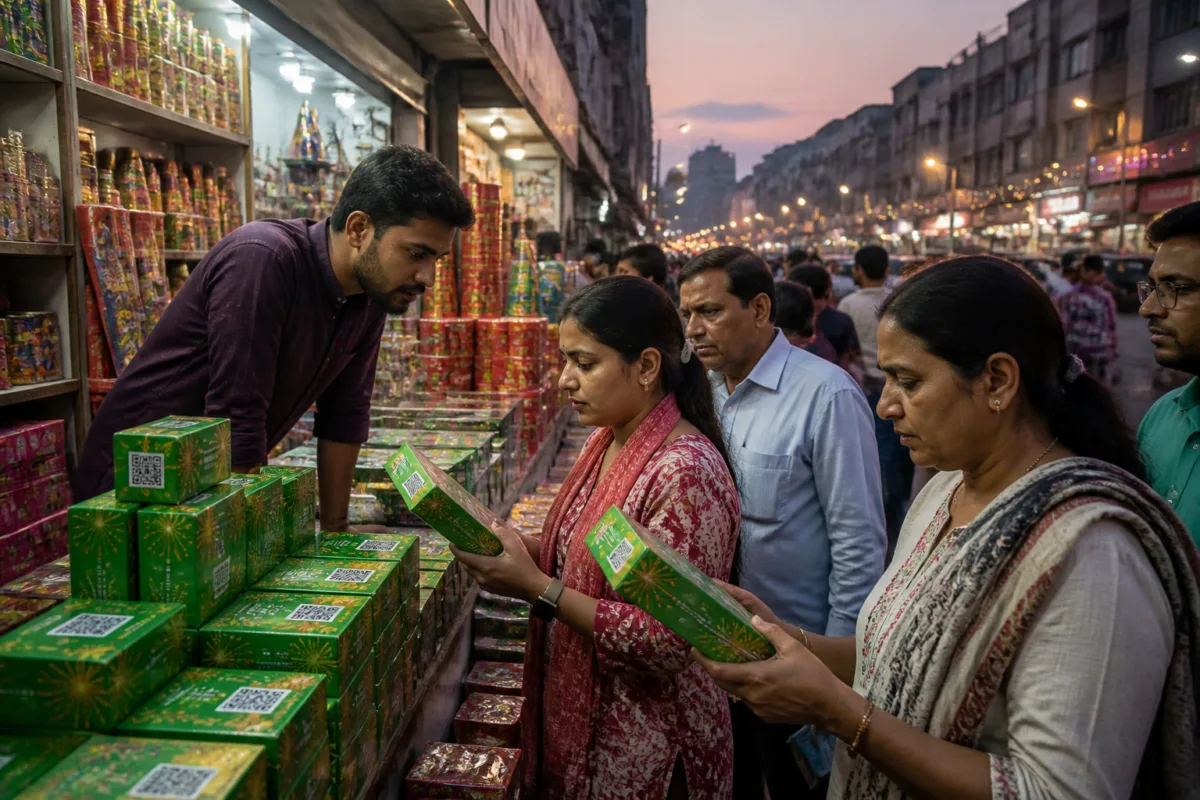
Delhi’s green crackers market expanded during the Diwali season, but the reported surge in sales also exposed a basic weakness in the city’s enforcement system: consumers were expected to identify compliant products without a reliable public mechanism to verify what was inside the box. The Chamber of Trade and Industry estimated that fireworks worth about Rs 300 crore were sold in Delhi during the season, while traders reported sales roughly 30% higher than last year. Yet the same account says there is no officially audited breakdown showing how much of that trade involved certified green crackers.
That gap matters because the legal framework, as described in the report, depended on a narrow product category. The Supreme Court had permitted only CSIR-NEERI-certified, QR-code-bearing green crackers to be sold in Delhi-NCR. Licensed shops therefore sold their stock under the green-cracker requirement. But a legal label on a packet and a verifiable product standard are not the same thing. The report says consumers encountered boxes marked “green”, “eco-friendly” or “pollution-free”, without a testing facility in Delhi that could help establish whether those claims were genuine.
The result was a compliance system that placed responsibility across several actors without giving each of them the same capacity to perform it. The court established the permitted category. Licensing authorities controlled which shops could sell. Manufacturers and registered brands supplied the products. Traders checked packaging and QR codes. Consumers made the final purchase decision. But, according to the report, neither buyers nor many sellers had an accessible way to test or authenticate the contents beyond what appeared on the packet.
This is the central institutional issue behind the season’s reported disorder. Traders quoted in the report said they were merchants, not chemists. They claimed to buy from NEERI-registered brands and inspect QR codes, but also said ordinary buyers could not easily distinguish green crackers from conventional products. That distinction is important because a QR code can function only if it leads to a trusted and usable verification system. If it cannot be checked at the point of sale, it becomes a printed assurance rather than an effective enforcement tool.
The market response shows that consumer demand was not necessarily opposed to regulation. The report says many buyers specifically sought green crackers because they knew those were the only legally permitted products. It also says licensed shops experienced heavy demand after permission was granted, with many outlets running out of stock a day before Diwali. Buyers then travelled to Gurugram, Noida, Faridabad, Ghaziabad and Sonipat to purchase fireworks.
That movement across the National Capital Region reveals how a city-level enforcement regime can become a regional supply-chain problem. Delhi’s restrictions did not operate in isolation from neighbouring urban markets. When licensed outlets in the capital ran short, demand moved across municipal and state boundaries. The report does not establish how products sold in each neighbouring city were regulated, but the cross-border shopping pattern suggests that enforcement in one jurisdiction can be weakened if consumers can access nearby markets with different levels of oversight.
The timing of the system was another reported failure. The CTI chairman, Brijesh Goyal, attributed the disruption to a short selling window, delayed licensing, late permissions, the absence of QR-verification arrangements and inadequate stock planning. These are administrative details, but they determine whether a court order can function beyond the text of the order. A restriction that is announced late, licensed late and supplied late leaves retailers with little time to comply and consumers with few legal options.
The estimated Rs 300 crore in sales should therefore be treated as an industry estimate, not as a final public account of the season. The report explicitly says that the share of certified green crackers within that figure is difficult to determine and has not been officially audited. That uncertainty limits what can be concluded about compliance. High sales do not prove that conventional fireworks were widely sold, just as the presence of green-cracker packaging does not by itself prove that every product met the required standard.
The report also cites a survey according to which roughly half of Delhi-NCR families that burst crackers used both green and conventional varieties. The supplied account does not identify the survey organisation, its sample size, its methodology or the date of fieldwork. It is therefore useful as an indication of the reported compliance challenge, but not as a definitive measure of the market. The distinction is significant in a policy area where public claims can quickly become evidence for further restrictions or enforcement action.
The numbers available in the report show a system under pressure from both demand and limited administrative preparation. Sales were estimated at Rs 300 crore, traders reported an increase of about 30% over the previous year, many shops reportedly exhausted stock before Diwali, and buyers travelled to five neighbouring cities named in the account. At the same time, the report provides no official figure for the number of licensed shops, the quantity of certified products supplied, the number of QR codes checked, or the number of violations detected.
Those missing figures point to the difference between regulating retail outlets and regulating products. A shop may possess a licence, and a packet may carry a QR code, but neither fact automatically establishes that the item has been independently verified at the point of sale. The system described in the report appears to have relied heavily on documentation and trader diligence, while lacking a visible inspection and testing layer for consumers. Without records of inspections, seizures, test results and prosecutions, it is difficult to measure whether the rules changed actual emissions or merely changed the language used in the market.
The episode also places municipal administration within a wider governance chain. Firework regulation involves judicial directions, scientific certification, licensing, retail supply, policing and public communication. No single institution appears to control every stage. The report attributes the estimated sales figure and several operational observations to the CTI, while the legal permission is attributed to the Supreme Court’s direction. It does not provide a consolidated statement from Delhi’s licensing, pollution-control or municipal authorities explaining how verification was conducted. That absence leaves the accountability structure unclear.
For residents, the practical question was not simply whether green crackers were legally permitted. It was whether an ordinary buyer could identify a compliant product before payment, whether a QR code could be checked immediately, and whether a misleading package could be reported and acted upon. The report says that consumers had no testing facility available in Delhi. That is a ground-level failure because a regulatory system becomes credible only when its rules can be understood and used by the people expected to follow them.
The reported experience also shows why seasonal enforcement cannot depend entirely on last-minute permissions. Fireworks are a time-bound market with concentrated demand, limited retail days and a supply chain that can shift quickly between neighbouring cities. If licensing, certification and stock planning are completed close to the festival, shortages can push buyers towards informal channels even when demand for legal products exists. The report’s account does not prove that this happened at a specific scale, but it does establish that late permissions and depleted shops were identified by traders as major operational problems.
The next test for the administration is whether the system produces an auditable record rather than another set of seasonal assurances. The CTI has argued that timely permissions, licensing, clear QR verification and sufficient stock could make fully certified green sales possible next year. That is a stakeholder proposal, not an established outcome. What remains unresolved in the supplied evidence is the number of products that were genuinely certified, the effectiveness of the QR system, the extent of conventional-firework sales and the institutional responsibility for testing. Until those elements are documented, the Delhi green-cracker market will remain regulated in principle but difficult to verify in practice.

