


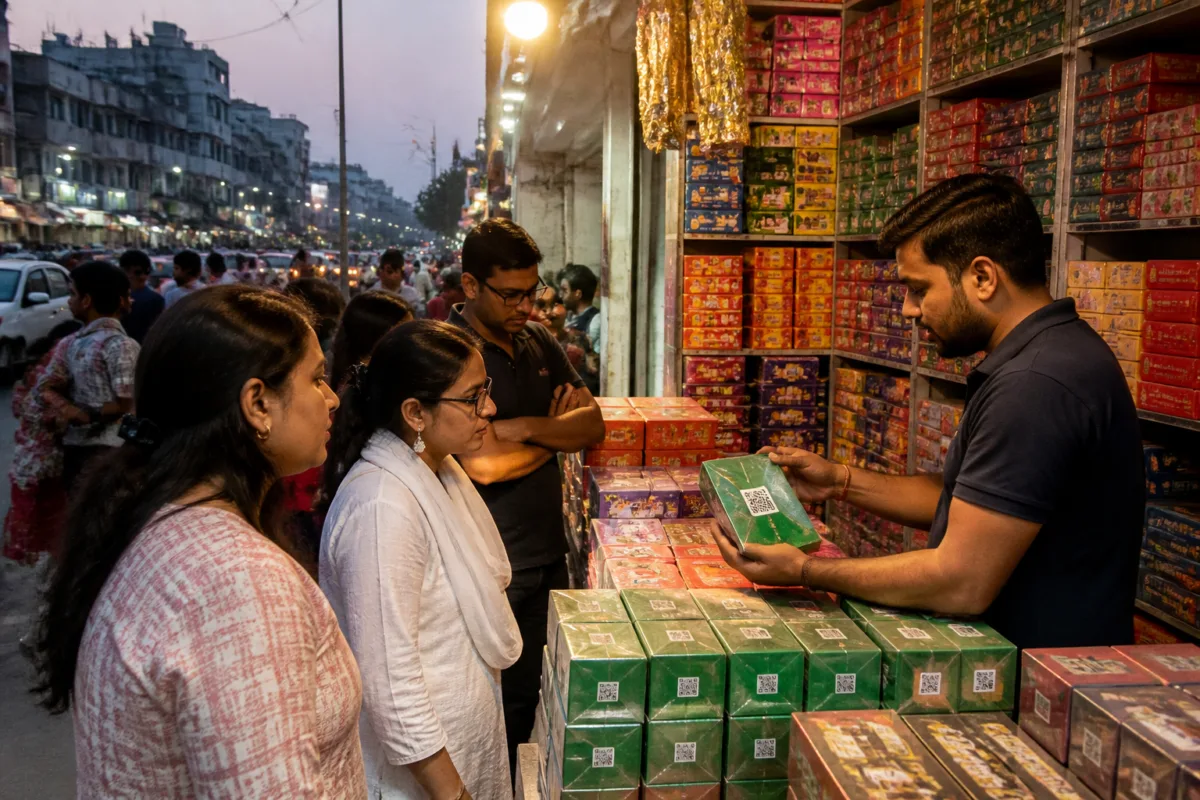
Delhi’s green crackers market was presented as a legal pathway to regulate Diwali fireworks, but the season’s reported sales reveal a deeper problem: consumers were asked to make an environmentally significant choice without being given a reliable way to verify what they were buying. The Chamber of Trade and Industry estimated that crackers worth about Rs 300 crore were sold in Delhi during the Diwali season, while traders said their stock was exhausted a day before Diwali. Yet the same report says there was no official audit showing how much of that sales value represented certified green crackers and how much represented conventional products.
That gap matters because the green-cracker framework depends on a chain of compliance rather than on a single label. The Supreme Court had permitted only CSIR-NEERI-certified crackers with QR codes to be sold in Delhi-NCR, according to the report. This placed obligations on manufacturers, distributors, licensed retailers, enforcement agencies and consumers. Each link was expected to work at the point of sale and use. The reported experience suggests that the legal permission was clearer than the operating system required to implement it.
The immediate trigger was high demand. Most cracker shops were reportedly empty a day before Diwali, and several buyers travelled to Gurugram, Noida, Faridabad, Ghaziabad and Sonipat to purchase supplies. Traders said sales were around 30 per cent higher than the previous year. The report also says that consumers specifically sought green crackers and QR-coded packages because they understood that only these products were legal. This indicates that the court’s restriction had reached the market as a consumer signal, even if the verification mechanism had not reached the market with the same clarity.
The result was a mismatch between demand and supply. Customers wanted products they believed were compliant, while licensed sellers were operating within a narrow sales window and facing delays in licensing and permissions, according to CTI chairman Brijesh Goyal. When legitimate stock ran out, buyers were pushed towards other markets in the National Capital Region. That movement did not automatically establish that the products purchased elsewhere were illegal, but it made the regulatory geography more complicated. A rule applying across Delhi-NCR still had to be implemented through multiple local authorities, retail points and enforcement arrangements.
The most consequential weakness identified in the report is the absence of a practical QR-verification system for buyers. Traders told the publication that they purchased from NEERI-registered brands and checked the QR codes printed on packages, but also said they were traders rather than chemists. Consumers, meanwhile, could not easily distinguish green crackers from conventional crackers. The report further says that packages carrying descriptions such as “green”, “eco-friendly” and “pollution-free” were found in the market, without a testing facility in Delhi that could help establish whether those claims were accurate.
This shifts the burden of compliance in an important way. A QR code can provide traceability only if a buyer can scan it, access a trusted database and understand the result. It also requires the information behind the code to be current, legible and linked to the exact product being sold. The supplied report does not establish whether such a database existed, how many products were registered, or which agency was responsible for operating the verification process. It does, however, record that buyers had no effective method to test or authenticate the products at the point of purchase.
The reported Rs 300-crore estimate therefore cannot be treated as a measure of certified green-cracker consumption. It is an estimate of total cracker sales in Delhi during the season, according to CTI. The report expressly states that an officially audited breakdown between certified green and traditional crackers was not available. That distinction is central. A high sales figure indicates strong demand and commercial activity, but it does not demonstrate that the regulatory objective was achieved.
The report also cites a survey according to which about half of Delhi-NCR families that used crackers burned both green and conventional varieties. The supplied material does not identify the survey organisation, sample size or methodology, so the figure cannot independently establish the scale of conventional-cracker use. It does, however, reinforce the implementation problem described by traders: even where consumers intended to comply, the market contained multiple product categories and the difference was not easy for ordinary buyers to establish.
This is a familiar governance challenge in urban environmental regulation. A legal restriction may be formally uniform, but compliance depends on everyday infrastructure: licensing deadlines, approved supply, inspection capacity, product databases, trained personnel and clear communication. If any of these elements arrives late or remains unclear, the regulation becomes difficult to follow even for people who are willing to follow it. In this case, the report attributes the disruption to late permissions, delayed licensing, a short period for sales, insufficient stock and the absence of QR verification.
The institutional structure is also spread across several levels. The court sets the permitted framework described in the report. CSIR-NEERI certification determines the relevant product standard. State and local authorities are involved in licensing and permissions. Retailers sell the products, while consumers are expected to identify compliant goods. The report does not specify how these responsibilities were divided in practice or which agency was accountable for testing products in Delhi. That missing accountability is significant because a system can have a clear rule and still produce weak compliance when no single institution owns the entire consumer-facing process.
The experience reported this season also shows why timing is not an administrative detail. Crackers are a seasonal product, and the demand window is concentrated around Diwali. A licence or permission granted late cannot be compensated for easily after the season has begun. Manufacturers and retailers need time to plan inventory, buyers need time to understand the legal categories, and enforcement agencies need time to communicate and inspect. When permissions arrive close to the purchasing period, compliant supply can be too limited to meet demand, while misleading or non-compliant products may become harder to distinguish.
The 30 per cent year-on-year increase in sales reported by traders adds another dimension. It suggests that demand was not merely sustained but higher than the previous year, although the report does not provide an independent sales audit or explain whether the increase was measured across all of Delhi or only among participating traders. The figure should therefore be read as a trade estimate. Its importance lies less in proving an exact market size than in showing that the regulatory system faced a substantial and concentrated demand surge.
For consumers, the practical consequence was uncertainty. A buyer could look for a green label and a QR code, yet still lack a reliable way to determine whether the product met the applicable standard. A retailer could rely on the package and the supplier, while acknowledging that the retailer was not equipped to assess the chemical composition. This creates a compliance chain in which each participant assumes that another participant has completed the necessary verification. Without a common, accessible checking mechanism, the final responsibility falls on the least informed actor: the consumer.
The public-health context is equally important, although the supplied report does not provide air-quality measurements or an official estimate of emissions from the season. Residents reportedly experienced considerable pollution on Diwali night and the following Monday morning. That observation establishes public concern and perceived exposure, but it does not by itself quantify the contribution of fireworks relative to other sources. The evidence available here supports a narrower conclusion: the city faced intense fireworks demand, while the mechanism intended to distinguish permitted products from conventional ones was not clearly auditable at the point of purchase.
CTI’s proposed solution is that timely permissions and licensing, clear QR verification and adequate stock could make fully certified green sales possible next year. That is an attributed industry position, not an established outcome. The report does not state whether authorities have accepted the proposal, announced a new verification system or committed to a specific timetable. Those details will determine whether the next season produces a different result.
The larger urban question is whether environmental regulation can work without an implementation layer that residents can see and use. In Delhi-NCR, the green-cracker policy was not only a question of what the court permitted. It was also a question of whether a customer could identify an authorised product, whether a shop could secure adequate stock, whether inspectors could test or trace goods, and whether authorities could publish an auditable account of compliance. The reported season shows that these operational questions were at least as important as the legal restriction itself.
The available evidence confirms strong demand, a reported Rs 300-crore Delhi market, depleted retail stock, purchases from neighbouring NCR cities and an unresolved distinction between certified green and conventional crackers. It does not establish the certified share of total sales, the extent of illegal sales, the performance of individual authorities or the effect of the season’s fireworks on measured pollution. The next significant developments are therefore likely to be the creation of a verifiable product-checking mechanism, clearer licensing timelines, adequate certified supply and an official audit separating compliant sales from the wider cracker market.

