


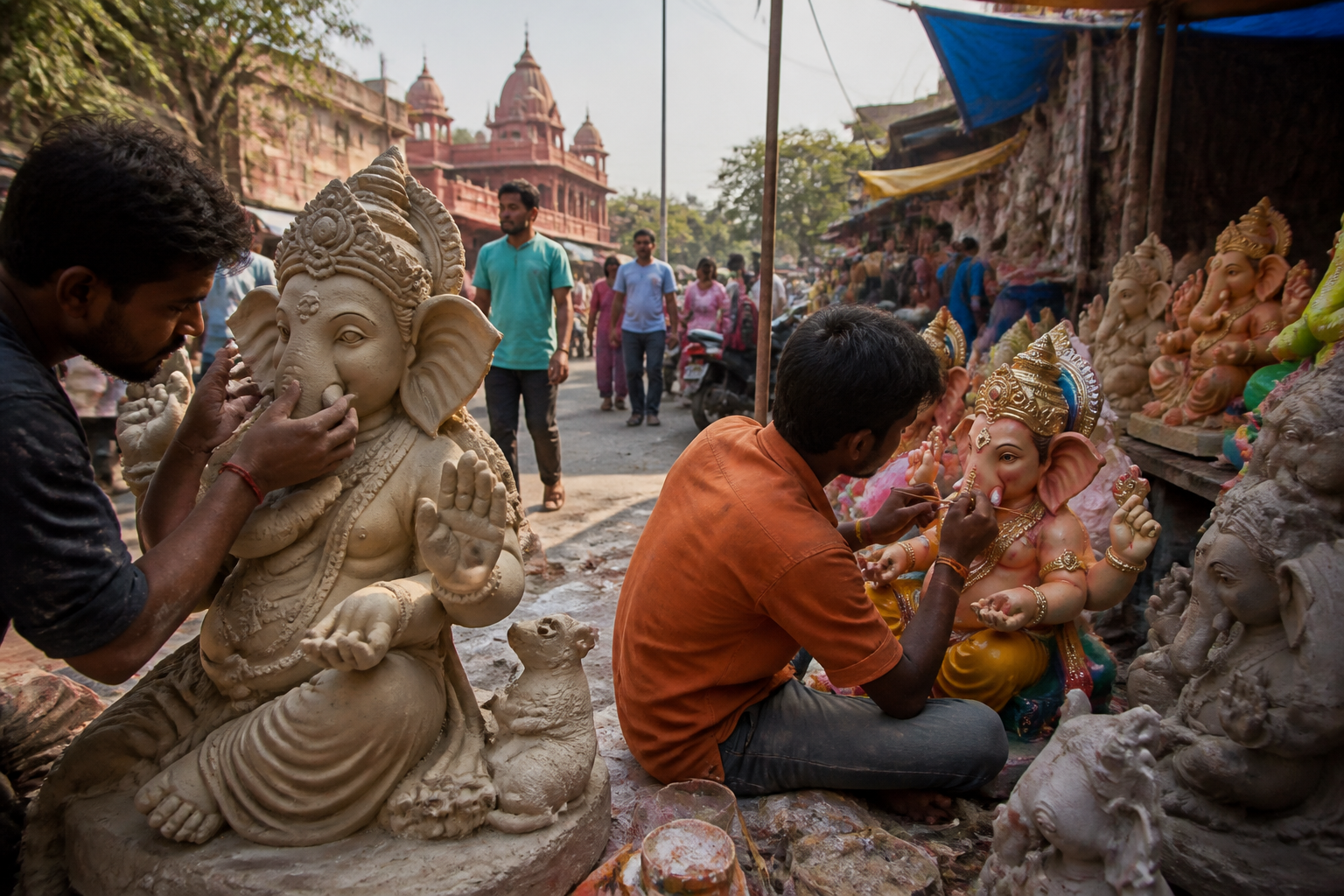
Delhi Ganpati idols are taking on newer forms this festival season, but the artisans making them near Jhandewalan are facing uncertainty after being asked to remove their temporary roadside shops, according to a report by Jagran – New Delhi.
The market near Jhandewalan Temple, between Karol Bagh and Rajendra Place, has become a busy production and sales area ahead of Ganesh celebrations. Artisans are moulding clay, refining facial expressions and adding colour and ornamentation to idols while working from morning until late at night.
Alongside traditional designs, buyers are showing greater interest in Bal Ganesh idols, seated figures on thrones, idols placed on cars and figures made in different poses. Artisans told Jagran that customers are increasingly looking beyond size and are also asking for distinctive designs and detailed facial expressions.
The reported production cycle for an idol ranges from about 15 days to one month. Idols measuring between six and eight feet are available for approximately Rs 25,000 to Rs 30,000. The artisans have travelled to Delhi from Rajasthan, Mumbai and Maharashtra, and Kolkata to meet seasonal demand.
For many of them, the work is both a livelihood and a family tradition. Shrawan Kumar, an artisan from Rajasthan who has been making Ganpati idols for 25 years, said he learnt the craft from his father during childhood. The report said the third generation of his family is now continuing the practice.
Making an idol involves more than creating a clay structure. Artisans work on the face, eyes, hands, feet, posture, colours and ornaments, with small changes affecting the expression of the finished figure. The temporary market allows this labour to take place close to customers, but it also leaves the artisans dependent on continued access to roadside space.
That arrangement is now under pressure. Artisans said police had instructed them to remove the temporary shops and sales points. They fear that relocation would leave them without a place to store completed idols or sell the products they have spent weeks preparing. Those who have arrived from other states said the possibility of losing their sales location could create an immediate financial burden.
The report does not specify the legal basis of the removal instruction, the alternative location offered to the artisans or the response of the local police and municipal authorities. It also does not establish how many artisans or temporary stalls are affected.
The developments highlight the seasonal dependence of informal cultural commerce on accessible urban space. For now, artisans continue to finish idols near Jhandewalan as the festival approaches, while uncertainty remains over whether the temporary market will be allowed to operate from its current location.
