


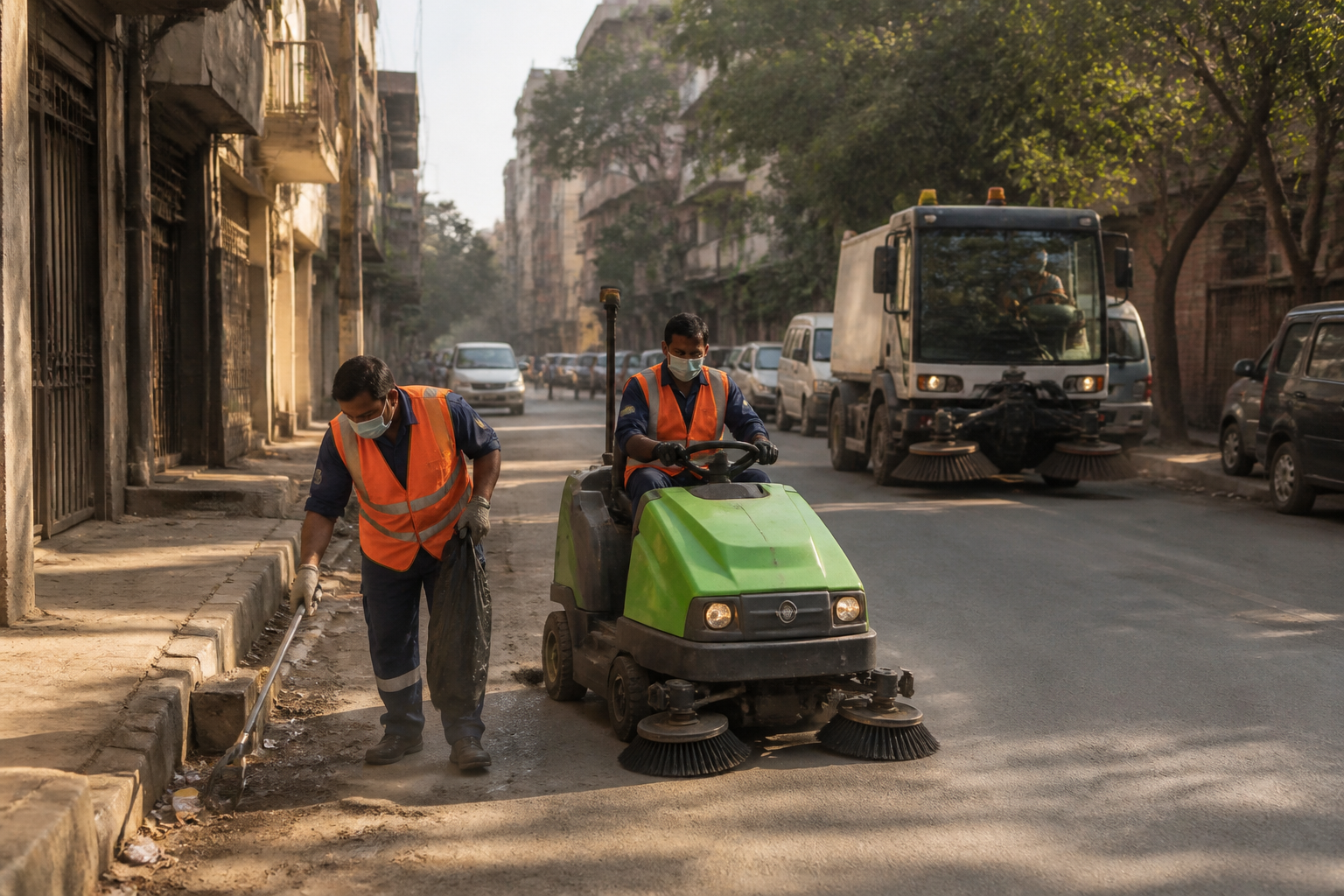
The Delhi government will fund the Municipal Corporation of Delhi (MCD) to procure 1,000 litter-picking machines and mechanical sweepers as part of an effort to improve garbage collection, dust removal and sanitation-worker safety, Chief Minister Rekha Gupta said on Wednesday.
Gupta made the announcement while addressing sanitation workers at the ‘Safai Mitra Suraksha Evam Samman Shivir’ held at the MCD headquarters. She said the machines would be deployed suitably across the city and that their numbers would be increased after the initial deployment.
The equipment programme includes large mechanical sweeping machines as well as smaller machines designed for narrow lanes and streets. The chief minister said the Delhi government had provided funds to the MCD for procuring 70 large sweepers. On Tuesday, the government also decided to provide funds for 30 small-sized mechanical sweepers to clean and remove dust from areas where larger machines may not be able to operate.
The announcement places mechanised cleaning alongside the work of sanitation employees, rather than presenting equipment as a replacement for the city’s workforce. Gupta said the government was providing sanitation workers with machines and tools while also working on their welfare through health- and education-related schemes.
The programme focused on sanitation workers and their families, with preventive health check-ups, assistance in accessing welfare schemes of the Centre and the Delhi government, and the distribution of personal protective equipment and safety kits, according to a post by the Delhi Chief Minister’s Office on X.
Union Minister for Social Justice and Empowerment Virendra Kumar and Union Minister of State BL Verma also attended the event. Kumar said sanitation workers should receive safety, dignity and socio-economic support, and that no worker should lose their life while cleaning a sewer or septic tank.
His remarks connect the equipment announcement to one of the most hazardous areas of municipal sanitation: the cleaning of sewers and septic tanks. The material supplied for the event did not specify whether the newly announced litter-picking and sweeping machines would be used for sewer or septic-tank operations. It did, however, state that the government’s broader safety effort includes protective equipment, safety kits and worker welfare measures.
Kumar said sanitation workers’ contribution to cities and towns could not be overlooked because their work supports cleanliness and public health. He also linked sanitation work with reducing the burden of disease and hospital expenditure.
The Delhi government’s announcement now moves to implementation by the MCD, which is expected to procure and deploy the machines. The initial equipment plan covers 1,000 litter-picking machines, 70 large mechanical sweepers and 30 small sweepers for narrow streets. The chief minister said the government would consider increasing the number of litter-picking machines after their deployment.
