


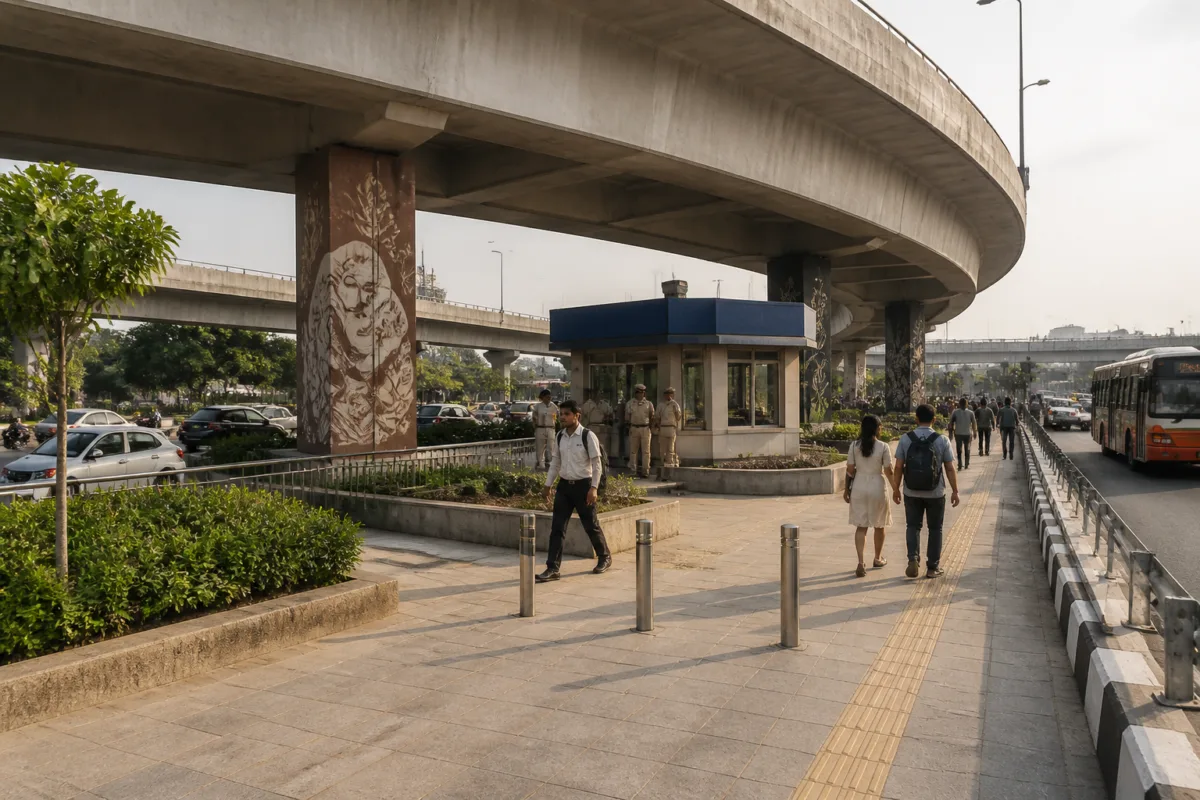
Delhi’s flyovers are being repositioned as more than traffic structures. A Public Works Department initiative is combining police booths, themed public spaces and corporate maintenance agreements to change how the land beneath and around major flyovers is used across the Capital. The programme brings together three objectives that are often handled separately in Indian cities: improving public safety, maintaining neglected infrastructure edges and making leftover urban spaces more visible and usable.
The immediate intervention is the construction of 400–500 police booths beneath flyovers across Delhi. The booths are being funded by the Public Works Department and built in coordination with Delhi Police. Once completed, they will be handed over to the police force. PWD Minister Parvesh Sahib Singh said the presence of a booth at a busy junction would make people feel safer and help police respond faster.
The second component is a beautification and public-space programme covering five flyovers and a stretch of Aurobindo Marg. Indian Oil Corporation Ltd has adopted Chirag Delhi, Panchsheel, IIT Delhi, Punjabi Bagh and Mukarba Chowk, along with the Aurobindo Marg stretch, under a memorandum of understanding. The company is expected to maintain the adopted sites for three years using Corporate Social Responsibility funds.
Taken together, the two components point to a particular model of urban management. The government is retaining responsibility for a core public-safety asset—the police booths—while using a corporate partnership to support the upkeep and visual transformation of selected spaces. That division of responsibility may appear straightforward, but it also shows how cities increasingly manage infrastructure through a mix of public budgets, departmental coordination and external institutional participation.
### Delhi flyovers and the problem of leftover urban space
Flyovers are designed primarily to move vehicles over congested junctions. Their success is usually measured through traffic movement, travel time or junction capacity. The space below them, however, frequently falls outside the main performance indicators used for transport infrastructure. It can become poorly lit, difficult to supervise, occupied informally or disconnected from the surrounding public realm.
The Delhi initiative treats those spaces as an urban management issue in their own right. The PWD is not only looking at the flyover deck or the road below it but also at the social and administrative conditions created by the infrastructure. A police booth addresses institutional presence. Themed development addresses appearance and use. Maintenance agreements address the question of who will keep the space in usable condition after the initial work is completed.
This is significant because beautification projects often focus on the moment of installation. Paint, artwork, landscaping or new street furniture can improve the immediate appearance of a location, but the value of such work depends on continued maintenance. In this case, the stated three-year maintenance period under the Indian Oil agreement gives the programme a defined operating window. The supplied report does not specify the maintenance standards, expenditure, performance measures or arrangements after that period, leaving those details outside what is currently established.
The police booths introduce a different form of permanence. Unlike a temporary visual upgrade, a booth represents a continuing public institution at a busy junction. PWD will construct the facilities and Delhi Police will receive them for operation. The arrangement therefore depends on coordination beyond construction: the spaces must be accepted, staffed and integrated into the police response system for the intended benefit to materialise.
### Five themes, five urban settings
The selected locations are not being given one uniform visual treatment. The reported themes have been chosen to suit the surroundings. Chirag Delhi will feature nature and wildlife. Panchsheel will showcase Indian classical dance through modern art. IIT Delhi will have a science and technology theme. Punjabi Bagh will feature a Yogshala, while Mukarba Chowk is planned as an inter-transit hub.
This approach suggests that the programme is attempting to connect infrastructure design with local identity and movement patterns. The IIT Delhi theme draws on the institutional character associated with the area. Punjabi Bagh’s proposed Yogshala gives the space a wellness-oriented identity. Mukarba Chowk is being treated differently from the themed locations because its stated purpose is to function as an inter-transit hub rather than simply as a visual installation.
The distinction matters. A public space under a flyover can be approached as a backdrop for beautification, or it can be planned around how people arrive, wait, pass through and use it. The available report establishes the intended themes but does not provide design drawings, area measurements, facilities, accessibility provisions or details of how pedestrians and public transport users will be accommodated. Those elements will determine whether the programme produces active public spaces or mainly improved visual corridors.
The choice of Mukarba Chowk also indicates the varied pressures placed on flyover environments. A major junction is not only a traffic node. It can also be a transfer point for people moving between different modes, a location where pedestrians cross roads and a place where the absence of organised facilities can make everyday travel difficult. Calling the site an inter-transit hub signals a broader ambition, although the supplied material does not establish the modes involved or the operational plan.
### What the funding model reveals
The programme’s financing structure separates construction from maintenance. PWD funds the police booths, while Indian Oil has adopted selected flyovers and the Aurobindo Marg stretch for three years under a CSR-linked agreement. This arrangement reflects a practical challenge in public infrastructure: building an asset is only one part of its lifecycle, while cleaning, repairs, landscaping, programming and security require continuing resources.
Using CSR funds for selected public spaces can help direct money towards improvements that may otherwise compete with core departmental expenditure. It can also create a visible partnership between a public authority and a large corporate entity. However, the arrangement makes accountability especially important. The report identifies the adopting company and the duration of the agreement, but it does not state the financial value of the memorandum, the precise scope of work or the mechanism through which PWD will review performance.
Those details are not minor administrative matters. They determine whether the public authority remains in control of design and maintenance standards, whether the spaces can be altered to meet changing needs and what happens if maintenance falls below expectations. They also influence how the public understands the space: as a government facility, a CSR-supported site or a joint public-private project.
The police-booth arrangement raises a parallel governance question. PWD is responsible for construction, but Delhi Police will operate the booths after handover. This division can be efficient when responsibilities are clearly defined. It can also create gaps if construction, staffing, utilities, upkeep and operational authority are not synchronised. The minister’s statement indicates that the work will progress flyover by flyover in coordination with the police, but the report does not provide a completion schedule or explain the handover process for individual sites.
### The limits of the available evidence
The reported numbers establish the scale of the police-booth component: 400–500 booths are planned beneath flyovers across Delhi. The public-space component covers five named flyovers and one road stretch, with a three-year maintenance commitment from Indian Oil. Beyond those figures, the supplied material does not include a citywide inventory of under-flyover spaces, a budget, a timeline, pedestrian-safety data or evidence of how residents currently use the selected locations.
That absence is important when assessing the programme. The initiative has a clear stated purpose, but its results cannot yet be measured from the information available. There is no reported data on existing response times at the junctions, incidents around the flyovers, footfall in the spaces, the condition of the sites before work or the number of booths already completed. It is therefore possible to describe the intervention and its administrative design, but not to establish whether it has already improved safety or public use.
The same caution applies to the language of beautification. The themes provide a framework for design, but a successful public-space intervention requires more than visual treatment. The eventual outcome will depend on whether spaces remain accessible, maintained and compatible with traffic movement and pedestrian needs. The report does not yet provide enough detail to judge those operational questions.
### The bigger urban question
Delhi’s flyover programme highlights a recurring problem in infrastructure-led urban development: cities often create large structures for movement without fully planning the public spaces that those structures produce. The area beneath a flyover may be technically residual, but it remains part of the daily urban experience. It can influence how safe a junction feels, how easily people move through it and whether public authorities are visibly present.
The current initiative attempts to bring those functions into one administrative frame. PWD is using its own funds for police booths, coordinating with Delhi Police and inviting a corporate partner to maintain selected spaces. The five themes and the proposed inter-transit hub at Mukarba Chowk show that the programme is not limited to one standard design solution.
What remains to be established is how the initiative will be monitored over time. The key milestones will be the completion and handover of the police booths, the delivery of the five themed flyover spaces and Aurobindo Marg’s planned treatment, and the performance of the three-year maintenance agreement. Further information on budgets, design standards, accessibility, staffing and post-agreement responsibility will be necessary to assess whether Delhi’s flyovers have gained a durable public purpose or only a temporary makeover.

