


Delhi’s environmental crimes are increasing faster than the city’s enforcement system appears able to investigate and prosecute them. A report by the Centre for Science and Environment (CSE), cited in Jagran’s coverage of its State of India’s Environment 2026: In Figures report, says more than 91 per cent of environmental cases in Delhi’s courts remain pending, while the conviction rate is below 18.5 per cent.
The figures point to a problem that extends beyond pollution levels or individual violations. They suggest that environmental regulation in the capital is being weakened at the point where complaints must become evidence, evidence must become a prosecution, and a prosecution must result in a timely judicial decision. The report’s central concern is therefore not only how many environmental offences are being recorded, but how rarely the enforcement chain produces a final outcome.
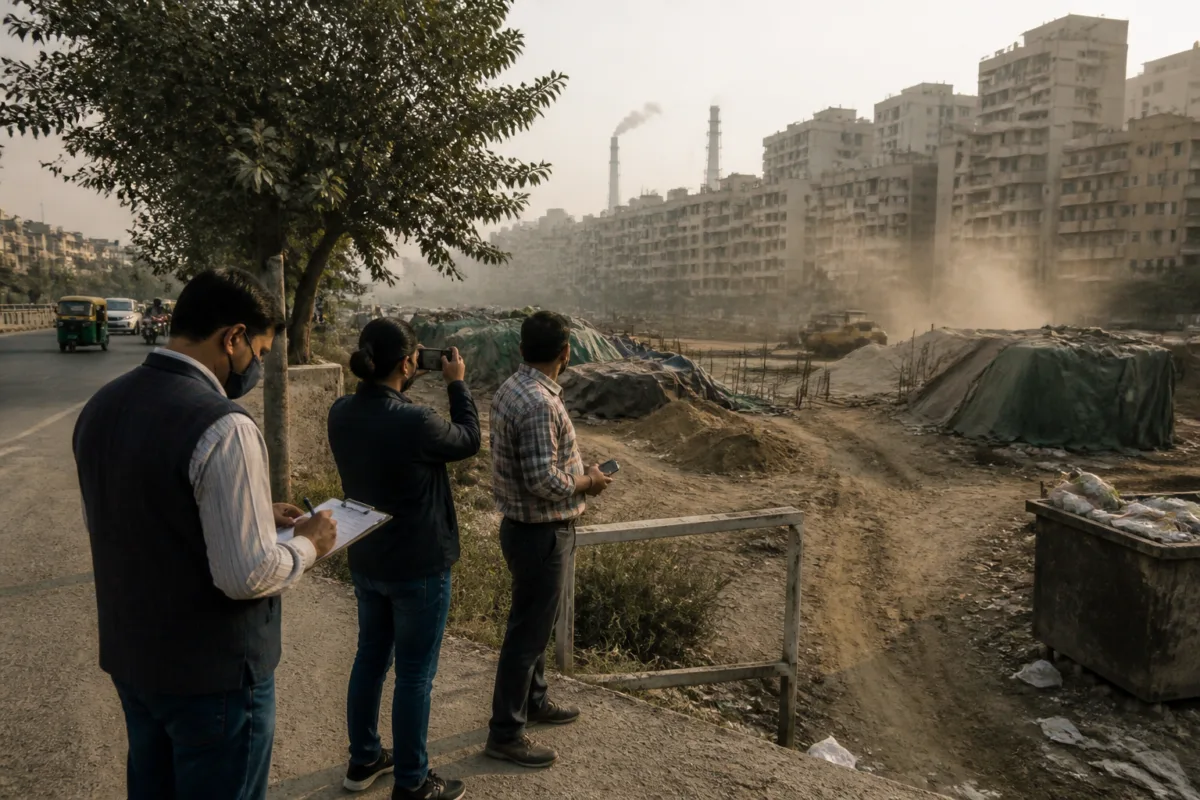
According to the Jagran report, Delhi accounts for more than 75 per cent of all environmental crimes recorded across Union territories. The cases cited include illegal tree cutting, the discharge of chemicals from factories, dust generated at construction sites in violation of rules, the dumping of restricted plastic and electronic waste, and the use of loudspeakers and generators at high volume during the night. The report says such cases have been rising annually at a rate of 12 to 15 per cent.
These categories cover very different forms of urban harm, but they share a common administrative feature: each requires a public authority to detect a violation, establish responsibility and preserve evidence that can withstand legal scrutiny. A tree-cutting case may depend on identifying the land, the tree and the person or agency responsible. An industrial discharge case may require scientific sampling and a clear chain of custody. A construction dust case may depend on demonstrating the condition of the site and linking it to a specific operator. Waste dumping and noise violations similarly require timely documentation.
The CSE findings, as reported, indicate that the system is generating cases without resolving them at a comparable pace. More than 91 per cent of environmental matters pending in Delhi’s courts means that registration or filing does not by itself translate into accountability. A case can enter the legal system while the environmental damage continues, the responsible entity changes, records become harder to obtain and witnesses or investigating personnel move on.
The low conviction rate adds another layer to the problem. Jagran reports that convictions remain below 18.5 per cent, which it attributes to weak prosecution and a shortage of scientific evidence. The figure does not mean that every case ending without conviction represents a false complaint. It does, however, show that the enforcement process is not consistently converting alleged environmental violations into legally sustainable cases.
That distinction matters in urban environmental administration. Regulatory action often begins with an inspection, notice, penalty or direction to stop an activity. Court proceedings require a higher level of documentary and evidentiary discipline. If samples are not collected correctly, if the source of pollution is not established, if site records are incomplete or if the law is not applied to the correct entity, a case can weaken even when the underlying environmental harm is visible to residents.
The report identifies the Delhi Pollution Control Committee and the Forest Department among the agencies affected by staff shortages. These agencies operate in areas where the city’s growth creates a large volume of regulatory work: construction, industrial activity, tree protection, waste handling and public nuisance control. A shortage of staff can reduce the frequency of inspections, delay responses and leave officials with insufficient time to prepare technically detailed case files.
Staff capacity also affects what happens before a case reaches court. Environmental enforcement is not limited to issuing notices after a violation has occurred. It involves monitoring, record-keeping, site visits, laboratory coordination, identification of responsible parties and follow-up. If these steps are divided among overstretched personnel, the gap between a violation and a prosecutable case can become the decisive weakness in the process.
The reported role of scientific evidence is equally important. Environmental offences are often difficult to prove through testimony alone because the harm may be dispersed, technical or temporary. Chemical contamination, air pollution from a construction site, waste composition and noise levels require measurements that are properly recorded and connected to the alleged violation. Without such evidence, a case may rely on photographs, complaints or inspection notes that do not fully establish the legal elements required for conviction.
The judicial side of the process presents a separate bottleneck. Jagran reports that environmental cases in Delhi’s special courts are progressing slowly. A special court can provide an institutional route for a particular class of cases, but designation alone does not guarantee speed. Timely hearings depend on the availability of judges, prosecutors, records, witnesses, expert evidence and procedural coordination between investigating agencies and the court.
The result is a system in which administrative enforcement and judicial disposal can fail in different ways. Agencies may register cases but submit weak files. Prosecutors may face incomplete technical evidence. Courts may carry a large backlog even when the cases are ready for hearing. The CSE figures cited by Jagran do not assign a single cause to the problem, but they do show that the failure is cumulative: a low conviction rate and a high pendency rate reinforce each other.
For residents, the consequences are not confined to legal statistics. Illegal tree cutting affects shade and local ecological conditions. Construction dust can add to the pollution burden in neighbourhoods where building activity is already intense. Chemical discharge and improper waste dumping can affect land and water. Night-time noise from loudspeakers and generators changes the liveability of residential areas. Each case may appear local, but together they describe how environmental rules are experienced at street level.
The report also places environmental enforcement within the broader structure of Delhi’s governance. Responsibility is distributed across specialised agencies, departments, courts and local enforcement mechanisms. Such distribution can provide expertise, but it can also make accountability difficult to trace. A resident may know that a tree has been cut or that dust is being generated, yet the route from complaint to inspection, prosecution and final judgment may pass through several institutions.
This institutional fragmentation makes accurate records especially important. The figures cited in the report distinguish between cases recorded, cases pending and cases resulting in conviction. Those are different stages of the enforcement cycle and should not be treated as interchangeable. The supplied Jagran report refers both to more than 91 environmental cases pending and to more than 91 per cent of cases pending. The percentage is the clearer finding presented in the report’s account; the absolute number of cases should be read cautiously unless the underlying CSE tables are consulted directly.
The available evidence nevertheless establishes a consistent direction of concern. Environmental offences in Delhi are reportedly rising by 12 to 15 per cent annually, the city accounts for more than 75 per cent of environmental crimes across Union territories, more than 91 per cent of cases are pending, and the conviction rate is below 18.5 per cent. Together, these numbers describe a widening gap between the scale of urban environmental violations and the capacity of the justice system to close cases.
The policy question is therefore not simply whether Delhi needs more environmental rules. The city already has rules covering tree protection, industrial discharge, construction dust, plastic and electronic waste, and noise. The evidence cited by CSE instead directs attention to implementation: whether agencies have enough personnel, whether inspections produce admissible scientific evidence, whether prosecutors can present cases effectively and whether courts can hear them without prolonged delay.
The CSE report does not, in the material supplied to Jagran, provide a detailed reform plan or identify the exact number of staff vacancies in each agency. It also does not establish how the cases are distributed across each category of offence. Those limitations matter because a useful response would depend on knowing where the greatest attrition occurs: detection, investigation, filing, prosecution or adjudication.
What the available figures do confirm is that Delhi’s environmental enforcement problem is structural rather than limited to isolated violations. Rising cases, persistent pendency and low convictions indicate that recording an offence is not the same as protecting the environment. The next developments worth monitoring are the underlying CSE data, agency staffing and investigation capacity, the quality of scientific evidence submitted in cases, and the pace at which Delhi’s special courts dispose of the pending matters.

