


The Delhi DTC strike has disrupted bus services across the capital, but the dispute is about more than a demand for higher wages. The nine demands raised by drivers and conductors point to a deeper problem in Delhi’s bus system: the people responsible for delivering a public service are often employed through private agencies or concessionaires, leaving questions about pay, benefits, classification and accountability at the centre of the conflict.
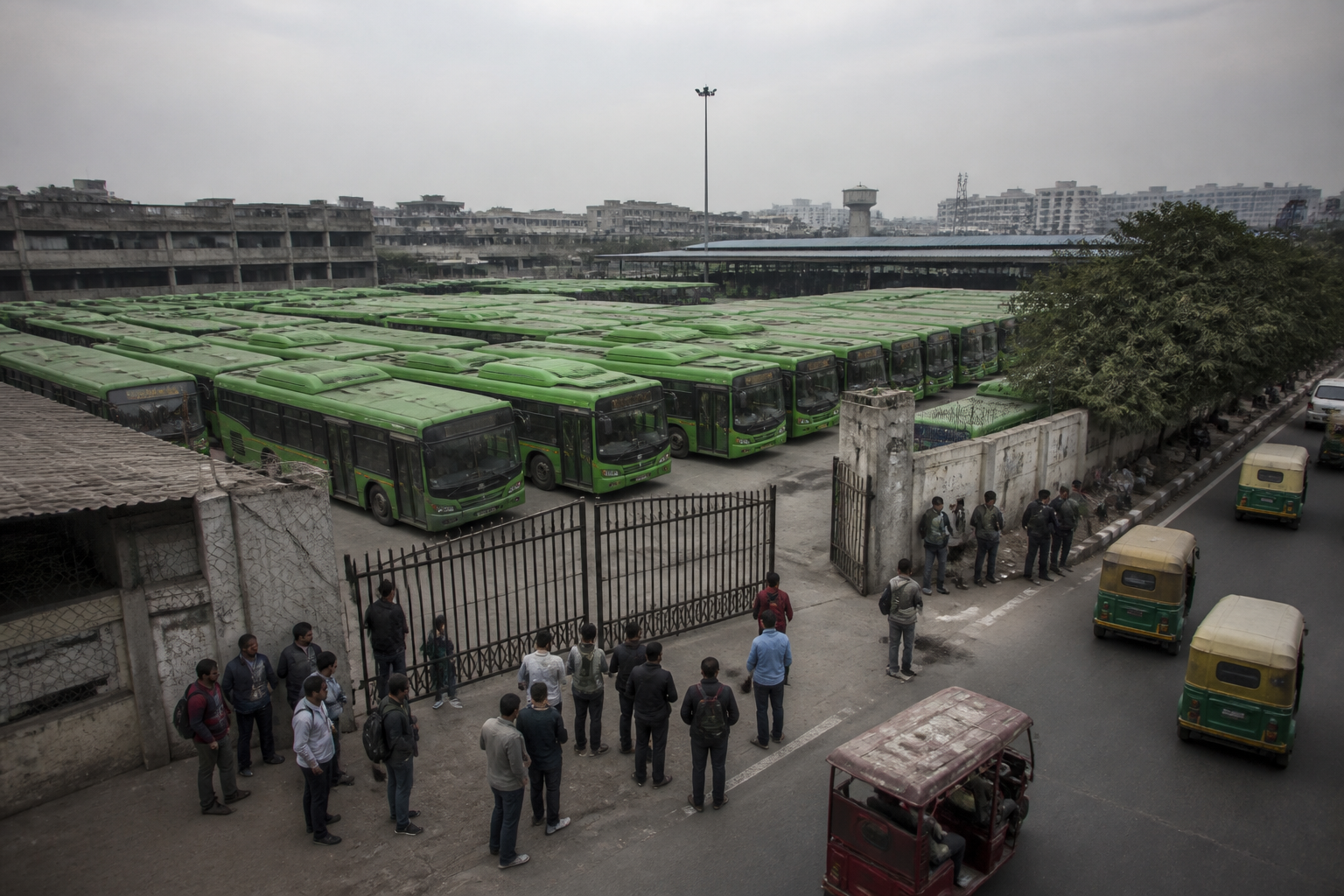
According to the Live Hindustan report, buses have remained parked at depots while passengers in several parts of Delhi have faced longer waits and fewer options. The union says about 12,000 drivers and conductors are associated with the protest. The reduction in DTC bus availability has pushed some passengers towards the metro, auto-rickshaws and cabs. The Delhi Metro Rail Corporation has arranged additional trains and trips in response to the increased passenger pressure, the report said.
The immediate disruption is visible at bus stops, but the institutional structure behind it is less apparent. The employees say they operate DTC buses, while a large number are engaged through private agencies or concessionaires. The government’s position, as reported, is that these workers were appointed through private concessionaires and should resolve their concerns through dialogue with those entities. This creates a divided chain of responsibility: the public system depends on the workers, but the employment relationship is not necessarily directly with the public transport operator.
That distinction matters because each of the nine demands concerns a basic condition of work as well as the reliability of the service delivered to passengers. The union’s principal demand is a daily wage of Rs 2,000. The workers argue that employees who hold heavy-vehicle licences and undergo training to drive buses should not be paid on the basis of the prevailing minimum-wage structure. The report cites current payments of approximately Rs 747 to Rs 862 per day.
The wage demand is accompanied by a claim about stagnating compensation. Workers say the dearness allowance, or DA, has not been increased for about one and a half years. They are seeking revisions at regular intervals under the applicable rules. The union also says that a basic-pay increment due after five years was not implemented after 2019 and has remained pending from 2024.
These demands show why describing the dispute only as a salary protest would be incomplete. For a worker operating a public bus, income is affected not just by the base daily payment but also by whether allowances are revised, increments are implemented and duties on holidays are compensated. The employees are seeking proper payment for work performed on government holidays, along with an annual bonus for contractual workers.
The demands also cover the risks that come with irregular or insecure employment. Drivers and conductors are asking for adequate medical facilities and medical or insurance cover. The union says that illness or the need for treatment can create additional financial pressure under the existing arrangement. They are also seeking social-security benefits, paid leave and protection against wage-related problems when leave is taken.
The ninth demand concerns how experience is recognised. The union claims that some drivers who have worked for 10 to 15 years are still placed in the unskilled category for wage purposes. It wants their classification and payment to reflect their experience and the nature of their work. This is not only a question of nomenclature. A classification determines how a worker’s contribution is valued in the wage structure and can influence access to associated benefits.
The dispute therefore exposes a tension within outsourced public transport. Contracting or concession arrangements may separate the authority that plans and depends on a service from the entity that formally employs the workers delivering it. When operations continue normally, that division may remain largely invisible to passengers. During a strike, it becomes central: the buses belong to the public transport network in functional terms, but responsibility for employment conditions is contested between workers, contractors and the government.
The report does not establish the precise contractual obligations of the private agencies or concessionaires, nor does it provide the government’s detailed response to each of the nine demands. It does, however, record the government’s broad position that the workers were hired through private concessionaires and should pursue a negotiated resolution. That leaves the outcome dependent on talks between parties whose responsibilities are not equally visible to the public.
For passengers, the result is a direct reduction in mobility choices. Delhi’s bus network serves a different role from the metro because buses provide surface-level access and connect areas that may not be directly served by metro stations. The report does not provide route-wise cancellations or passenger numbers, so the full scale of the service reduction cannot be quantified from the available information. But the reported shift towards the metro, autos and cabs indicates that the disruption is being absorbed unevenly across the city.
The metro can add trains and trips, as DMRC has done during the strike, but that response does not make the transport modes interchangeable. Additional metro capacity can address some corridors and peak-period demand, while passengers dependent on bus routes may still face longer or more expensive journeys. The report does not provide details of the additional service frequency or the areas most affected, but it makes clear that a bus strike creates pressure across the wider mobility system rather than remaining confined to bus depots.
The nine demands also raise a question about the meaning of public-service accountability in a contracted system. If a private concessionaire controls employment, the government may argue that the employment dispute is primarily between the workers and the contractor. Yet when a work stoppage removes buses from city streets, passengers experience it as a failure of public transport. The gap between operational dependence and contractual responsibility becomes a governance issue.
That issue is particularly important when workers perform safety-sensitive tasks. The supplied report links their demands to heavy-bus driving, licensing and training, but it does not provide details about the training system, recruitment standards or safety procedures. It would therefore be premature to draw conclusions about service quality or safety outcomes. The available evidence supports a narrower conclusion: the workers believe their skill, experience and responsibilities are not adequately reflected in their pay and classification.
The strike also demonstrates how employment insecurity can become an urban infrastructure problem. A bus is a physical asset, but it cannot provide mobility without a driver and conductor. Depots, routes and vehicles represent only one part of the transport system; labour conditions are another. When those conditions are disputed, infrastructure capacity on paper does not translate into service on the ground.
The government’s stated preference for dialogue places negotiations at the centre of the immediate next step. The unresolved questions are whether private concessionaires will address the demands, what role the government will take in the discussions, and whether any settlement will cover wages alone or also include DA, increments, holiday pay, bonuses, medical cover, social security, paid leave and worker classification.
The DTC strike has thus made visible a structural feature of Delhi’s bus system that is often hidden during normal operations. The immediate fact is that buses are off the road and passengers are facing disruption. The wider evidence supplied in the report points to an employment model in which public mobility depends on workers seeking more predictable pay, benefits and recognition while the government places responsibility on private concessionaires. The next significant development will be the outcome of dialogue over the nine demands and the restoration of regular bus services.
