


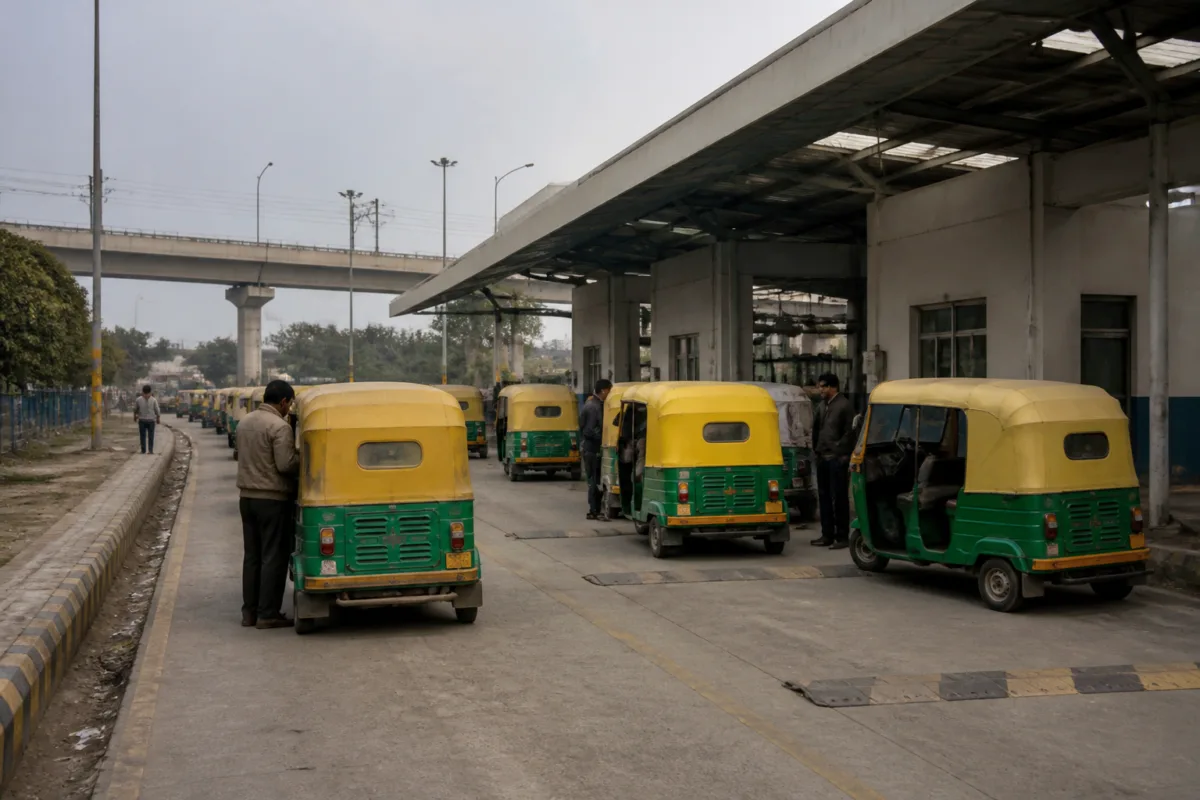
Delhi’s auto fitness test disruption at the Burari automatic testing centre has left thousands of drivers facing a difficult choice: operate without a renewed fitness certificate and risk penalties, or keep vehicles off the road while the certification process remains stalled. The problem, reported after about a week of disruption, is not simply a technical delay. It exposes the administrative risks that arise when an existing manual process is moved into an automated system without a functioning transition arrangement.
The Burari centre began bringing auto-rickshaws within the scope of automatic fitness testing, according to the report by Jagran. Since the new arrangement took effect, fitness certificates for autos have reportedly stopped being issued. Drivers whose certificates are due for renewal therefore remain caught between a regulatory requirement and a testing channel that is not currently delivering the required document.
That gap has an immediate street-level consequence. The report says drivers are being fined for operating without valid fitness certification and are also facing challans from traffic police. For an auto-rickshaw driver, the disruption is not confined to a government counter or testing centre. It can affect whether the vehicle can legally remain in service and whether the driver can continue earning from daily trips.
The episode also shows how vehicle regulation is experienced in a city. Fitness certification is designed as a compliance and safety process, but its effectiveness depends on operational continuity. A rule can be formally valid while its implementation remains inaccessible. When that happens, enforcement continues on the road even as the administrative route for compliance is blocked. The result is a system in which drivers can be penalised for a condition they are unable to regularise through the designated process.
According to the report, auto-rickshaws were previously examined manually by fitness inspectors of the transport department, after which certificates were issued. The introduction of the automatic testing arrangement changed that route. The reported disruption therefore appears linked not to a general refusal by drivers to comply, but to a breakdown during the shift from manual inspection to automated testing.
This distinction matters for understanding the institutional issue. A transition from manual inspection to automated testing can seek to standardise assessments and reduce discretion, but the new system must also have adequate capacity, clear operating procedures and a fallback mechanism. The supplied report does not establish the technical reason for the stoppage or identify whether the problem lies with equipment, staffing, scheduling, documentation or another operational issue. It does establish that the certification process has been interrupted and that drivers continue to face enforcement consequences.
The response from the drivers’ side has come through the Aapka Apna Auto Taxi Union. Its general secretary, Upendra Singh, wrote to Delhi Chief Minister Rekha Gupta and Transport Minister Pankaj Kumar Singh seeking intervention. The letter asked the government to permit manual testing to resume until the automatic testing centre has a proper arrangement for inspecting autos.
The union’s demand points to the immediate administrative solution it believes can prevent further financial loss: restore the earlier inspection method temporarily while the automated process is made functional. The report does not say whether the government has accepted this request, issued new instructions or announced a restoration date. That absence leaves the central operational question unresolved for drivers: what valid route is currently available to obtain or renew a fitness certificate?
The Burari case also highlights the difference between introducing a new compliance platform and completing a regulatory reform. The visible part of reform is the new centre or testing technology. The less visible part is the service chain around it: appointment access, inspection capacity, certificate issuance, communication with enforcement agencies and a process for exceptional cases. If any one of these elements fails, the user experiences the entire reform as unavailable.
For transport administration, the problem is especially sensitive because auto-rickshaws are part of Delhi’s everyday mobility network. The source report does not provide route-level passenger figures or quantify the number of autos removed from service. It does, however, describe the affected group as thousands of drivers and says that enforcement action is taking place. This indicates that the disruption is broader than an isolated individual complaint, even though the precise scale of service impact has not been established in the supplied material.
The incident also raises a question about coordination between the transport department and traffic enforcement. The transport system controls the certification process, while traffic police can issue challans when vehicles are found without the required fitness status. The report describes the consequences of both processes from the drivers’ perspective but does not state whether the two agencies have created any temporary exemption, extension or verification mechanism during the disruption.
That coordination is central to any transition in vehicle testing. If a testing centre is unable to issue certificates for a defined period, enforcement agencies need an authoritative way to distinguish deliberate non-compliance from an unresolved administrative blockage. The article does not report that such a mechanism exists in this case. The union’s request for directions to transport officials suggests that drivers are seeking precisely this kind of interim clarity.
The dispute therefore involves more than a demand to return to manual inspection. It concerns how the state allocates risk during a system change. Under the reported arrangement, the immediate risk appears to have shifted to drivers, who may incur fines or lose income while waiting for the certification process to function. The source does not provide the amount of any fine, the number of challans issued or the estimated financial loss. Those details would be necessary to measure the economic burden more precisely.
There is also a public-interest dimension. Fitness testing is connected to the legal operation of vehicles, and the stated purpose of such certification is to ensure that vehicles meet required standards. A temporary manual process may help maintain access to certification, but the report does not provide evidence on whether the proposed fallback would preserve the same inspection standards or how it would be supervised. That is why the question is not simply whether manual testing should return, but how continuity and regulatory credibility can be maintained together.
The Burari disruption demonstrates a recurring challenge in urban governance: digitisation or automation does not eliminate the need for human administration. It changes where that administration is required. A centre may automate inspection, but officials must still manage exceptions, downtime, appeals, communication and enforcement instructions. Without those supporting arrangements, technology can create a new bottleneck even when it is intended to make compliance more efficient.
For drivers, the immediate demand remains clear. The union wants manual inspection and certificate issuance to continue until the automated centre is ready to handle autos properly. For the government, the next steps would need to clarify whether that temporary arrangement will be permitted, whether transport officials will receive written instructions and when the automatic testing process will resume. None of those outcomes had been announced in the supplied report.
What the episode confirms is that Delhi’s vehicle-fitness system is currently imposing the consequences of compliance failure without providing a clearly reported functioning route to compliance for affected auto-rickshaw drivers. What remains unclear is the operational cause of the stoppage, the number of vehicles affected and the government’s response to the union’s letter. Those are the facts that will determine whether the Burari problem remains a local interruption or becomes evidence of a wider weakness in the city’s transition to automated transport regulation.

