


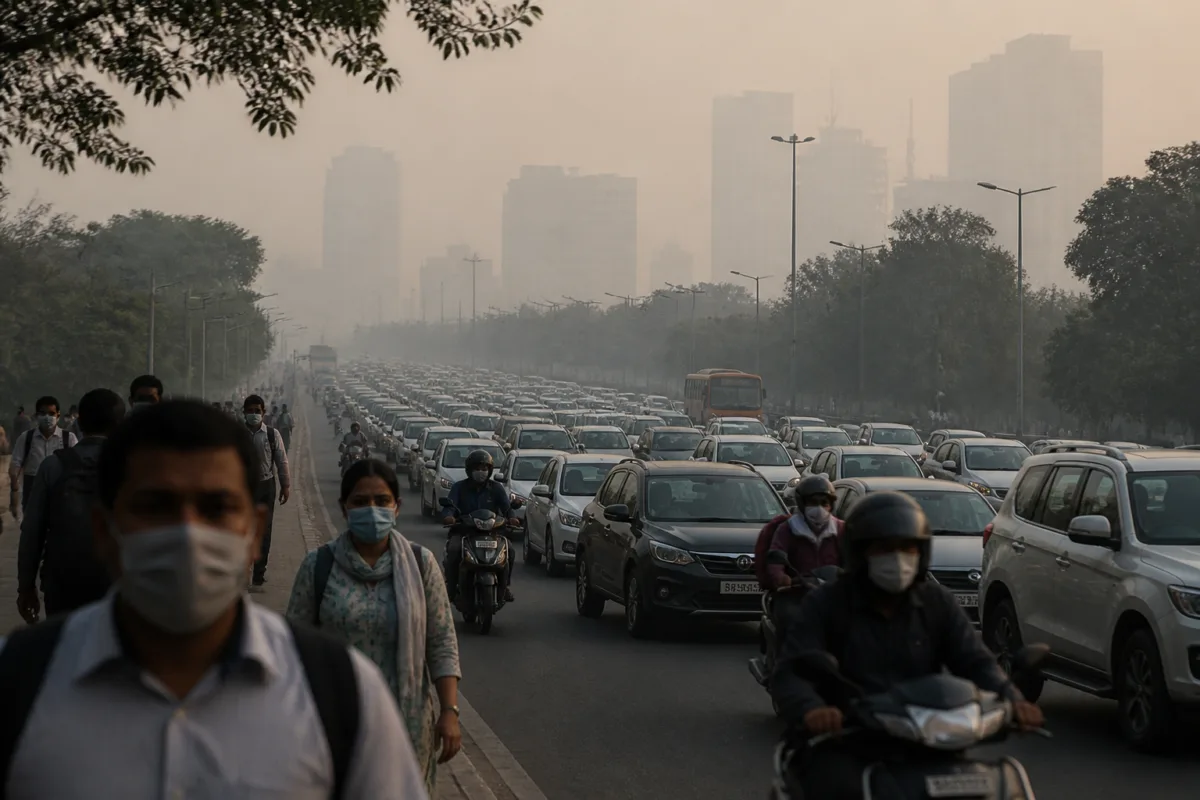
Delhi’s AQI surged from an average of 124 on 30 October to 464 by 11:31 am on 3 November, as weak winds, falling temperatures, local emissions and smoke from crop-residue burning combined to sharply worsen air quality across the National Capital Region.
Data cited from AQI.in show that Delhi’s average AQI more than doubled within a day, rising from 124 on 30 October to 256 on 31 October. It then climbed to 369 on 1 November and 393 on 2 November. The maximum AQI recorded on 2 November was 499, just one point below the top of the scale.
On 3 November, the city’s AQI reached 464 at 11:31 am. The level was recorded at 432 at 12:01 am the same day, according to the report. The rapid deterioration came only days before Diwali, after a temporary improvement in air quality during the final days of October.
Rain and stronger winds had earlier helped clear some pollution from the atmosphere. The improvement was linked to rain associated with a western disturbance and a weather system connected with Cyclone Arnab. Rain can bring some pollutants down, while stronger winds disperse pollution and reduce its concentration in a particular area.
That relief did not last after weather conditions turned dry. Pollutants from vehicles, industries, construction activity, road dust and waste burning began accumulating again, with the effect visible in Delhi and other NCR cities, the report said.
A key factor behind the sudden rise is the atmosphere’s reduced ability to disperse pollution, a condition known as weak atmospheric ventilation. When wind speeds fall and the height to which air can rise and mix becomes lower, pollutants remain trapped close to the ground instead of being carried away.
The problem can intensify during nights and early mornings, when weaker winds allow emissions from vehicles, industries and other sources to accumulate. The India Meteorological Department and the Indian Institute of Tropical Meteorology, under the Ministry of Earth Sciences, account for such weather conditions in their air-quality forecasts.
Regional smoke may add to the pressure on Delhi’s air. Stubble-burning incidents in Punjab and Pakistan can send smoke towards the National Capital Region when wind conditions carry it in that direction. The report said continued crop-residue burning could affect air quality in Delhi and nearby cities in the coming days.
The rise from 124 to 464 illustrates how quickly Delhi’s air can deteriorate when temporary weather-led relief ends and multiple emission sources operate under stagnant atmospheric conditions. The immediate trajectory will depend on wind strength, atmospheric mixing, further rainfall and the continuation of crop-residue burning, according to the factors cited in the report.

