


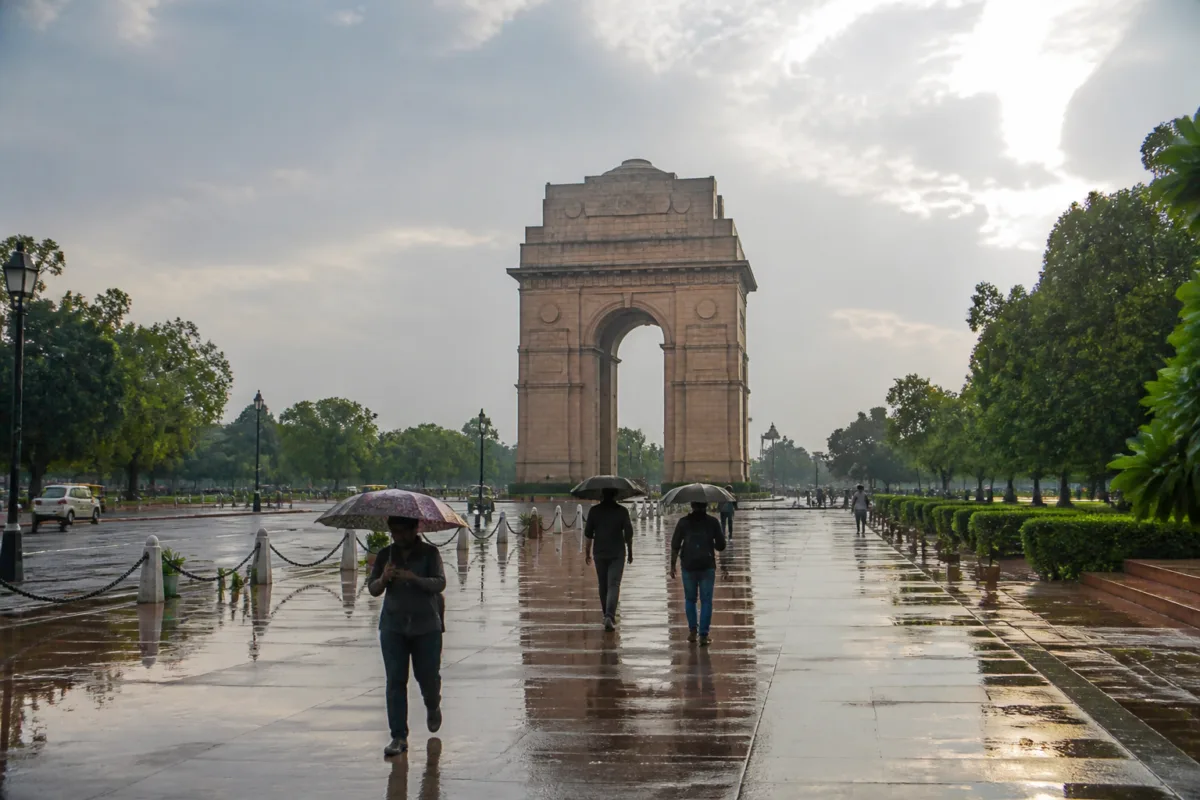
Delhi’s air quality improved sharply in October 2026, but the evidence in the latest data makes it difficult to attribute the change to pollution-control action alone. Unusually heavy rainfall, lower temperatures and favourable meteorological conditions played a significant role in bringing the city’s AQI down, even as the Delhi government presented the improvement as evidence of targeted action and public participation.
The distinction matters because Delhi’s air quality is shaped by both emissions and atmospheric conditions. Government measures may influence the amount of pollution entering the air, but rainfall and wind can also remove pollutants or prevent them from accumulating near the ground. The latest figures show that both factors were present at the same time, making the city’s October improvement a test of how air-quality outcomes are assessed and communicated.
Delhi minister Manjinder Singh Sirsa credited the government’s “targeted action” and public participation after the city recorded an AQI of 60 on Friday. In a post on X, Sirsa shared visuals of India Gate and described the reading as “Satisfactory”. He said the result showed that targeted action was producing real results and thanked Delhi residents for their participation in efforts to secure cleaner air.
The improvement is real. According to figures cited in the report, Delhi’s average AQI in October stood at 167, the lowest October average since 2015. The average was lower than 223 in October 2025, 234 in 2024, 219 in 2023, 210 in 2022 and 264 in 2015. The city’s average AQI between January and October was 168, its lowest for that period since 2020, when it stood at 156.
But the October average also coincided with an unusually wet month. Delhi received 61.4 millimetres of rainfall in the 24 hours ending at 8.30am on Friday, making it the wettest October day in four years and the sixth wettest October day since 1951. Cumulative rainfall reached 123.3mm by Friday morning, more than eight times the monthly normal of 15.1mm.
The timing of the cleanest reading is particularly important. The AQI fell to 60 on October 30, the same day that 61.4mm of rain was recorded at Safdarjung. The city’s maximum temperature at Safdarjung was 20.7 degrees Celsius, making it the coldest October day in terms of maximum temperature since 1951. These conditions created an unusually favourable environment for short-term pollution reduction.
Manoj Kumar of the Centre for Research on Energy and Clean Air pointed to the role of meteorology in interpreting the data. He said Delhi’s October AQI was lower than in previous years but remained 1.5 times higher than the average AQI for September 2026. He also noted that the AQI was already relatively low before the Graded Response Action Plan was imposed and declined further on October 30 as rainfall intensified.
The CREA assessment, as reported by PTI, does not establish that pollution-control measures had no effect. Instead, it highlights the difficulty of separating the impact of policy action from the impact of weather. When rainfall, temperature and other atmospheric conditions change sharply, a single AQI reading or even a monthly average cannot by itself demonstrate how much improvement came from enforcement, restrictions, construction controls, traffic measures or changes in emissions.
The pattern of daily readings reflects this mixed picture. Delhi recorded five days in the “poor” category, three “satisfactory” days and 22 “moderate” days during October up to the time of the report. Air quality entered the poor category on October 21, when the AQI reached 245. Yet the month’s highest AQI of 245 was itself the lowest monthly peak since 2015, indicating that the city avoided the more severe spikes seen in several previous Octobers.
This is where the institutional question becomes important. The Graded Response Action Plan is designed to trigger progressively stronger measures as air quality worsens. Its operation depends on accurate assessment of pollution levels and on decisions about when restrictions should begin, continue or be withdrawn. If weather has already suppressed pollution before a response plan is activated, the subsequent improvement cannot automatically be treated as proof that the plan caused the change.
That does not make the response plan irrelevant. It means that its performance must be assessed against conditions that can be compared across time. Air-quality governance requires authorities to examine emissions, source contributions and meteorological conditions together. Otherwise, favourable weather may make controls appear more effective than they were, while adverse weather may obscure the effect of genuine reductions in emissions.
The data also shows why Delhi’s clean-air challenge cannot be reduced to a single seasonal headline. The October average of 167 was substantially better than the averages recorded in several recent years, but it still remained well above the “satisfactory” level on a monthly basis. The city’s AQI was also higher than its September 2026 average by a factor of 1.5, according to the CREA analysis cited in the report.
Rainfall can provide immediate relief, but it does not necessarily indicate that the underlying sources of pollution have been removed. The report does not provide a source-wise breakdown of emissions or establish how road dust, construction activity, vehicles, industrial emissions, waste burning or other contributors changed during the month. Without that information, the AQI data can show the outcome but not fully explain the contribution of each intervention.
The government’s emphasis on public participation reflects another part of the policy landscape. Clean-air action is administered through multiple authorities and depends on compliance by residents, businesses, construction agencies and transport users. However, the supplied evidence does not quantify the effect of public participation or identify which specific measures produced measurable reductions. The claim therefore remains an official interpretation of the improvement rather than a demonstrated causal finding in the data presented.
The most defensible conclusion is that Delhi experienced a genuine and significant improvement in air quality during October, while exceptional rainfall and cooler conditions were major contributors. Government measures may also have played a role, but the information supplied does not allow their independent effect to be separated from the weather effect.
For Delhi’s air-quality governance, the next important step is not simply to record a lower AQI. It is to compare pollution levels with meteorological conditions and emissions data over longer periods. That approach would show whether cleaner air persists when rainfall declines and whether the city’s control measures are reducing pollution beyond the temporary relief provided by favourable weather.

